QUESTION IMAGE
Question
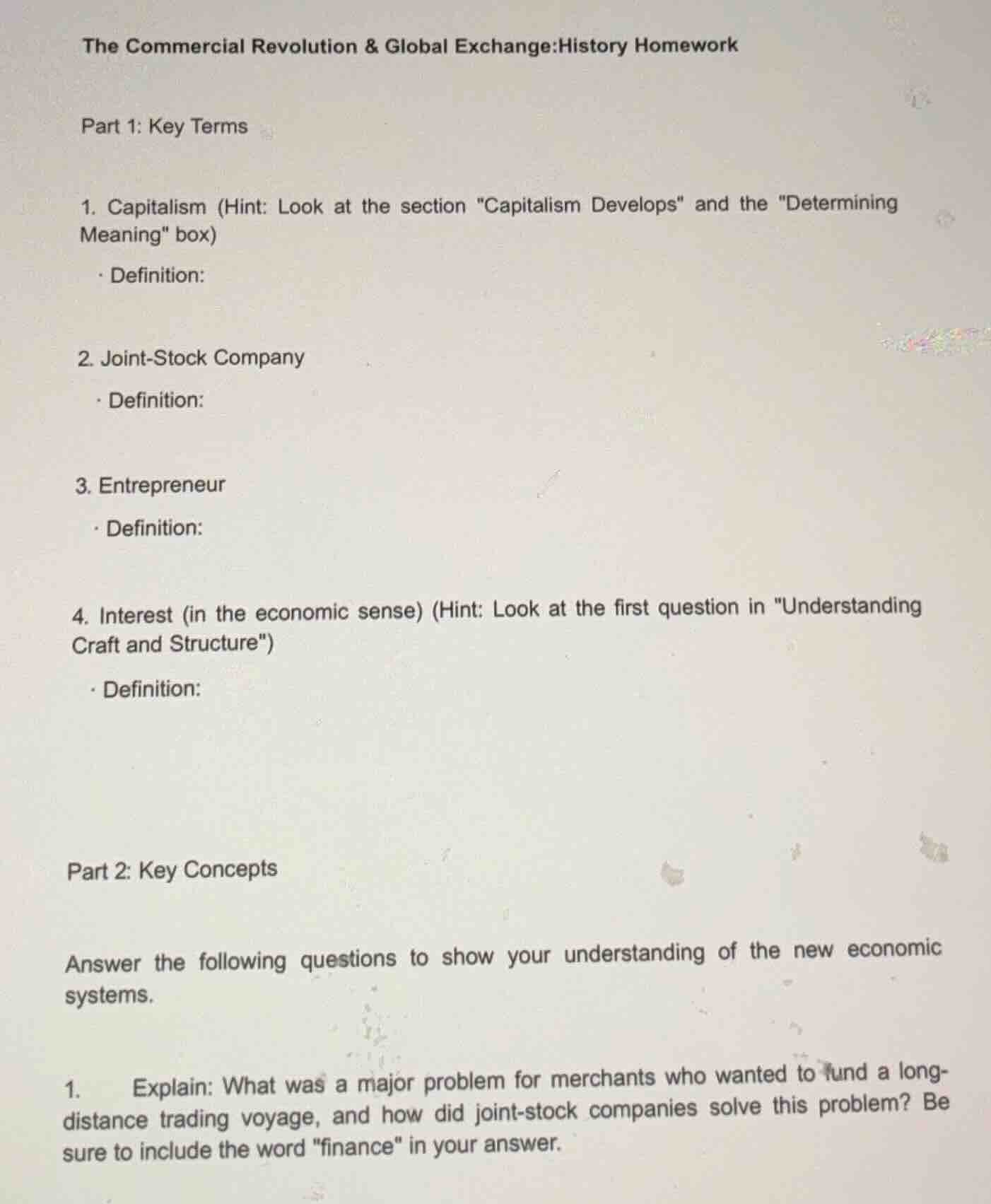
the commercial revolution & global exchange: history homework
part 1: key terms
- capitalism (hint: look at the section \capitalism develops\ and the \determining meaning\ box)
- definition:
- joint-stock company
- definition:
- entrepreneur
- definition:
- interest (in the economic sense) (hint: look at the first question in \understanding craft and structure\)
- definition:
part 2: key concepts
answer the following questions to show your understanding of the new economic systems.
- explain: what was a major problem for merchants who wanted to fund a long-distance trading voyage, and how did joint-stock companies solve this problem? be sure to include the word \finance\ in your answer.
Define capitalism
Capitalism is an economic system based on private ownership of resources and capital. Businesses compete in a free market to generate profits.
Define joint-stock company
A joint-stock company is a business owned collectively by individual shareholders. Investors buy shares of stock, sharing both the risks and profits.
Define entrepreneur
An entrepreneur is an individual who organizes, manages, and assumes the financial risks of a business venture. They aim to make a profit.
Define interest
In economics, interest is the price paid for borrowing money. It is typically calculated as a percentage of the principal loan amount.
Explain long-distance trade funding
Long-distance voyages were extremely expensive and highly risky for a single merchant. Joint-stock companies solved this by allowing multiple investors to pool their money to finance the voyage, spreading the risk.
A major problem for individual merchants was the high cost and extreme risk of losing everything if a ship sank or was plundered. Joint-stock companies solved this problem by allowing many investors to pool their money to finance** the voyage, which distributed the financial risk among many people rather than risking a single merchant's entire fortune.
</answer>

Snap & solve any problem in the app
Get step-by-step solutions on Sovi AI
Photo-based solutions with guided steps
Explore more problems and detailed explanations
Question 1
Capitalism Definition: An economic system based on private ownership of capital and resources, where businesses compete in a free market to make a profit.
Question 2
Joint-Stock Company Definition: A business entity owned collectively by shareholders, who pool their capital to fund ventures and share in the profits and risks.
Question 3
Entrepreneur Definition: A person who starts, organizes, and manages a business venture, taking on financial risks in pursuit of profit.
Question 4
Interest Definition: The cost of borrowing money, or the fee earned for lending money, usually expressed as a percentage of the total amount borrowed.
Question 5
Explanation: A major problem for individual merchants was the high cost and extreme risk of losing everything if a ship sank or was plundered. Joint-stock companies solved this problem by allowing many investors to pool their money to finance the voyage, which distributed the financial risk among many people rather than risking a single merchant's entire fortune.