QUESTION IMAGE
Question
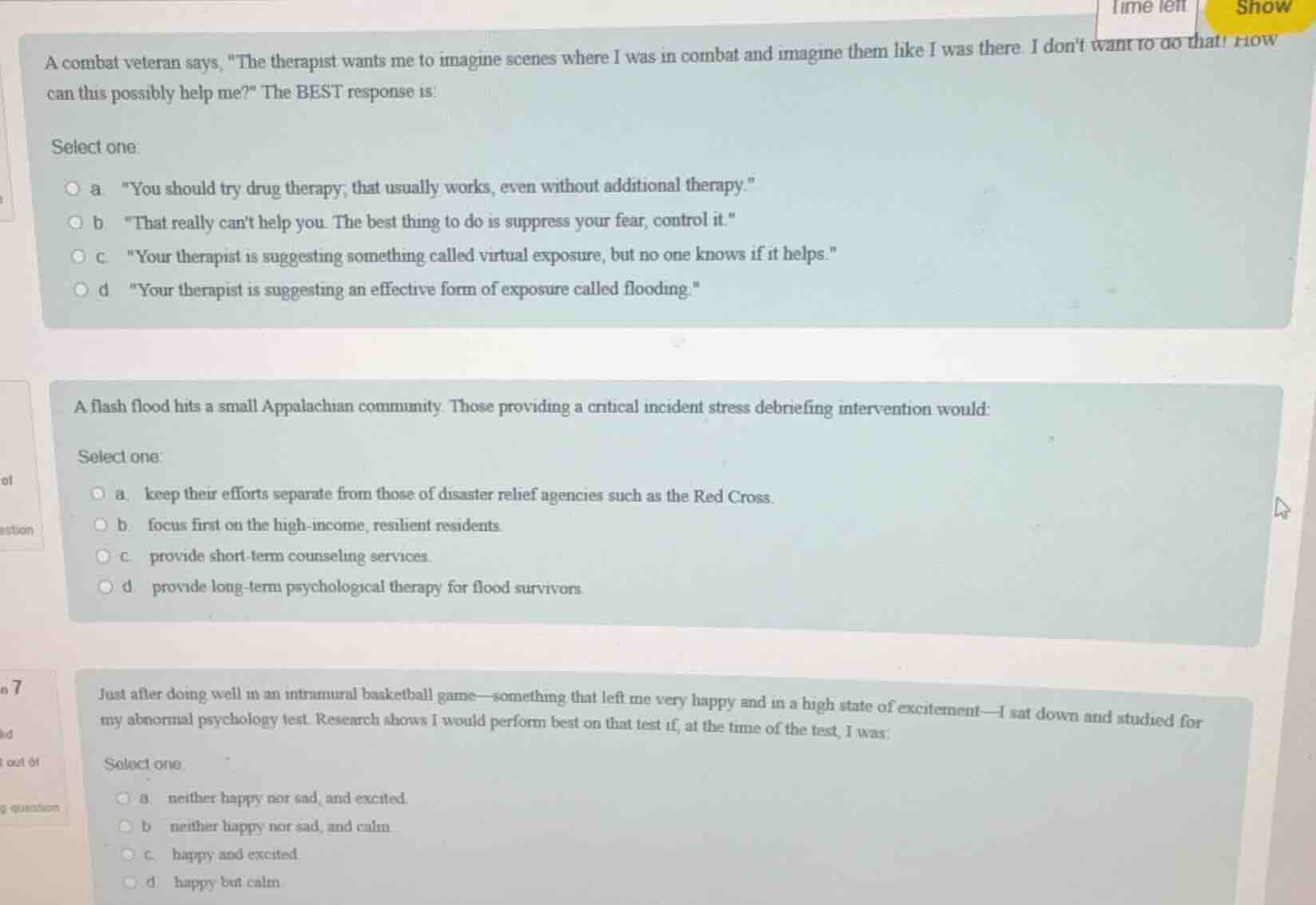
a combat veteran says, \the therapist wants me to imagine scenes where i was in combat and imagine them like i was there. i dont want to do that! how can this possibly help me?\ the best response is:
select one:
a. \you should try drug therapy; that usually works, even without additional therapy.\
b. \that really cant help you. the best thing to do is suppress your fear, control it.\
c. \your therapist is suggesting something called virtual exposure, but no one knows if it helps.\
d. \your therapist is suggesting an effective form of exposure called flooding.\
a flash flood hits a small appalachian community. those providing a critical incident stress debriefing intervention would:
select one:
a. keep their efforts separate from those of disaster relief agencies such as the red cross.
b. focus first on the high-income, resilient residents.
c. provide short-term counseling services.
d. provide long-term psychological therapy for flood survivors.
just after doing well in an intramural basketball game-something that left me very happy and in a high state of excitement-i sat down and studied for my abnormal psychology test. research shows i would perform best on that test if, at the time of the test, i was:
select one:
a. neither happy nor sad, and excited.
b. neither happy nor sad, and calm.
c. happy and excited.
d. happy but calm.
Analyze the first question on combat trauma exposure
The first question describes a combat veteran asked to imagine combat scenes vividly. This technique is a form of exposure therapy. Specifically, prolonged, intense imaginal exposure to the feared stimuli without gradual steps is known as flooding.
- Option (a) is incorrect because drug therapy alone is not universally the best response, nor does it address the veteran's question about how imagining scenes helps.
- Option (b) is incorrect because suppressing fear is counterproductive in treating PTSD.
- Option (c) is incorrect because virtual exposure involves digital simulations (VR), whereas the therapist is asking the veteran to "imagine" the scenes (imaginal exposure/flooding), and exposure therapy is well-documented to help.
- Option (d) correctly identifies this therapeutic technique as flooding, which is a highly effective, evidence-based form of exposure therapy for PTSD Symptoms.
Analyze the second question on critical incident stress debriefing
The second question asks about the nature of a critical incident stress debriefing (CISD) intervention following a natural disaster (a flash flood).
- CISD is a specific, short-term psychological first-aid intervention designed to help victims process trauma immediately following a disaster.
- Option (a) is incorrect because disaster response efforts should be collaborative, not separate.
- Option (b) is incorrect because interventions should prioritize those in greatest need, not high-income residents.
- Option (c) is correct because CISD is a short-term, immediate group or individual crisis intervention, rather than long-term psychotherapy.
- Option (d) is incorrect because CISD is explicitly a short-term crisis intervention, not long-term therapy.
Analyze the third question on state-dependent learning
The third question describes studying for an abnormal psychology test while in a highly specific emotional and physiological state (very happy and in a high state of excitement).
- According to the psychological principle of state-dependent learning, memory retrieval is most efficient when an individual is in the same state of consciousness or emotional state during testing as they were during encoding (studying).
- Since the student studied while "happy and excited," they will perform best if, at the time of the test, they are also "happy and excited."
- Therefore, option (c) is the correct choice.

Snap & solve any problem in the app
Get step-by-step solutions on Sovi AI
Photo-based solutions with guided steps
Explore more problems and detailed explanations
Question 1
- a. "You should try drug therapy; that usually works, even without additional therapy."
- b. "That really can't help you. The best thing to do is suppress your fear, control it."
- c. "Your therapist is suggesting something called virtual exposure, but no one knows if it helps."
- d. "Your therapist is suggesting an effective form of exposure called flooding." (Correct answer)
Question 2
- a. keep their efforts separate from those of disaster relief agencies such as the Red Cross.
- b. focus first on the high-income, resilient residents.
- c. provide short-term counseling services. (Correct answer)
- d. provide long-term psychological therapy for flood survivors.
Question 3
- a. neither happy nor sad, and excited.
- b. neither happy nor sad, and calm.
- c. happy and excited. (Correct answer)
- d. happy but calm.