QUESTION IMAGE
Question
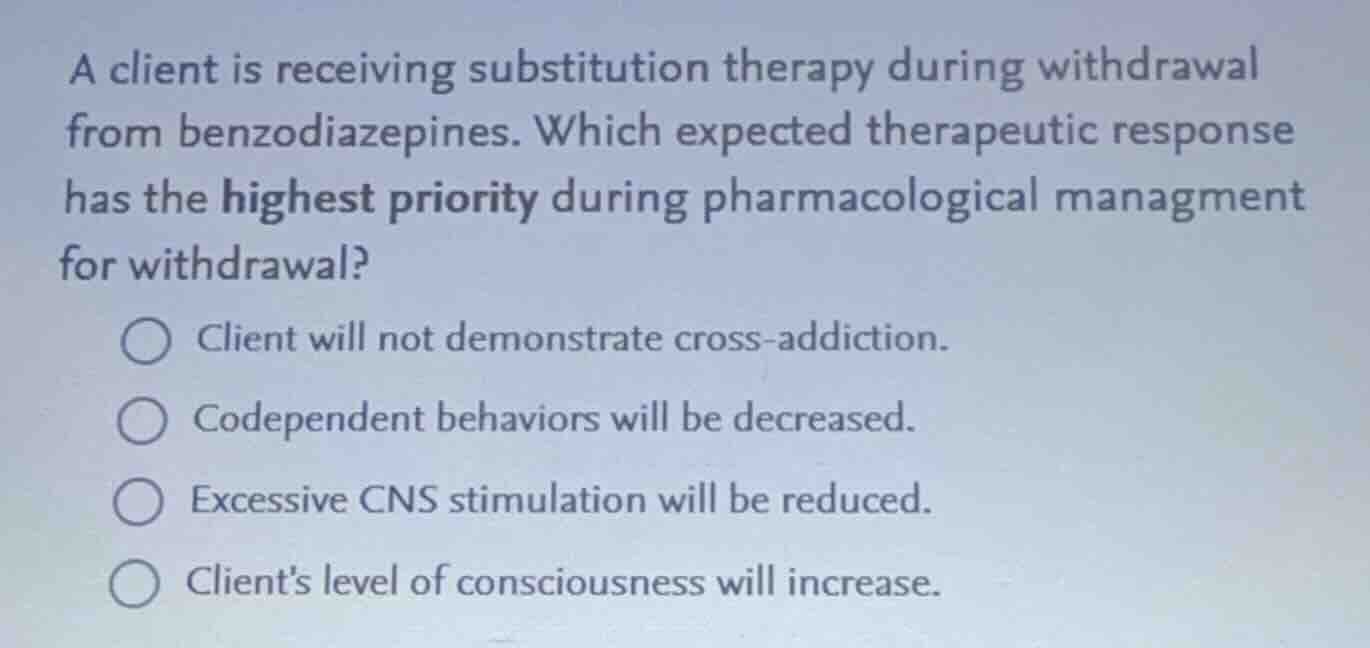
a client is receiving substitution therapy during withdrawal from benzodiazepines. which expected therapeutic response has the highest priority during pharmacological managment for withdrawal?
client will not demonstrate cross-addiction.
codependent behaviors will be decreased.
excessive cns stimulation will be reduced.
clients level of consciousness will increase.
Analyze the pathophysiology of benzodiazepine withdrawal
Benzodiazepines enhance the inhibitory effects of GABA in the central nervous system (CNS). Abrupt cessation leads to a severe reduction in GABAergic inhibition, resulting in acute, potentially life-threatening CNS hyperexcitability (excessive CNS stimulation), which can manifest as tremors, severe anxiety, tachycardia, hypertension, and grand mal seizures.
Evaluate the role of substitution therapy
Substitution therapy (typically using a long-acting benzodiazepine like chlordiazepoxide or diazepam) is administered to gradually taper the drug level. The primary physiological goal of this pharmacological intervention is to prevent dangerous hyperexcitability by stabilizing CNS activity.
Determine the highest priority therapeutic response
Reducing excessive CNS stimulation is the highest priority because uncontrolled CNS hyperexcitability can lead to seizures, status epilepticus, and death. Other options, such as addressing codependency or cross-addiction, are long-term psychosocial goals rather than immediate, life-saving physiological priorities during acute withdrawal management.

Snap & solve any problem in the app
Get step-by-step solutions on Sovi AI
Photo-based solutions with guided steps
Explore more problems and detailed explanations
- Client will not demonstrate cross-addiction.
- Codependent behaviors will be decreased.
- Excessive CNS stimulation will be reduced. (Correct answer)
- Client's level of consciousness will increase.