QUESTION IMAGE
Question
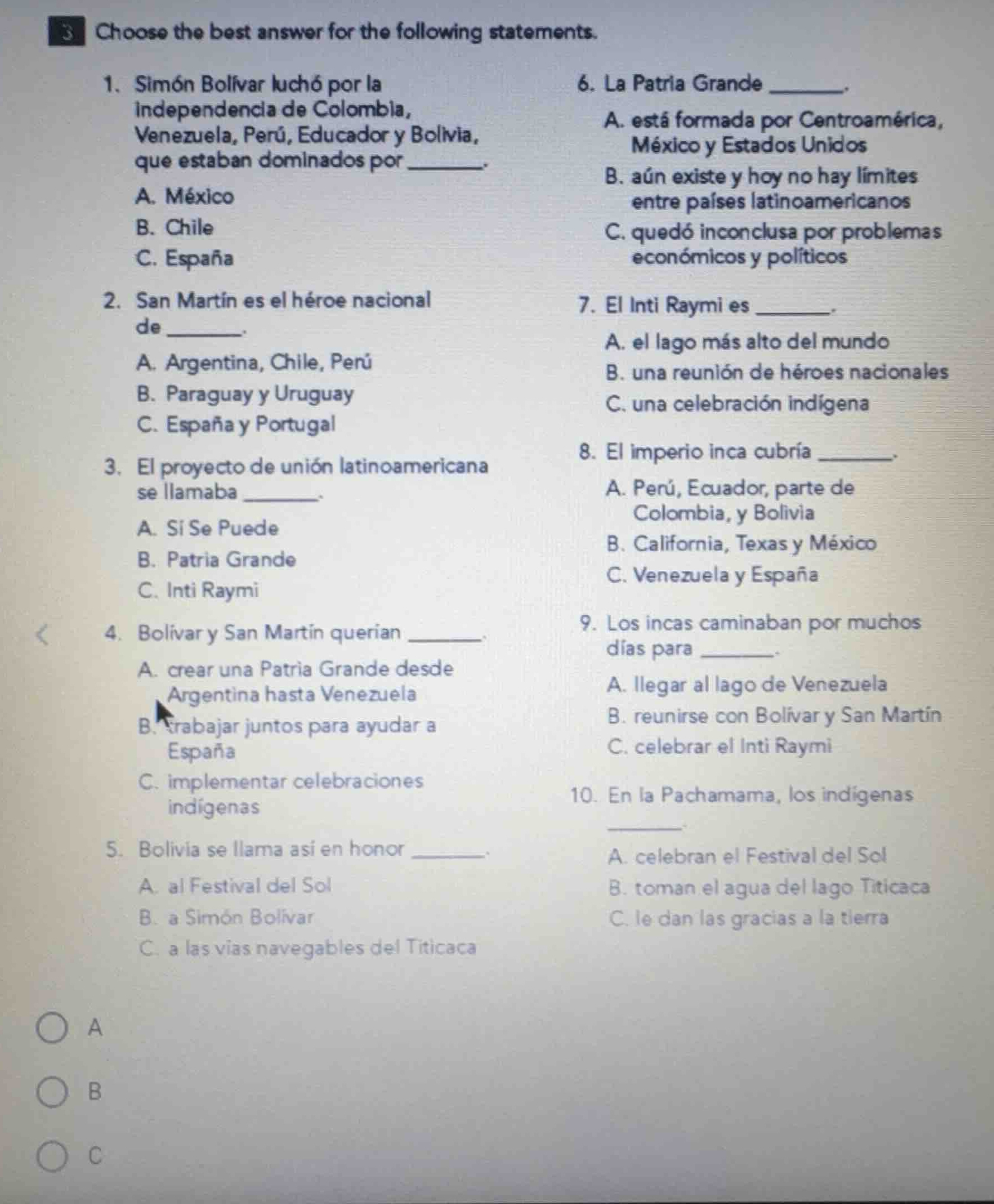
3 choose the best answer for the following statements.
- simón bolívar luchó por la independencia de colombia, venezuela, perú, ecuador y bolivia, que estaban dominados por ______.
a. méxico
b. chile
c. españa
- san martín es el héroe nacional de ______.
a. argentina, chile, perú
b. paraguay y uruguay
c. españa y portugal
- el proyecto de unión latinoamericana se llamaba ______.
a. sí se puede
b. patria grande
c. inti raymi
- bolívar y san martín querían ______.
a. crear una patria grande desde argentina hasta venezuela
b. trabajar juntos para ayudar a españa
c. implementar celebraciones indígenas
- bolivia se llama así en honor ______.
a. al festival del sol
b. a simón bolívar
c. a las vías navegables del titicaca
- la patria grande ______.
a. está formada por centroamérica, méxico y estados unidos
b. aún existe y hoy no hay límites entre países latinoamericanos
c. quedó inconclusa por problemas económicos y políticos
- el inti raymi es ______.
a. el lago más alto del mundo
b. una reunión de héroes nacionales
c. una celebración indígena
- el imperio inca cubría ______.
a. perú, ecuador, parte de colombia, y bolivia
b. california, texas y méxico
c. venezuela y españa
- los incas caminaban por muchos días para ______.
a. llegar al lago de venezuela
b. reunirse con bolívar y san martín
c. celebrar el inti raymi
- en la pachamama, los indígenas ______.
a. celebran el festival del sol
b. toman el agua del lago titicaca
c. le dan las gracias a la tierra
Analyze Bolívar's struggle for independence
We analyze statement 1: "Simón Bolívar luchó por la independencia de Colombia, Venezuela, Perú, Ecuador y Bolivia, que estaban dominados por ______."
- Simón Bolívar led campaigns to liberate northern South America from Spanish colonial rule.
- Therefore, these territories were dominated by Spain (España).
- This corresponds to option C.
Identify San Martín's national hero status
We analyze statement 2: "San Martín es el héroe nacional de ______."
- José de San Martín is a national hero of Argentina, Chile, and Peru, having led the liberation campaigns in the southern part of the continent.
- This corresponds to option A.
Identify the Latin American union project
We analyze statement 3: "El proyecto de unión latinoamericana se llamaba ______."
- The political concept and dream of a unified, large homeland in South America championed by Bolívar is known as "La Patria Grande".
- This corresponds to option B.
Determine the goal of Bolívar and San Martín
We analyze statement 4: "Bolívar y San Martín querían ______."
- Both liberators envisioned a united South America, aiming to create a great homeland ("Patria Grande") stretching across the liberated territories from Argentina to Venezuela.
- This corresponds to option A.
Determine the origin of Bolivia's name
We analyze statement 5: "Bolivia se llama así en honor ______."
- The country of Bolivia was named in honor of the liberator Simón Bolívar.
- This corresponds to option B.
Analyze the outcome of La Patria Grande
We analyze statement 6: "La Patria Grande ______."
- The dream of a unified Latin American nation remained unfinished ("quedó inconclusa") due to regional, economic, and political conflicts that arose after independence.
- This corresponds to option C.
Define El Inti Raymi
We analyze statement 7: "El Inti Raymi es ______."
- Inti Raymi is a traditional indigenous celebration of the sun god (Inti) celebrated in the Andean region.
- This corresponds to option C.
Identify the territory of the Inca Empire
We analyze statement 8: "El imperio inca cubría ______."
- The Inca Empire (Tahuantinsuyu) spanned across modern-day Peru, Ecuador, parts of Colombia, Bolivia, Chile, and Argentina.
- This corresponds to option A.
Analyze the purpose of Inca journeys
We analyze statement 9: "Los incas caminaban por muchos días para ______."
- In the context of Andean cultural traditions and pilgrimages, the Incas traveled long distances to celebrate major religious festivals, specifically the Sun Festival (Inti Raymi).
- This corresponds to option C.
Define the Pachamama ritual
We analyze statement 10: "En la Pachamama, los indígenas ______."
- Pachamama represents Mother Earth. In indigenous rituals dedicated to Pachamama, people give thanks to the earth ("le dan las gracias a la tierra") through offerings.
- This corresponds to option C.

Snap & solve any problem in the app
Get step-by-step solutions on Sovi AI
Photo-based solutions with guided steps
Explore more problems and detailed explanations
Question 1
- (A) México
- (B) Chile
- (C) España (Correct answer)
Question 2
- (A) Argentina, Chile, Perú (Correct answer)
- (B) Paraguay y Uruguay
- (C) España y Portugal
Question 3
- (A) Sí Se Puede
- (B) Patria Grande (Correct answer)
- (C) Inti Raymi
Question 4
- (A) crear una Patria Grande desde Argentina hasta Venezuela (Correct answer)
- (B) trabajar juntos para ayudar a España
- (C) implementar celebraciones indígenas
Question 5
- (A) al Festival del Sol
- (B) a Simón Bolívar (Correct answer)
- (C) a las vías navegables del Titicaca
Question 6
- (A) está formada por Centroamérica, México y Estados Unidos
- (B) aún existe y hoy no hay límites entre países latinoamericanos
- (C) quedó inconclusa por problemas económicos y políticos (Correct answer)
Question 7
- (A) el lago más alto del mundo
- (B) una reunión de héroes nacionales</mcq-correct>
- (C) una celebración indígena (Correct answer)
Question 8
- (A) Perú, Ecuador, parte de Colombia, y Bolivia (Correct answer)
<mcq-option>(B) California, Texas y México
- (C) Venezuela y España
Question 9
- (A) llegar al lago de Venezuela
- (B) reunirse con Bolívar y San Martín</mcq-correct>
- (C) celebrar el Inti Raymi (Correct answer)
Question 10
<mcq-option>(A) celebran el Festival del Sol
- (B) toman el agua del lago Titicaca
- (C) le dan las gracias a la tierra (Correct answer)