Sovi.AI - AI Math Tutor

Scan to solve math questions

QUESTION IMAGE

chloroplast thylakoids are stacks of discs in a chloroplast that absorb…

Question

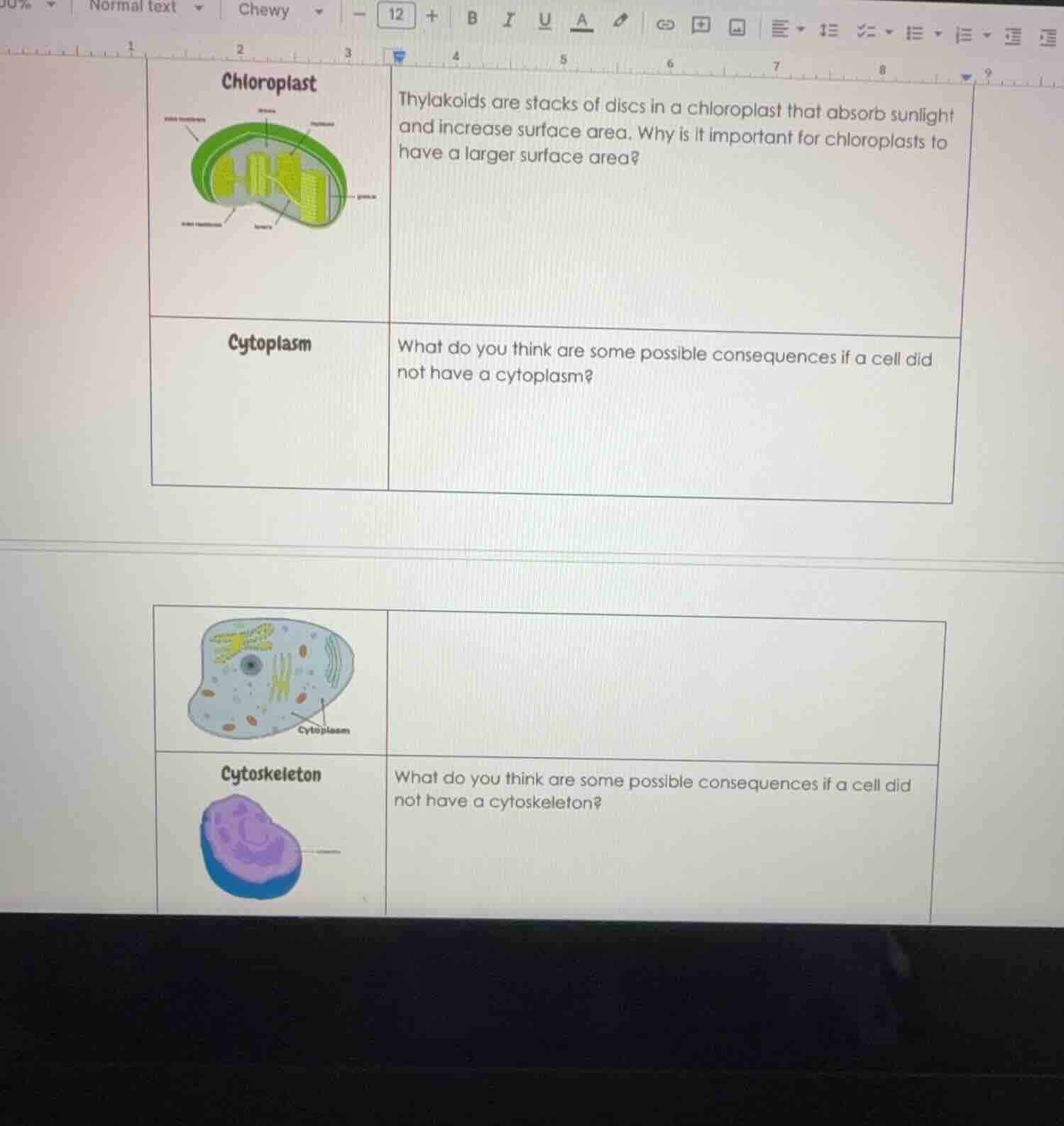
chloroplast
thylakoids are stacks of discs in a chloroplast that absorb sunlight and increase surface area. why is it important for chloroplasts to have a larger surface area?

cytoplasm
what do you think are some possible consequences if a cell did not have a cytoplasm?

cytoskeleton
what do you think are some possible consequences if a cell did not have a cytoskeleton?

Explanation:

Response

<pre_analysis>
{
"quality": "clear",
"question_count": 3,
"skills_matched": [
"direct_cot",
"explain_then_answer",
"quick"
],
"needs_drawing": false,
"concepts_used": [],
"new_concepts": [
"Chloroplast Structure",
"Cytoplasm Function",
"Cytoskeleton Function"
],
"current_concepts": [
"Chloroplast Structure",
"Cytoplasm Function",
"Cytoskeleton Function"
]
}
</pre_analysis>

<reasoning>

Chloroplast surface area significance

A larger surface area allows the chloroplast to absorb more sunlight, maximizing the rate of photosynthesis.

Consequences of lacking cytoplasm

Without cytoplasm, the cell would lose its shape, organelles would have no medium for suspension or movement, and essential metabolic reactions could not occur.

Consequences of lacking a cytoskeleton

Without a cytoskeleton, the cell would lose its structural support, fail to maintain its shape, and be unable to transport materials internally or divide.
</reasoning>

<answer>

Question 1

A larger surface area allows for maximum absorption of sunlight, which increases the efficiency and rate of photosynthesis.

Question 2

The cell would collapse, organelles would not be suspended or protected, and vital metabolic reactions would fail to take place due to the lack of a fluid medium.

Question 3

The cell would lose its structural shape and stability, internal transport of organelles and molecules would stop, and cell division would be impossible.
</answer>

<post_analysis>
{
"subject": "Natural Science",
"question_type": "Multi-part",
"knowledge_point": [
"Natural Science",
"Biology",
"Cellular Organelles and Structures"
]
}
</post_analysis>

Answer:

<pre_analysis>
{
"quality": "clear",
"question_count": 3,
"skills_matched": [
"direct_cot",
"explain_then_answer",
"quick"
],
"needs_drawing": false,
"concepts_used": [],
"new_concepts": [
"Chloroplast Structure",
"Cytoplasm Function",
"Cytoskeleton Function"
],
"current_concepts": [
"Chloroplast Structure",
"Cytoplasm Function",
"Cytoskeleton Function"
]
}
</pre_analysis>

<reasoning>

Chloroplast surface area significance

A larger surface area allows the chloroplast to absorb more sunlight, maximizing the rate of photosynthesis.

Consequences of lacking cytoplasm

Without cytoplasm, the cell would lose its shape, organelles would have no medium for suspension or movement, and essential metabolic reactions could not occur.

Consequences of lacking a cytoskeleton

Without a cytoskeleton, the cell would lose its structural support, fail to maintain its shape, and be unable to transport materials internally or divide.
</reasoning>

<answer>

Question 1

A larger surface area allows for maximum absorption of sunlight, which increases the efficiency and rate of photosynthesis.

Question 2

The cell would collapse, organelles would not be suspended or protected, and vital metabolic reactions would fail to take place due to the lack of a fluid medium.

Question 3

The cell would lose its structural shape and stability, internal transport of organelles and molecules would stop, and cell division would be impossible.
</answer>

<post_analysis>
{
"subject": "Natural Science",
"question_type": "Multi-part",
"knowledge_point": [
"Natural Science",
"Biology",
"Cellular Organelles and Structures"
]
}
</post_analysis>