QUESTION IMAGE
Question
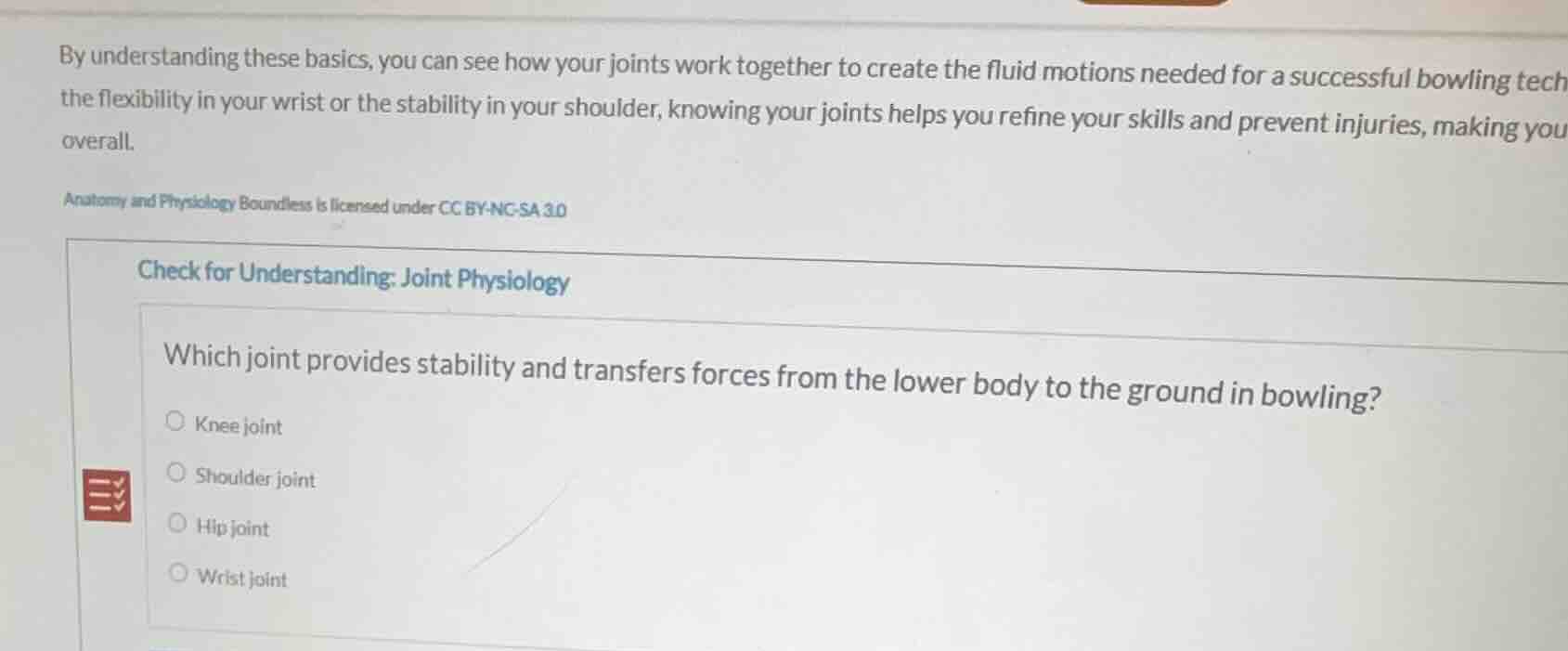
check for understanding: joint physiology
which joint provides stability and transfers forces from the lower body to the ground in bowling?
knee joint
shoulder joint
hip joint
wrist joint
Analyze the question requirements
The question asks which joint provides stability and transfers forces from the lower body to the ground during the sport of bowling.
Evaluate the role of each joint
- Knee joint: This joint is crucial for stabilizing the lower limb, absorbing impact, and transferring the force generated by the legs down through the ankle and foot to the ground during the slide and release phases of bowling.
- Shoulder joint: This is an upper body joint responsible for the arm swing and ball release, not for transferring lower body forces to the ground.
- Hip joint: While it connects the axial skeleton to the lower limb, the knee joint acts as the primary dynamic stabilizer and force transmitter directly supporting the body's weight and momentum transfer to the ground during the final delivery step.
- Wrist joint: This is an upper body joint that controls the release and spin of the bowling ball.
Connect to joint physiology and biomechanics
In Joint Physiology and Joint Biomechanics, the knee joint acts as a major weight-bearing hinge joint. During the dynamic movements of bowling, particularly the approach and slide, the knee joint stabilizes the lower body and manages the kinetic chain transfer of force to the ground. This demonstrates Joint Function in Sports.

Snap & solve any problem in the app
Get step-by-step solutions on Sovi AI
Photo-based solutions with guided steps
Explore more problems and detailed explanations
- Knee joint (Correct answer)
- Shoulder joint
- Hip joint
- Wrist joint