QUESTION IMAGE
Question
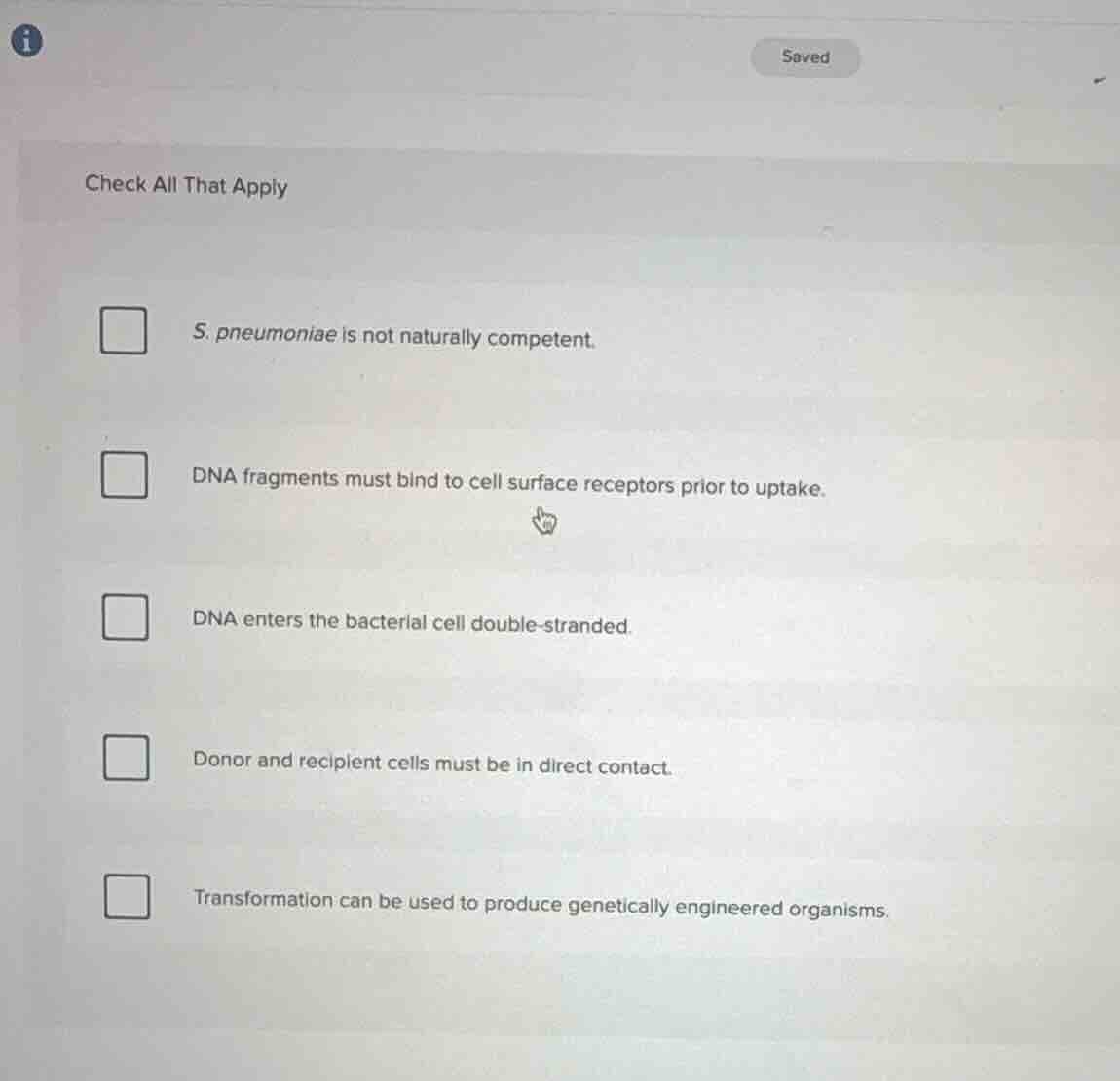
check all that apply
s. pneumoniae is not naturally competent.
dna fragments must bind to cell surface receptors prior to uptake.
dna enters the bacterial cell double-stranded.
donor and recipient cells must be in direct contact.
transformation can be used to produce genetically engineered organisms.
Evaluate natural competence of S. pneumoniae
Streptococcus pneumoniae is a classic model organism for natural competence, famously demonstrated in Griffith's transformation experiment. Thus, the statement "S. pneumoniae is not naturally competent" is false.
Analyze DNA binding, uptake, and contact requirements
- In natural transformation, extracellular DNA fragments must first bind to specific cell surface receptors before being transported into the cell. This statement is true.
- During natural transformation, one strand of the double-stranded DNA is typically degraded by a nuclease during uptake, meaning DNA enters the cytoplasm as single-stranded DNA (ssDNA). Thus, "DNA enters the bacterial cell double-stranded" is false.
- Transformation involves the uptake of naked DNA from the environment; direct cell-to-cell contact is not required (unlike conjugation). Thus, "Donor and recipient cells must be in direct contact" is false.
Evaluate genetic engineering application
Transformation is widely used in biotechnology and laboratory settings to introduce recombinant plasmid DNA into competent bacterial cells to produce genetically engineered organisms. This statement is true.

Snap & solve any problem in the app
Get step-by-step solutions on Sovi AI
Photo-based solutions with guided steps
Explore more problems and detailed explanations
- S. pneumoniae is not naturally competent.
- DNA fragments must bind to cell surface receptors prior to uptake. (Correct answer)
- DNA enters the bacterial cell double-stranded.
- Donor and recipient cells must be in direct contact.
- Transformation can be used to produce genetically engineered organisms. (Correct answer)