QUESTION IMAGE
Question
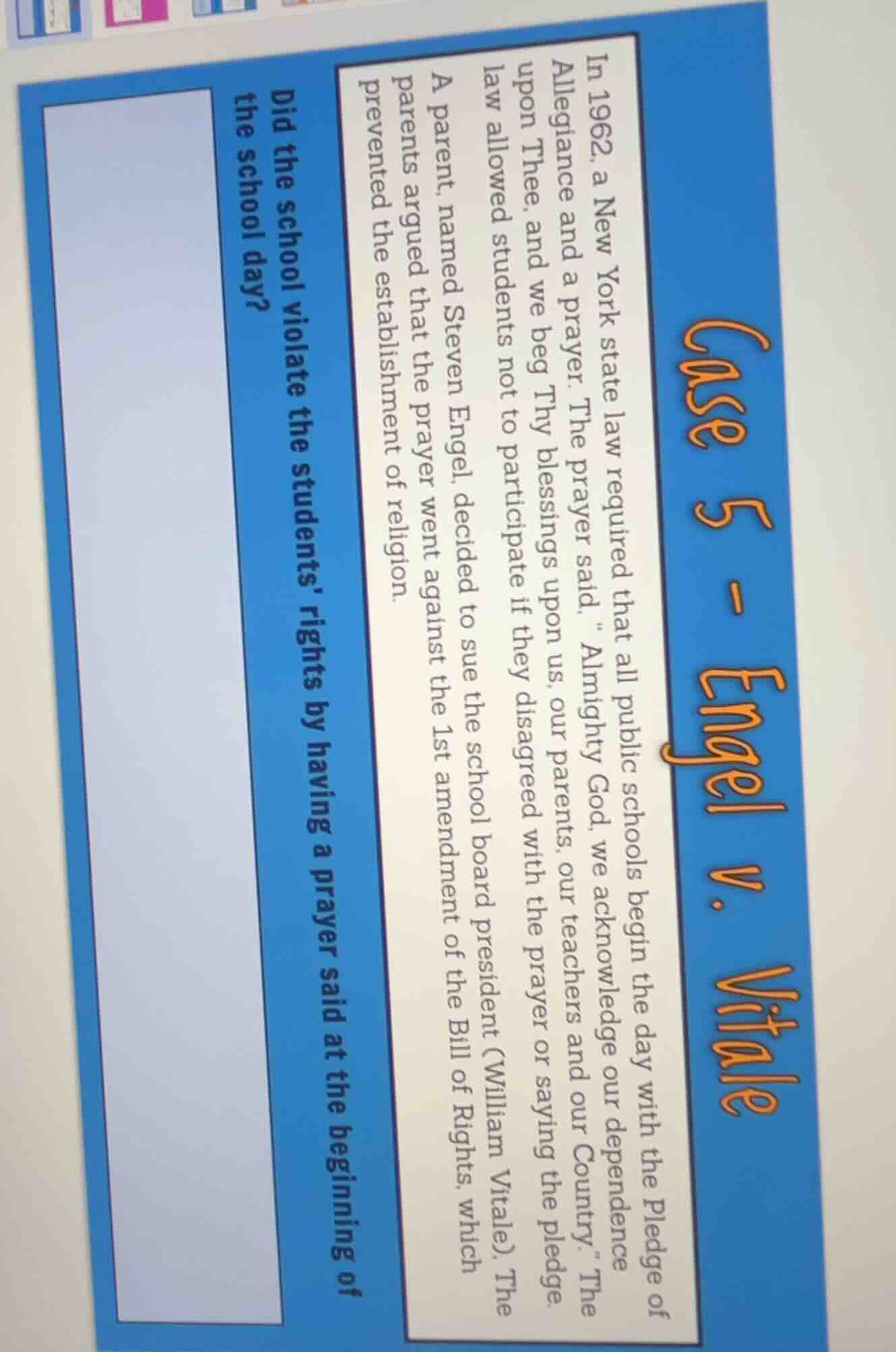
case 5 - engel v. vitale
in 1962, a new york state law required that all public schools begin the day with the pledge of allegiance and a prayer. the prayer said, \almighty god, we acknowledge our dependence upon thee, and we beg thy blessings upon us, our parents, our teachers and our country.\ the law allowed students not to participate if they disagreed with the prayer or saying the pledge. a parent, named steven engel, decided to sue the school board president (william vitale). the parents argued that the prayer went against the 1st amendment of the bill of rights, which prevented the establishment of religion.
did the school violate the students rights by having a prayer said at the beginning of the school day?
The case of Engel v. Vitale involves the 1st Amendment's Establishment Clause, which prohibits the government (including public schools, as they are government - funded) from establishing or promoting a religion. The school - mandated prayer, even with an opt - out, was seen as the school (a government entity) endorsing a religious activity. The Supreme Court ruled that this violated the students' rights under the 1st Amendment's Establishment Clause, as public schools cannot conduct religious prayers as part of the school day because it amounts to the government establishing a religious practice.

Snap & solve any problem in the app
Get step-by-step solutions on Sovi AI
Photo-based solutions with guided steps
Explore more problems and detailed explanations
Yes, the school violated the students' rights. The 1st Amendment's Establishment Clause (part of the Bill of Rights) prohibits government - run institutions like public schools from promoting or establishing religious practices. The mandatory (even with an opt - out) school - led prayer was a religious activity imposed by a government - affiliated entity (the public school), which violated the separation of church and state and the students' rights to be free from government - sponsored religious indoctrination or establishment of religion.