Sovi.AI - AI Math Tutor

Scan to solve math questions

QUESTION IMAGE

cardiac arrest in children and infants is most commonly caused by: hemo…

Question

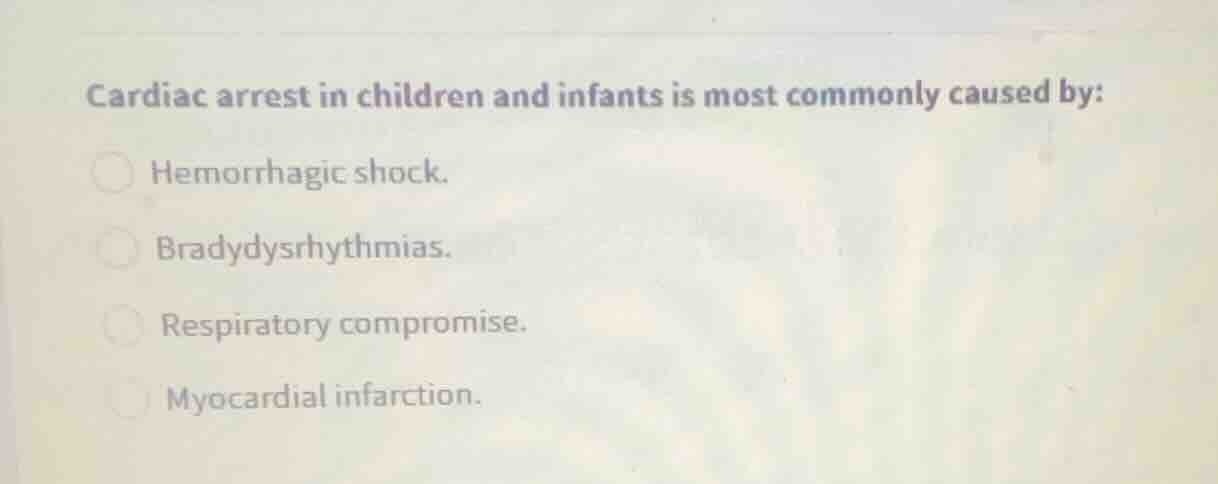
cardiac arrest in children and infants is most commonly caused by:

hemorrhagic shock.
bradydysrhythmias.
respiratory compromise.
myocardial infarction.

Explanation:

Response

<pre_analysis>
{
"quality": "clear",
"question_count": 1,
"skills_matched": [
"direct_cot",
"multiple_choice_formatter",
"explain_then_answer",
"tutor"
],
"needs_drawing": false,
"concepts_used": [
"Pediatric Emergencies",
"Respiratory Failure"
],
"new_concepts": [
"Pediatric Cardiac Arrest Etiology"
],
"current_concepts": [
"Pediatric Emergencies",
"Respiratory Failure",
"Pediatric Cardiac Arrest Etiology"
]
}
</pre_analysis>

<reasoning>

Identify pediatric cardiac arrest etiology

Unlike adults, whose cardiac arrest is typically primary and cardiac in origin (such as myocardial infarction or ventricular fibrillation), cardiac arrest in infants and children is usually secondary. It is most commonly the terminal result of progressive respiratory failure or shock.

Analyze the role of respiratory compromise

In pediatric patients, Pediatric Emergencies frequently involve airway and breathing issues. Untreated respiratory distress leads to Respiratory Failure, which causes severe hypoxia and acidosis. This progressive hypoxia eventually leads to bradycardia and, ultimately, cardiac arrest. Therefore, respiratory compromise is the leading precursor.

Evaluate the other options

  • Hemorrhagic shock: While shock is a major cause of pediatric cardiac arrest, respiratory compromise is statistically the most common cause overall.
  • Bradydysrhythmias: These are often the terminal rhythm preceding arrest, but they are typically secondary to hypoxia caused by respiratory failure rather than the primary etiology.
  • Myocardial infarction: This is extremely rare in infants and children.

</reasoning>

<answer>
<mcq-option>Hemorrhagic shock.</mcq-option>
<mcq-option>Bradydysrhythmias.</mcq-option>
<mcq-correct>Respiratory compromise.</mcq-correct>
<mcq-option>Myocardial infarction.</mcq-option>
</answer>

<post_analysis>
{
"subject": "Natural Science",
"question_type": "Multiple Choice",
"knowledge_point": [
"Natural Science",
"Medicine",
"Pediatric Emergency Medicine"
]
}
</post_analysis>

Answer:

<pre_analysis>
{
"quality": "clear",
"question_count": 1,
"skills_matched": [
"direct_cot",
"multiple_choice_formatter",
"explain_then_answer",
"tutor"
],
"needs_drawing": false,
"concepts_used": [
"Pediatric Emergencies",
"Respiratory Failure"
],
"new_concepts": [
"Pediatric Cardiac Arrest Etiology"
],
"current_concepts": [
"Pediatric Emergencies",
"Respiratory Failure",
"Pediatric Cardiac Arrest Etiology"
]
}
</pre_analysis>

<reasoning>

Identify pediatric cardiac arrest etiology

Unlike adults, whose cardiac arrest is typically primary and cardiac in origin (such as myocardial infarction or ventricular fibrillation), cardiac arrest in infants and children is usually secondary. It is most commonly the terminal result of progressive respiratory failure or shock.

Analyze the role of respiratory compromise

In pediatric patients, Pediatric Emergencies frequently involve airway and breathing issues. Untreated respiratory distress leads to Respiratory Failure, which causes severe hypoxia and acidosis. This progressive hypoxia eventually leads to bradycardia and, ultimately, cardiac arrest. Therefore, respiratory compromise is the leading precursor.

Evaluate the other options

  • Hemorrhagic shock: While shock is a major cause of pediatric cardiac arrest, respiratory compromise is statistically the most common cause overall.
  • Bradydysrhythmias: These are often the terminal rhythm preceding arrest, but they are typically secondary to hypoxia caused by respiratory failure rather than the primary etiology.
  • Myocardial infarction: This is extremely rare in infants and children.

</reasoning>

<answer>
<mcq-option>Hemorrhagic shock.</mcq-option>
<mcq-option>Bradydysrhythmias.</mcq-option>
<mcq-correct>Respiratory compromise.</mcq-correct>
<mcq-option>Myocardial infarction.</mcq-option>
</answer>

<post_analysis>
{
"subject": "Natural Science",
"question_type": "Multiple Choice",
"knowledge_point": [
"Natural Science",
"Medicine",
"Pediatric Emergency Medicine"
]
}
</post_analysis>