QUESTION IMAGE
Question
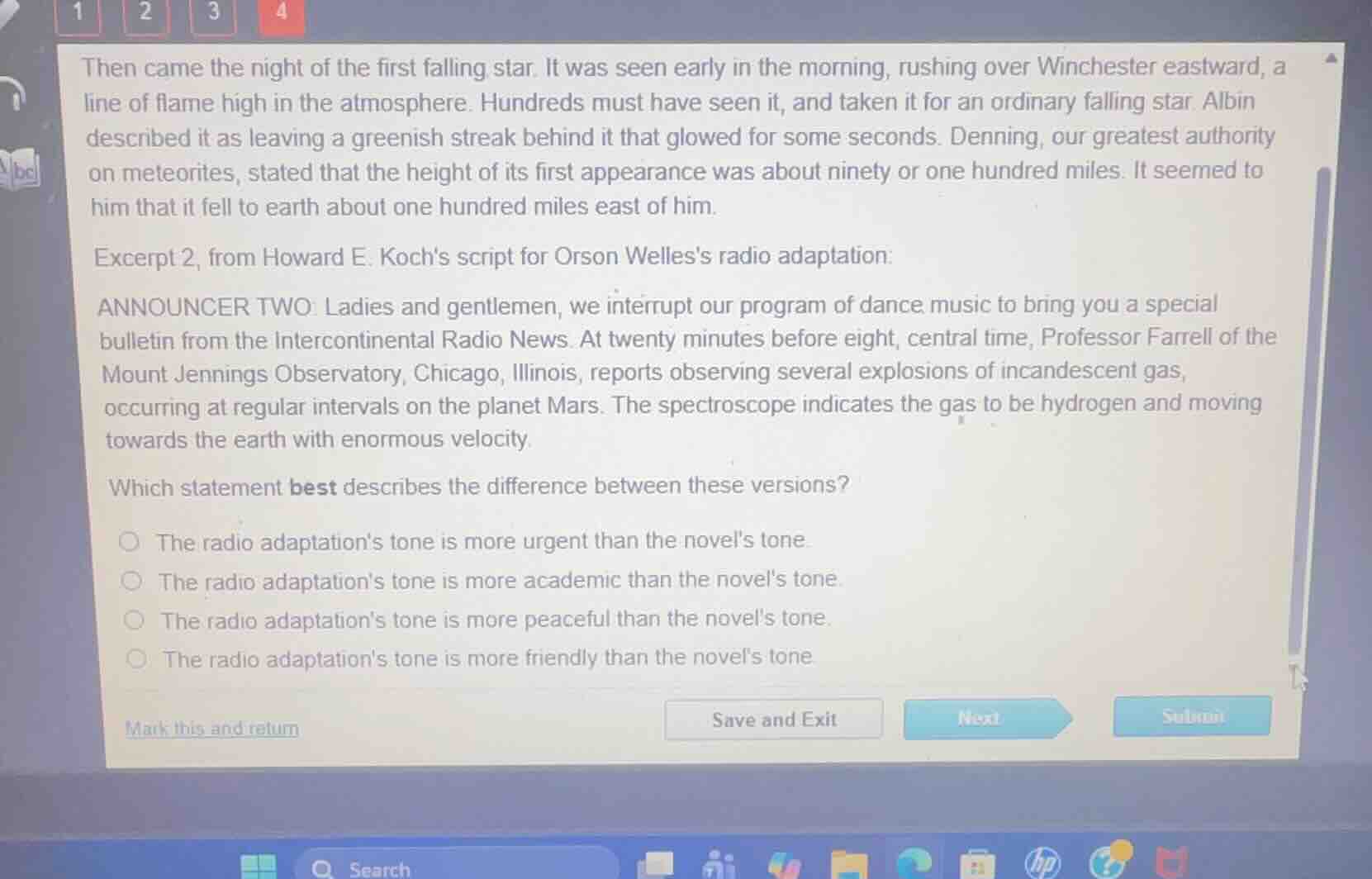
then came the night of the first falling star. it was seen early in the morning, rushing over winchester eastward, a line of flame high in the atmosphere. hundreds must have seen it, and taken it for an ordinary falling star. albin described it as leaving a greenish streak behind it that glowed for some seconds. denning, our greatest authority on meteorites, stated that the height of its first appearance was about ninety or one hundred miles. it seemed to him that it fell to earth about one hundred miles east of him.
excerpt 2, from howard e. kochs script for orson welless radio adaptation:
announcer two: ladies and gentlemen, we interrupt our program of dance music to bring you a special bulletin from the intercontinental radio news. at twenty minutes before eight, central time, professor farrell of the mount jennings observatory, chicago, illinois, reports observing several explosions of incandescent gas, occurring at regular intervals on the planet mars. the spectroscope indicates the gas to be hydrogen and moving towards the earth with enormous velocity.
which statement best describes the difference between these versions?
the radio adaptations tone is more urgent than the novels tone.
the radio adaptations tone is more academic than the novels tone.
the radio adaptations tone is more peaceful than the novels tone.
the radio adaptations tone is more friendly than the novels tone.
Analyze the first excerpt
The first excerpt describes the falling star retrospectively and calmly: "Then came the night of the first falling star. It was seen early in the morning...". It relies on scientific observations and recollections ("Albin described it...", "Denning, our greatest authority..."). The tone is reflective, observational, and narrative.
Analyze the second excerpt
The second excerpt is a radio broadcast script: "Ladies and gentlemen, we interrupt our program of dance music to bring you a special bulletin...". It uses urgent, immediate language ("we interrupt", "special bulletin", "explosions of incandescent gas... moving towards the earth with enormous velocity"). This creates a sense of immediate danger and breaking news.
Compare the tones
Using Tone and Mood Analysis, we compare the two passages. The radio adaptation interrupts a regular program to deliver sudden, alarming news about gas moving toward Earth with "enormous velocity." This makes the radio adaptation's tone significantly more urgent and alarming than the novel's calm, retrospective narrative tone.
Evaluate the options
- Option 1: "The radio adaptation's tone is more urgent than the novel's tone." This matches our analysis of the breaking-news interruption.
- Option 2: "The radio adaptation's tone is more academic than the novel's tone." Incorrect; the novel cites scientific authorities ("Denning, our greatest authority on meteorites"), making it more academic.
- Option 3: "The radio adaptation's tone is more peaceful than the novel's tone." Incorrect; an interruption about explosions is not peaceful.
- Option 4: "The radio adaptation's tone is more friendly than the novel's tone." Incorrect; the tone is alarming and professional, not friendly.

Snap & solve any problem in the app
Get step-by-step solutions on Sovi AI
Photo-based solutions with guided steps
Explore more problems and detailed explanations
- (A) The radio adaptation's tone is more urgent than the novel's tone. (Correct answer)
- (B) The radio adaptation's tone is more academic than the novel's tone.
- (C) The radio adaptation's tone is more peaceful than the novel's tone.
- (D) The radio adaptation's tone is more friendly than the novel's tone.