QUESTION IMAGE
Question
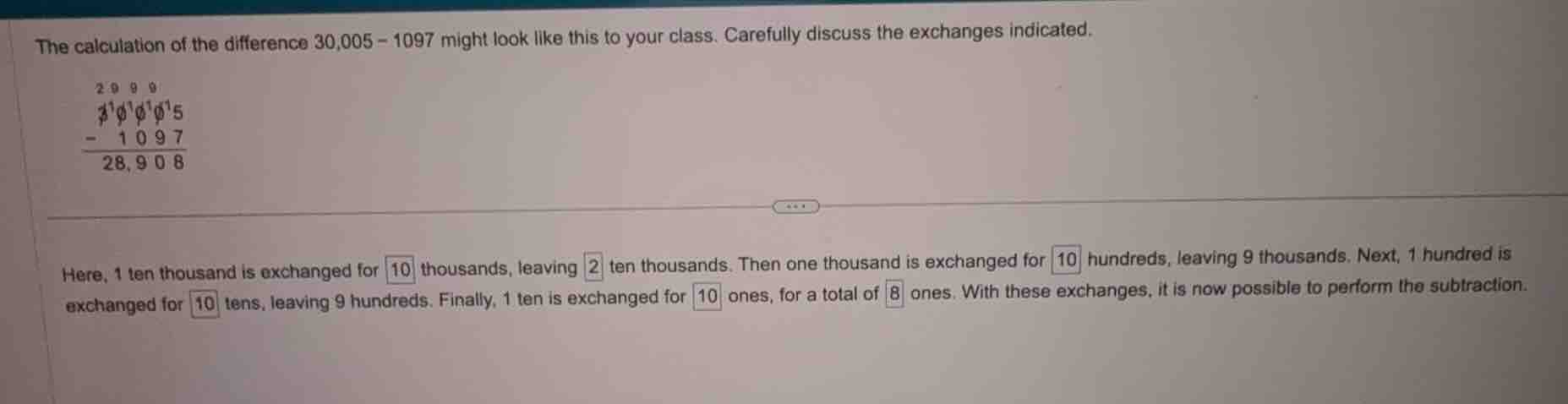
the calculation of the difference \\(30,005 - 1097\\) might look like this to your class. carefully discuss the exchanges indicated.
here, 1 ten thousand is exchanged for 10 thousands, leaving 2 ten thousands. then one thousand is exchanged for 10 hundreds, leaving 9 thousands. next, 1 hundred is exchanged for 10 tens, leaving 9 hundreds. finally, 1 ten is exchanged for 10 ones, for a total of 8 ones. with these exchanges, it is now possible to perform the subtraction.
Identify the missing values in the explanation
We need to fill in the blanks in the explanation of the subtraction \(30,005 - 1097\).
The text reads:
"Here, 1 ten thousand is exchanged for [blank 1] thousands, leaving [blank 2] ten thousands. Then one thousand is exchanged for [blank 3] hundreds, leaving 9 thousands. Next, 1 hundred is exchanged for [blank 4] tens, leaving 9 hundreds. Finally, 1 ten is exchanged for [blank 5] ones, for a total of [blank 6] ones. With these exchanges, it is now possible to perform the subtraction."
Analyze the first exchange
We start with \(30,005\).
The ten-thousands digit is \(3\).
We take \(1\) ten thousand, leaving \(2\) ten thousands.
\(1\) ten thousand is exchanged for \(10\) thousands.
- Blank 1: \(10\)
- Blank 2: \(2\)
Analyze the second exchange
We now have \(10\) thousands.
We take \(1\) thousand (leaving \(9\) thousands) and exchange it for \(10\) hundreds.
- Blank 3: \(10\)
Analyze the third exchange
We now have \(10\) hundreds.
We take \(1\) hundred (leaving \(9\) hundreds) and exchange it for \(10\) tens.
- Blank 4: \(10\)
Analyze the final exchange
We now have \(10\) tens.
We take \(1\) ten (leaving \(9\) tens) and exchange it for \(10\) ones.
- Blank 5: \(10\)
Since we already had \(5\) ones in the units place of \(30,005\), adding the \(10\) ones gives a total of \(10 + 5 = 15\) ones.
- Blank 6: \(15\)

Snap & solve any problem in the app
Get step-by-step solutions on Sovi AI
Photo-based solutions with guided steps
Explore more problems and detailed explanations
Here, 1 ten thousand is exchanged for <blank>10</blank> thousands, leaving <blank>2</blank> ten thousands. Then one thousand is exchanged for <blank>10</blank> hundreds, leaving 9 thousands. Next, 1 hundred is exchanged for <blank>10</blank> tens, leaving 9 hundreds. Finally, 1 ten is exchanged for <blank>10</blank> ones, for a total of <blank>15</blank> ones. With these exchanges, it is now possible to perform the subtraction.