QUESTION IMAGE
Question
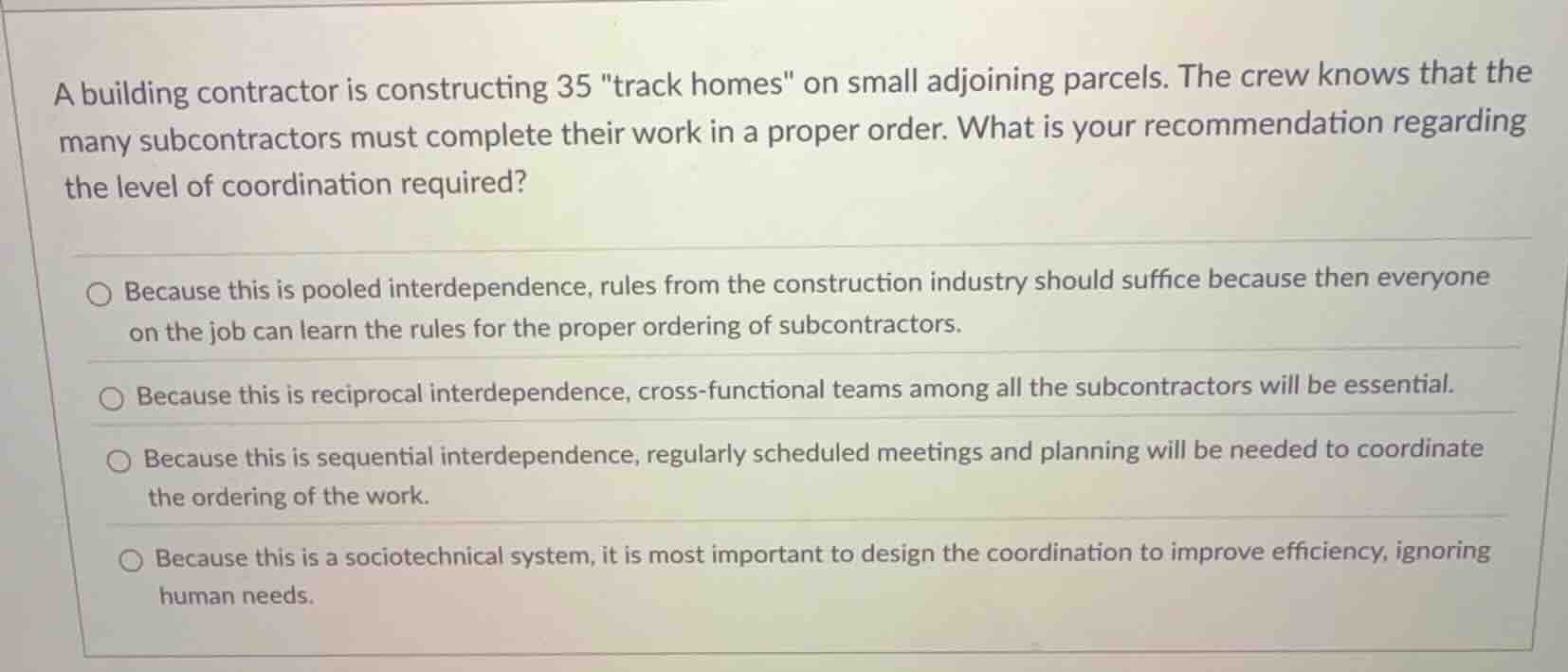
a building contractor is constructing 35 \track homes\ on small adjoining parcels. the crew knows that the many subcontractors must complete their work in a proper order. what is your recommendation regarding the level of coordination required?
because this is pooled interdependence, rules from the construction industry should suffice because then everyone on the job can learn the rules for the proper ordering of subcontractors.
because this is reciprocal interdependence, cross-functional teams among all the subcontractors will be essential.
because this is sequential interdependence, regularly scheduled meetings and planning will be needed to coordinate the ordering of the work.
because this is a sociotechnical system, it is most important to design the coordination to improve efficiency, ignoring human needs.
Analyze the task interdependence type
The scenario describes a construction project where "many subcontractors must complete their work in a proper order." This step-by-step, ordered flow of work from one subcontractor to the next (e.g., foundation, then framing, then plumbing, then electrical) is a classic example of sequential interdependence, where the output of one unit becomes the input for the next.
Evaluate coordination requirements
According to James D. Thompson's classic organizational theory, different types of interdependence require different coordination mechanisms:
- Pooled interdependence is coordinated by rules and standardization.
- Sequential interdependence is coordinated by planning, scheduling, and regular meetings to ensure smooth handoffs.
- Reciprocal interdependence requires mutual adjustment and cross-functional teams.
Therefore, sequential interdependence requires regularly scheduled meetings and planning to coordinate the ordering of the work.
Assess the given options
- Option 1 suggests pooled interdependence and rules, which is incorrect because the work must be done in a specific sequential order.
- Option 2 suggests reciprocal interdependence and cross-functional teams, which is over-engineered for a standard sequential construction flow.
- Option 3 correctly identifies the situation as sequential interdependence and recommends scheduled meetings and planning.
- Option 4 mentions a sociotechnical system but incorrectly suggests "ignoring human needs," which contradicts the core philosophy of sociotechnical systems theory.

Snap & solve any problem in the app
Get step-by-step solutions on Sovi AI
Photo-based solutions with guided steps
Explore more problems and detailed explanations
- Because this is pooled interdependence, rules from the construction industry should suffice because then everyone on the job can learn the rules for the proper ordering of subcontractors.
- Because this is reciprocal interdependence, cross-functional teams among all the subcontractors will be essential.
- Because this is sequential interdependence, regularly scheduled meetings and planning will be needed to coordinate the ordering of the work. (Correct answer)
- Because this is a sociotechnical system, it is most important to design the coordination to improve efficiency, ignoring human needs.