QUESTION IMAGE
Question
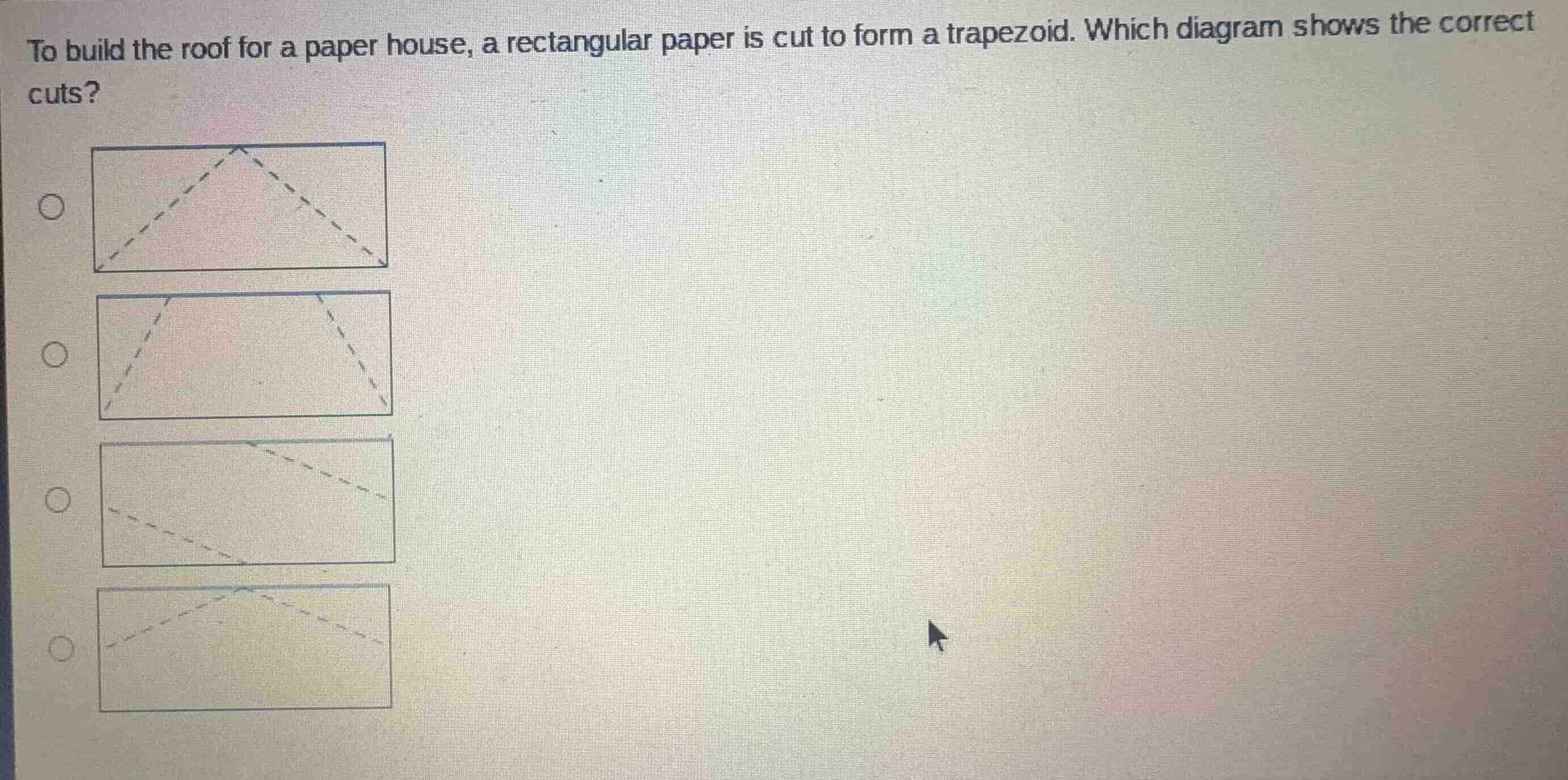
to build the roof for a paper house, a rectangular paper is cut to form a trapezoid. which diagram shows the correct cuts?
<pre_analysis>
{
"quality": "clear",
"question_count": 1,
"skills_matched": [
"direct_cot",
"multiple_choice_formatter",
"explain_then_answer",
"tutor"
],
"needs_drawing": false,
"concepts_used": [
"Area of Polygons"
],
"new_concepts": [
"Trapezoid Properties",
"Geometric Cutting"
],
"current_concepts": [
"Area of Polygons",
"Trapezoid Properties",
"Geometric Cutting"
]
}
</pre_analysis>
<reasoning>
Understand the goal of the cuts
The objective is to cut a rectangular piece of paper along the dashed lines to form a trapezoid. A trapezoid is a quadrilateral with at least one pair of parallel sides. Since we start with a rectangle, the top and bottom edges are already parallel.
Analyze the first option
Using the Area of Polygons knowledge point, we can identify the resulting shapes.
In the first diagram, two dashed lines start from the bottom corners and meet at a single point on the top edge. Cutting along these lines removes two right triangles from the sides, leaving a single triangle in the middle. A triangle is not a trapezoid.
Analyze the second option
In the second diagram, two dashed lines start from the bottom corners and go up to two distinct points on the top edge. Cutting along these lines removes two right triangles from the left and right sides. The remaining middle piece has:
- A flat bottom edge (part of the original bottom edge).
- A flat top edge (the segment between the two cut points on the original top edge).
- Two slanted side edges.
Since the top and bottom edges remain parallel, this shape is a trapezoid.
Analyze the third option
In the third diagram, one dashed line cuts from the bottom edge to the left edge, and another cuts from the top edge to the right edge. The resulting central piece does not have parallel top and bottom bases of a standard trapezoid, nor does it form a simple trapezoid.
Analyze the fourth option
In the fourth diagram, the dashed lines meet at a point on the top edge but do not start from the bottom corners, or they form a non-parallel quadrilateral. It does not produce a trapezoid with parallel top and bottom bases. Thus, the second option is the correct diagram.
</reasoning>
<answer>
<mcq-option>(A) A triangle is formed by cutting to a single point on the top edge.</mcq-option>
<mcq-correct>(B) A trapezoid is formed by cutting to two separate points on the top edge, keeping the top and bottom sides parallel.</mcq-correct>
<mcq-option>(C) An irregular shape is formed by non-symmetric cuts on opposite sides.</mcq-option>
<mcq-option>(D) A non-trapezoidal shape is formed by shallow cuts that do not reach the corners.</mcq-option>
</answer>
<post_analysis>
{
"subject": "Mathematics",
"question_type": "Multiple Choice",
"knowledge_point": [
"Mathematics",
"Geometry",
"Trapezoid Properties"
]
}
</post_analysis>
Snap & solve any problem in the app
Get step-by-step solutions on Sovi AI
Photo-based solutions with guided steps
Explore more problems and detailed explanations
<pre_analysis>
{
"quality": "clear",
"question_count": 1,
"skills_matched": [
"direct_cot",
"multiple_choice_formatter",
"explain_then_answer",
"tutor"
],
"needs_drawing": false,
"concepts_used": [
"Area of Polygons"
],
"new_concepts": [
"Trapezoid Properties",
"Geometric Cutting"
],
"current_concepts": [
"Area of Polygons",
"Trapezoid Properties",
"Geometric Cutting"
]
}
</pre_analysis>
<reasoning>
Understand the goal of the cuts
The objective is to cut a rectangular piece of paper along the dashed lines to form a trapezoid. A trapezoid is a quadrilateral with at least one pair of parallel sides. Since we start with a rectangle, the top and bottom edges are already parallel.
Analyze the first option
Using the Area of Polygons knowledge point, we can identify the resulting shapes.
In the first diagram, two dashed lines start from the bottom corners and meet at a single point on the top edge. Cutting along these lines removes two right triangles from the sides, leaving a single triangle in the middle. A triangle is not a trapezoid.
Analyze the second option
In the second diagram, two dashed lines start from the bottom corners and go up to two distinct points on the top edge. Cutting along these lines removes two right triangles from the left and right sides. The remaining middle piece has:
- A flat bottom edge (part of the original bottom edge).
- A flat top edge (the segment between the two cut points on the original top edge).
- Two slanted side edges.
Since the top and bottom edges remain parallel, this shape is a trapezoid.
Analyze the third option
In the third diagram, one dashed line cuts from the bottom edge to the left edge, and another cuts from the top edge to the right edge. The resulting central piece does not have parallel top and bottom bases of a standard trapezoid, nor does it form a simple trapezoid.
Analyze the fourth option
In the fourth diagram, the dashed lines meet at a point on the top edge but do not start from the bottom corners, or they form a non-parallel quadrilateral. It does not produce a trapezoid with parallel top and bottom bases. Thus, the second option is the correct diagram.
</reasoning>
<answer>
<mcq-option>(A) A triangle is formed by cutting to a single point on the top edge.</mcq-option>
<mcq-correct>(B) A trapezoid is formed by cutting to two separate points on the top edge, keeping the top and bottom sides parallel.</mcq-correct>
<mcq-option>(C) An irregular shape is formed by non-symmetric cuts on opposite sides.</mcq-option>
<mcq-option>(D) A non-trapezoidal shape is formed by shallow cuts that do not reach the corners.</mcq-option>
</answer>
<post_analysis>
{
"subject": "Mathematics",
"question_type": "Multiple Choice",
"knowledge_point": [
"Mathematics",
"Geometry",
"Trapezoid Properties"
]
}
</post_analysis>