QUESTION IMAGE
Question
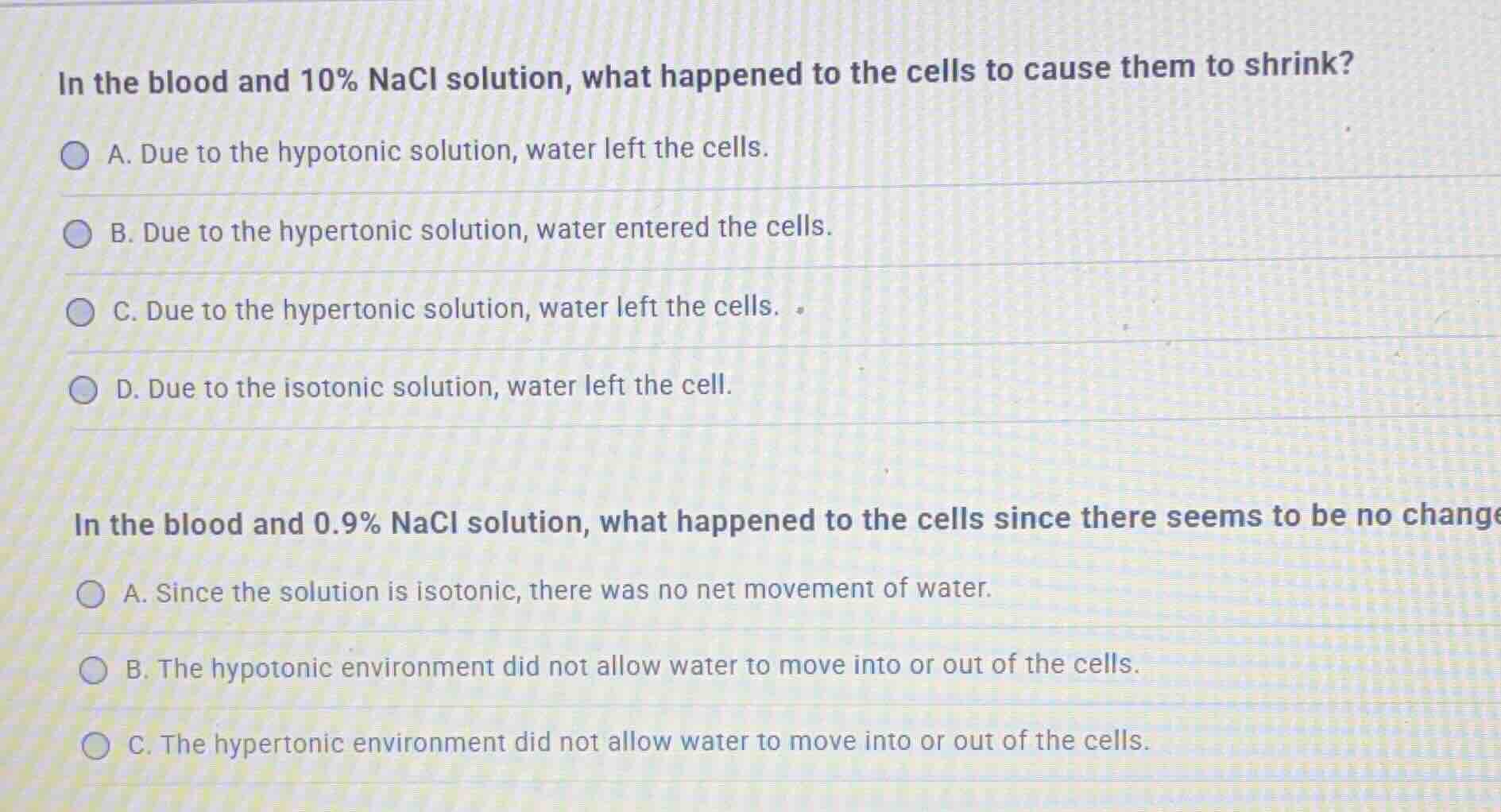
in the blood and 10% nacl solution, what happened to the cells to cause them to shrink?
a. due to the hypotonic solution, water left the cells.
b. due to the hypertonic solution, water entered the cells.
c. due to the hypertonic solution, water left the cells.
d. due to the isotonic solution, water left the cell.
in the blood and 0.9% nacl solution, what happened to the cells since there seems to be no change?
a. since the solution is isotonic, there was no net movement of water.
b. the hypotonic environment did not allow water to move into or out of the cells.
c. the hypertonic environment did not allow water to move into or out of the cells.
Analyze the first question regarding the 10% NaCl solution
Using the Osmosis Principles and Tonicity Effects knowledge points
- A \(10\%\) \(\text{NaCl}\) solution has a much higher solute concentration than the intracellular fluid of red blood cells (which is approximately \(0.9\%\) \(\text{NaCl}\)).
- This makes the \(10\%\) \(\text{NaCl}\) solution hypertonic relative to the cells.
- Water moves down its concentration gradient from an area of lower solute concentration (inside the cell) to higher solute concentration (outside the cell).
- Therefore, water leaves the cells, causing them to shrink (crenate). This matches option C.
Analyze the second question regarding the 0.9% NaCl solution
Using the Osmosis Principles and Tonicity Effects knowledge points
- A \(0.9\%\) \(\text{NaCl}\) solution is physiological saline, which has the same solute concentration as the inside of red blood cells.
- This makes the solution isotonic relative to the cells.
- In an isotonic environment, water molecules move in and out of the cell at equal rates, resulting in no net movement of water and no change in cell shape. This matches option A.

Snap & solve any problem in the app
Get step-by-step solutions on Sovi AI
Photo-based solutions with guided steps
Explore more problems and detailed explanations
Question 1
- A. Due to the hypotonic solution, water left the cells.
- B. Due to the hypertonic solution, water entered the cells.
- C. Due to the hypertonic solution, water left the cells. (Correct answer)
- D. Due to the isotonic solution, water left the cell.
Question 2
- A. Since the solution is isotonic, there was no net movement of water. (Correct answer)
- B. The hypotonic environment did not allow water to move into or out of the cells.
- C. The hypertonic environment did not allow water to move into or out of the cells.