QUESTION IMAGE
Question
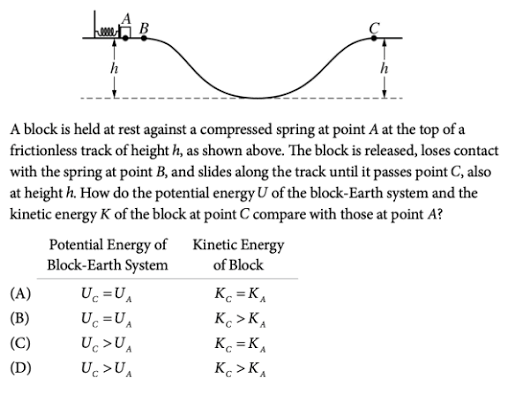
a block is held at rest against a compressed spring at point (a) at the top of a frictionless track of height (h), as shown above. the block is released, loses contact with the spring at point (b), and slides along the track until it passes point (c), also at height (h). how do the potential energy (u) of the block-earth system and the kinetic energy (k) of the block at point (c) compare with those at point (a)?
\
🆕 New Concept Discovered: Conservation of Mechanical Energy
Total energy stays constant when there is no friction.
Step 1: Compare Potential Energy at A and C
The gravitational potential energy \( U \) of a block-Earth system depends only on the height \( y \) of the block relative to a reference level:
- At point A: The block is at height \( h \), so its potential energy is:
- At point C: The block is also at height \( h \), so its potential energy is:
Since the heights are identical, the potential energies must be equal:
Step 2: Compare Kinetic Energy at A and C
We can analyze the kinetic energy \( K \) by looking at the total mechanical energy of the system at both points.
- At point A: The block is held at rest, so its initial kinetic energy is zero:
However, the compressed spring stores elastic potential energy \( U_s \). The total energy of the system at point A is:
- At point C: The block has released all of the spring's stored energy because it lost contact with the spring at point B. Since the track is frictionless, the total mechanical energy is conserved:
Substitute \( U_C = U_A \) and \( K_A = 0 \) into the conservation equation:
Since the spring was compressed at the start, \( U_s > 0 \), which means:
Since \( K_A = 0 \), we find:

Snap & solve any problem in the app
Get step-by-step solutions on Sovi AI
Photo-based solutions with guided steps
Explore more problems and detailed explanations
(B) \( U_C = U_A \) and \( K_C > K_A \)