QUESTION IMAGE
Question
biomolecule review worksheet
organic molecules
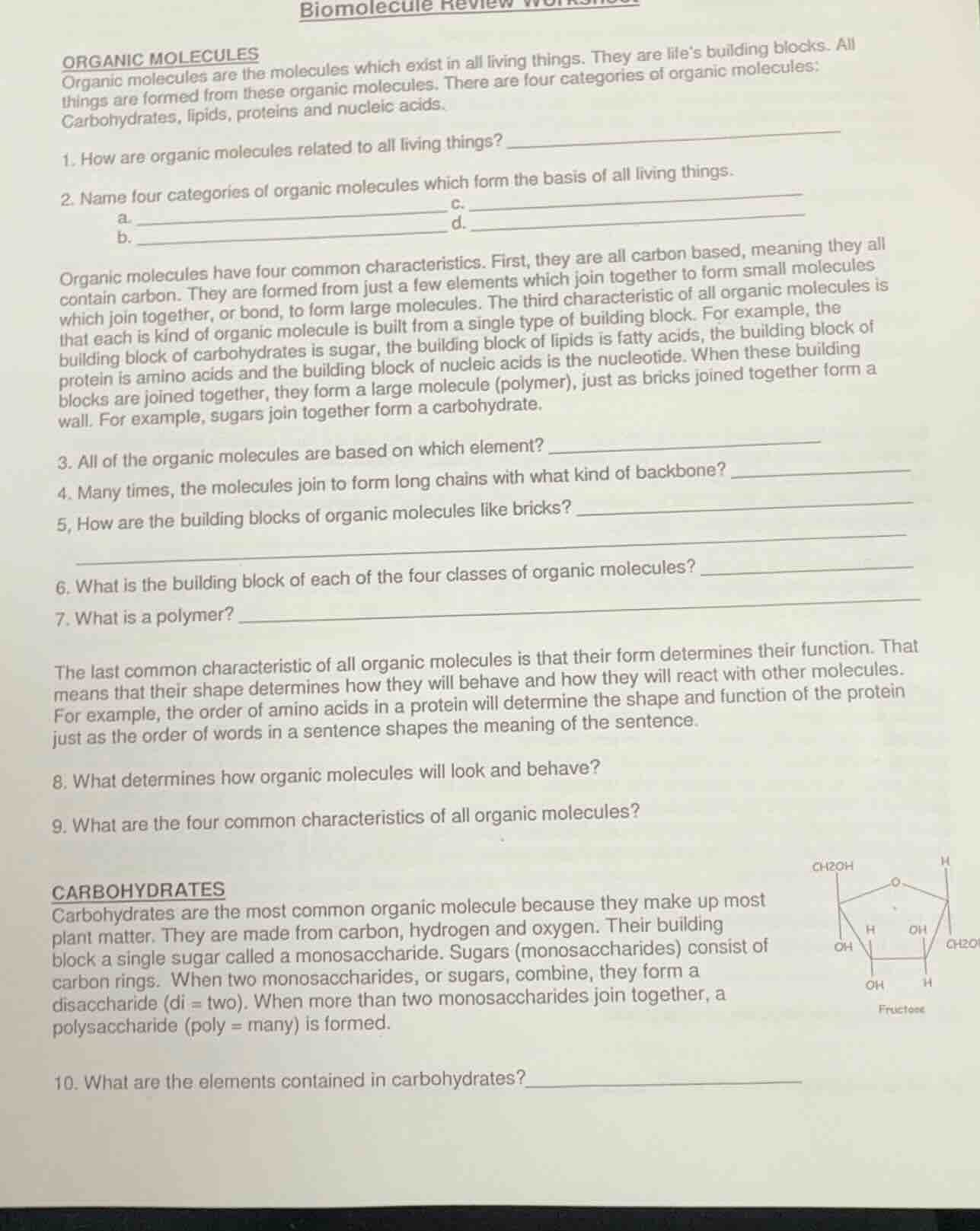
organic molecules are the molecules which exist in all living things. they are lifes building blocks. all things are formed from these organic molecules. there are four categories of organic molecules: carbohydrates, lipids, proteins and nucleic acids.
- how are organic molecules related to all living things?
- name four categories of organic molecules which form the basis of all living things.
a.
b.
c.
d.
organic molecules have four common characteristics. first, they are all carbon based, meaning they all contain carbon. they are formed from just a few elements which join together to form small molecules which join together, or bond, to form large molecules. the third characteristic of all organic molecules is that each is kind of organic molecule is built from a single type of building block. for example, the building block of carbohydrates is sugar, the building block of lipids is fatty acids, the building block of protein is amino acids and the building block of nucleic acids is the nucleotide. when these building blocks are joined together, they form a large molecule (polymer), just as bricks joined together form a wall. for example, sugars join together form a carbohydrate.
- all of the organic molecules are based on which element?
- many times, the molecules join to form long chains with what kind of backbone?
- how are the building blocks of organic molecules like bricks?
- what is the building block of each of the four classes of organic molecules?
- what is a polymer?
the last common characteristic of all organic molecules is that their form determines their function. that means that their shape determines how they will behave and how they will react with other molecules. for example, the order of amino acids in a protein will determine the shape and function of the protein just as the order of words in a sentence shapes the meaning of the sentence.
- what determines how organic molecules will look and behave?
- what are the four common characteristics of all organic molecules?
carbohydrates
carbohydrates are the most common organic molecule because they make up most plant matter. they are made from carbon, hydrogen and oxygen. their building block a single sugar called a monosaccharide. sugars (monosaccharides) consist of carbon rings. when two monosaccharides, or sugars, combine, they form a disaccharide (di = two). when more than two monosaccharides join together, a polysaccharide (poly = many) is formed.
- what are the elements contained in carbohydrates?
Analyze organic molecule relationship
The text states organic molecules exist in all living things and are life's building blocks. This relates to the Characteristics of Life because all living organisms are composed of these essential carbon-based structures.
Identify four categories
The introductory paragraph explicitly lists the four categories of organic molecules: carbohydrates, lipids, proteins, and nucleic acids.
Determine elemental basis
The text states that organic molecules have common characteristics, and first, "they are all carbon based, meaning they all contain carbon."
Identify chain backbone
The text mentions that small molecules join together to form large molecules. In organic chemistry, these long chains are built on a carbon backbone.
Compare building blocks to bricks
The text explains that "each kind of organic molecule is built from a single type of building block" and "when these building blocks are joined together, they form a large molecule (polymer), just as bricks joined together form a wall."
List building blocks
The text identifies the building blocks: sugar for carbohydrates, fatty acids for lipids, amino acids for proteins, and nucleotides for nucleic acids.
Define a polymer
According to the text, a polymer is a large molecule formed when building blocks are joined together.
Determine form and function
The text states that "their form determines their function," meaning their shape determines how they look, behave, and react.
Summarize common characteristics
Based on the passage, the four common characteristics are:
- They are all carbon-based.
- They are formed from just a few elements joining to form small molecules.
- Each is built from a single type of building block (monomer) to form polymers.
- Their form (shape) determines their function.
Identify carbohydrate elements
The text under "CARBOHYDRATES" states they "are made from carbon, hydrogen and oxygen."

Snap & solve any problem in the app
Get step-by-step solutions on Sovi AI
Photo-based solutions with guided steps
Explore more problems and detailed explanations
Question 1
They exist in all living things and serve as life's building blocks.
Question 2
a. Carbohydrates
b. Lipids
c. Proteins
d. Nucleic acids
Question 3
Carbon
Question 4
Carbon backbone
Question 5
They join together to form a larger structure (a polymer), just as individual bricks join to form a wall.
Question 6
- Carbohydrates: Sugar (monosaccharide)
- Lipids: Fatty acids
- Proteins: Amino acids
- Nucleic acids: Nucleotides
Question 7
A large molecule formed when many smaller building blocks (monomers) are joined together.
Question 8
Their form (or shape).
Question 9
- They are all carbon-based.
- They are formed from a few elements joining to make small molecules.
- They are built from single types of building blocks to form polymers.
- Their form determines their function.
Question 10
Carbon, hydrogen, and oxygen.