QUESTION IMAGE
Question
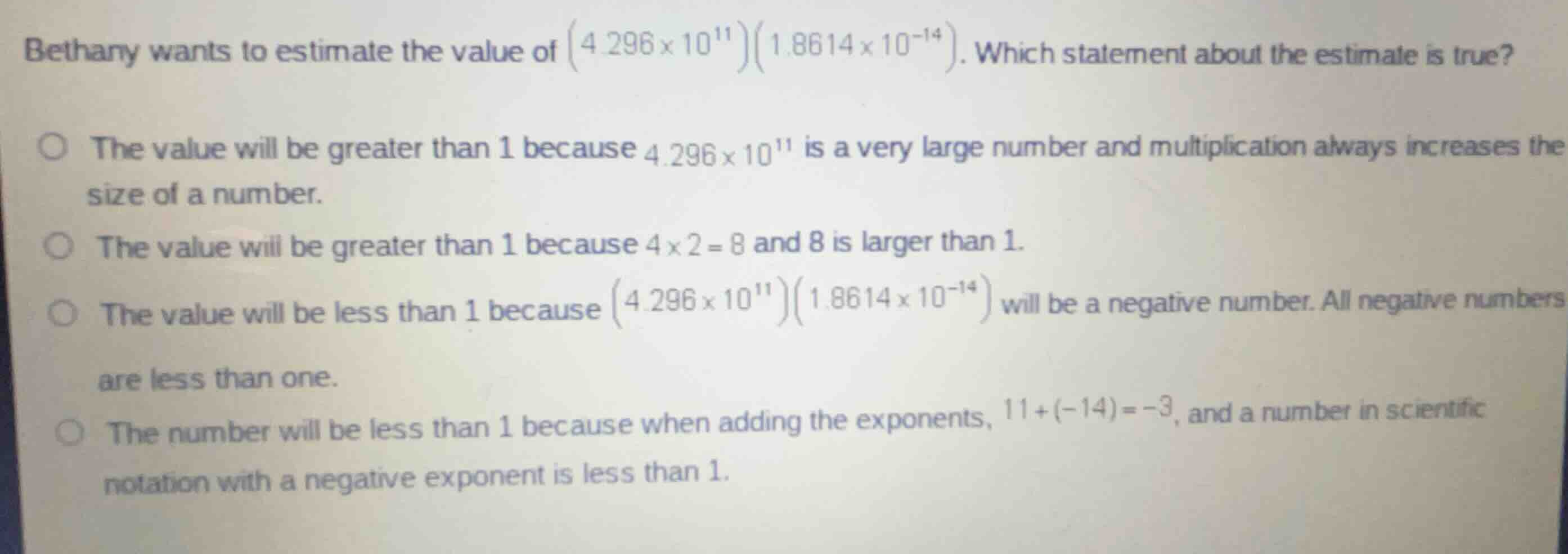
bethany wants to estimate the value of \\((4.296 \times 10^{11})(1.8614 \times 10^{-14})\\). which statement about the estimate is true?
- the value will be greater than 1 because \\(4.296 \times 10^{11}\\) is a very large number and multiplication always increases the size of a number.
- the value will be greater than 1 because \\(4 \times 2 = 8\\) and 8 is larger than 1.
- the value will be less than 1 because \\((4.296 \times 10^{11})(1.8614 \times 10^{-14})\\) will be a negative number. all negative numbers are less than one.
- the number will be less than 1 because when adding the exponents, \\(11 + (-14) = -3\\), and a number in scientific notation with a negative exponent is less than 1.
Estimate the product using scientific notation
$$
(4.296 \times 10^{11})(1.8614 \times 10^{-14}) \approx (4 \times 10^{11})(2 \times 10^{-14})
$$
Multiply the coefficients and add the exponents
$$
(4 \times 2) \times 10^{11 + (-14)} = 8 \times 10^{-3}
$$
Determine if the estimated value is less than 1
$$
8 \times 10^{-3} = 0.008 < 1
$$

Snap & solve any problem in the app
Get step-by-step solutions on Sovi AI
Photo-based solutions with guided steps
Explore more problems and detailed explanations
- The value will be greater than 1 because \(4.296 \times 10^{11}\) is a very large number and multiplication always increases the size of a number.
- The value will be greater than 1 because \(4 \times 2 = 8\) and 8 is larger than 1.
- The value will be less than 1 because \((4.296 \times 10^{11})(1.8614 \times 10^{-14})\) will be a negative number. All negative numbers are less than one.
- The number will be less than 1 because when adding the exponents, \(11 + (-14) = -3\), and a number in scientific notation with a negative exponent is less than 1. (Correct answer)