QUESTION IMAGE
Question
because i could not stop for death
emily dickinson
because i could not stop for death-
he kindly stopped for me-
the carriage held but just ourselves-
and immortality.
we slowly drove-he knew no haste
and i had put away
my labor and my leisure too,
for his civility-
we passed the school, where children strove
at recess-in the ring-
we passed the fields of gazing grain-
we passed the setting sun-
or rather-he passed us-
the dews drew quivering and chill-
for only gossamer, my gown-
my tippet-only tulle-
we paused before a house that seemed
a swelling of the ground-
the roof was scarcely visible-
the cornice-in the ground-
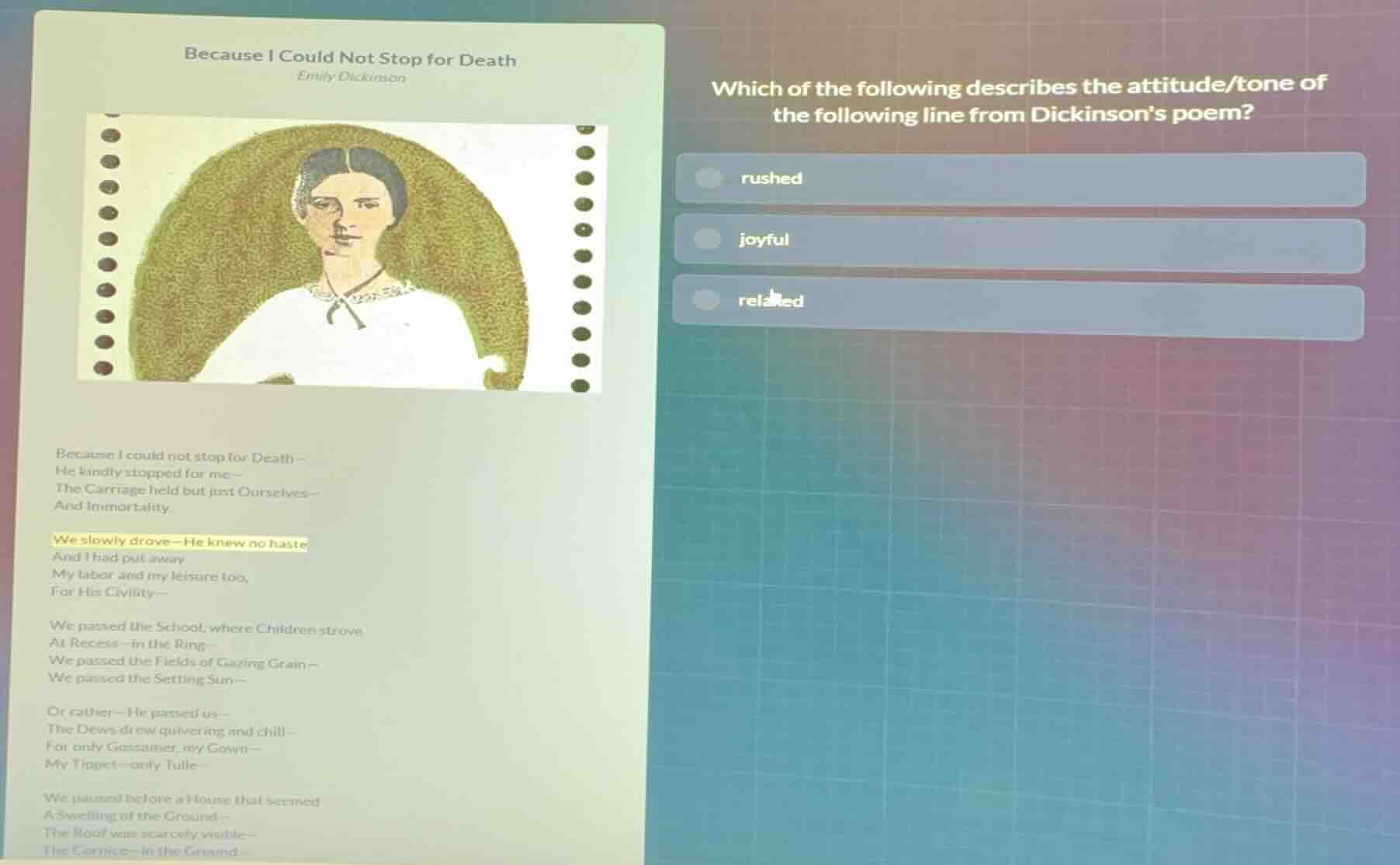
which of the following describes the attitude/tone of the following line from dickinsons poem?
we slowly drove-he knew no haste
rushed
joyful
relaxed
Identify the highlighted line in the poem
The question asks for the attitude/tone of a specific line from Emily Dickinson's poem "Because I could not stop for Death." Looking at the left side of the image, the second stanza contains a highlighted line in yellow: "We slowly drove—He knew no haste".
Analyze the meaning and tone of the line
The line "We slowly drove—He knew no haste" describes a slow, unhurried carriage ride with Death. The words "slowly" and "knew no haste" indicate a calm, peaceful, and unhurried pace. This lack of urgency or anxiety conveys a relaxed and tranquil attitude toward the journey.
Evaluate the given multiple-choice options
- "rushed": Incorrect, as the text explicitly states they drove "slowly" and "knew no haste."
- "joyful": Incorrect, while peaceful, the tone is not celebratory or highly cheerful.
- "relaxed": Correct, as the slow, unhurried pace reflects a calm, composed, and relaxed state.

Snap & solve any problem in the app
Get step-by-step solutions on Sovi AI
Photo-based solutions with guided steps
Explore more problems and detailed explanations
- rushed
- joyful
- relaxed (Correct answer)