QUESTION IMAGE
Question
3 - barriers to accurate social perception
learning objective: evaluate the barriers that can inhibit the accuracy of social perception.
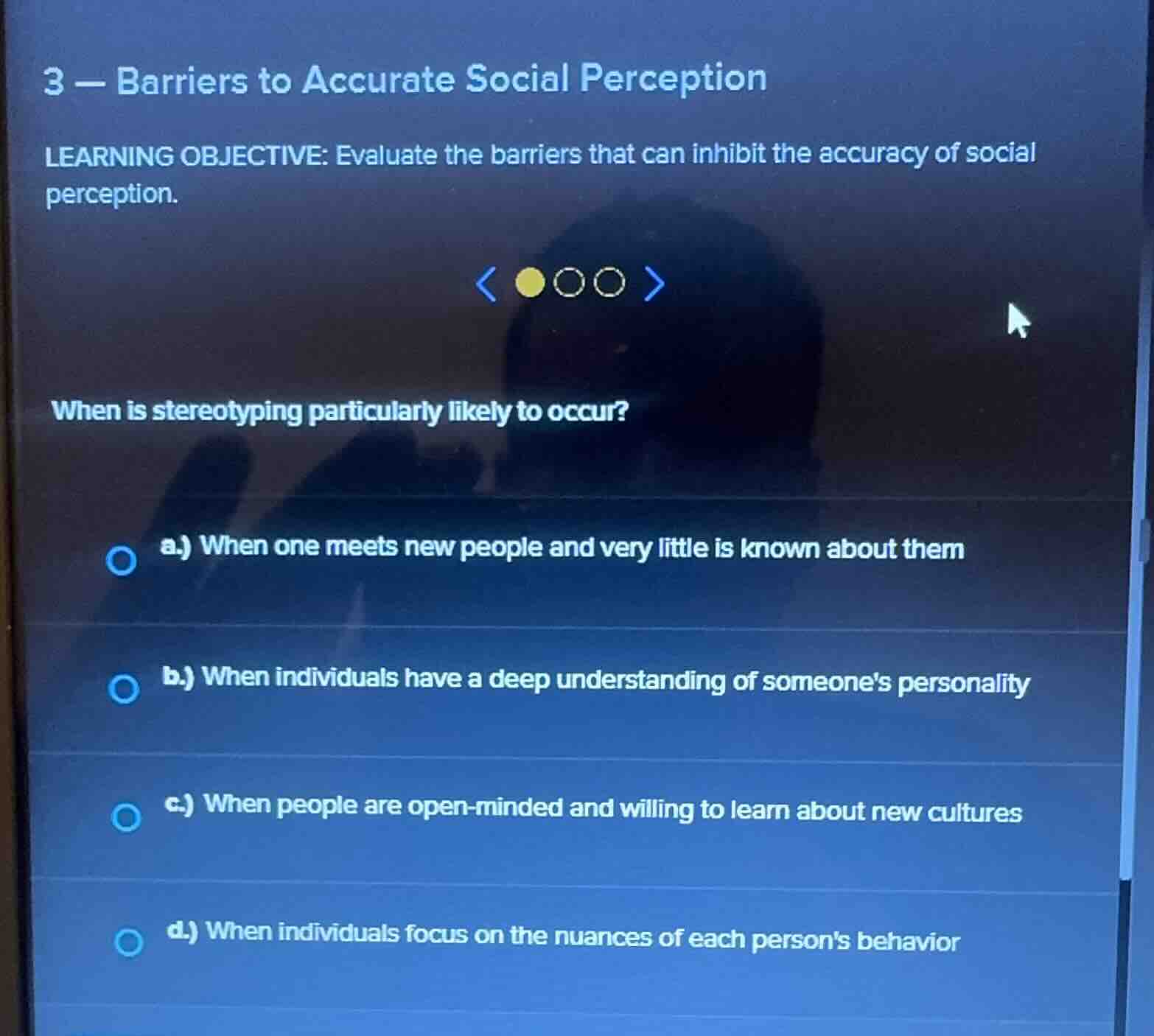
when is stereotyping particularly likely to occur?
a.) when one meets new people and very little is known about them
b.) when individuals have a deep understanding of someones personality
c.) when people are open-minded and willing to learn about new cultures
d.) when individuals focus on the nuances of each persons behavior
Analyze the nature of stereotyping
Stereotyping is a cognitive shortcut where we attribute specific characteristics to an individual based on their membership in a particular social group. It serves as a mental simplification tool when cognitive resources or information are limited.
Evaluate the conditions that trigger stereotyping
Using our understanding of Perception Elements, we look at when the mind relies most heavily on cognitive shortcuts:
- When we have abundant, detailed, and individualized information about someone, we engage in controlled, systematic processing rather than relying on category-based generalizations.
- Conversely, when we meet new people and have very little unique information about them, our brains fill in the information gaps by relying on category-based schemas (stereotypes) to make quick assessments.
Assess the given options
- a.) When one meets new people and very little is known about them: This matches the condition of high ambiguity and low individual information, where stereotyping is highly likely to occur to fill cognitive gaps.
- b.) When individuals have a deep understanding of someone's personality: Deep understanding leads to individuation, which reduces and overrides stereotyping.
- c.) When people are open-minded and willing to learn about new cultures: Open-mindedness and active learning promote conscious processing, which actively combats automatic stereotyping.
- d.) When individuals focus on the nuances of each person's behavior: Focusing on unique personal nuances is the opposite of category-based generalization.

Snap & solve any problem in the app
Get step-by-step solutions on Sovi AI
Photo-based solutions with guided steps
Explore more problems and detailed explanations
- a.) When one meets new people and very little is known about them (Correct answer)
- b.) When individuals have a deep understanding of someone's personality
- c.) When people are open-minded and willing to learn about new cultures
- d.) When individuals focus on the nuances of each person's behavior