QUESTION IMAGE
Question
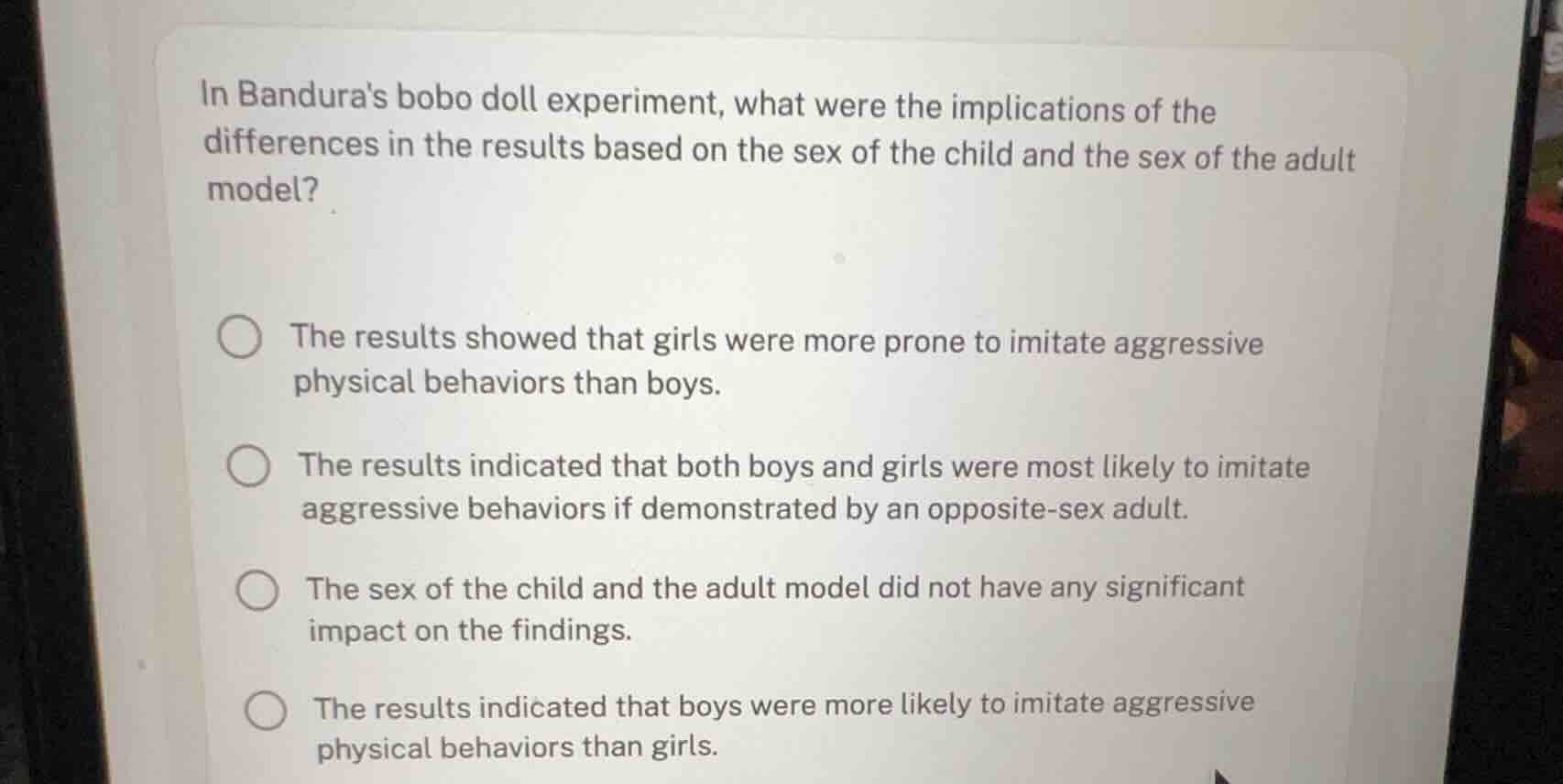
in banduras bobo doll experiment, what were the implications of the differences in the results based on the sex of the child and the sex of the adult model?
the results showed that girls were more prone to imitate aggressive physical behaviors than boys.
the results indicated that both boys and girls were most likely to imitate aggressive behaviors if demonstrated by an opposite-sex adult.
the sex of the child and the adult model did not have any significant impact on the findings.
the results indicated that boys were more likely to imitate aggressive physical behaviors than girls.
<pre_analysis>
{
"quality": "clear",
"question_count": 1,
"skills_matched": [
"direct_cot",
"multiple_choice_formatter",
"explain_then_answer",
"tutor"
],
"needs_drawing": false,
"concepts_used": [
"Observational Learning"
],
"new_concepts": [
"Bobo Doll Experiment",
"Gender Roles in Imitation"
],
"current_concepts": [
"Observational Learning",
"Bobo Doll Experiment",
"Gender Roles in Imitation"
]
}
</pre_analysis>
<reasoning>
Analyze the Bobo doll experiment findings
In Albert Bandura's famous 1961 Bobo doll experiment, researchers investigated Observational Learning and aggression in children. They specifically analyzed how the sex of the child and the sex of the adult model influenced the imitation of aggressive behaviors.
Evaluate gender differences in aggression
The study's results showed distinct differences based on gender:
- Boys exhibited significantly more physical aggression than girls.
- Children were more likely to imitate same-sex models, meaning boys imitated male models more, and girls imitated female models more.
- Overall, boys showed a much higher likelihood of imitating aggressive physical behaviors than girls.
Assess the given options
- Option 1: "The results showed that girls were more prone to imitate aggressive physical behaviors than boys." (Incorrect; boys showed more physical aggression).
- Option 2: "The results indicated that both boys and girls were most likely to imitate aggressive behaviors if demonstrated by an opposite-sex adult." (Incorrect; they were more influenced by same-sex models).
- Option 3: "The sex of the child and the adult model did not have any significant impact on the findings." (Incorrect; sex had a highly significant impact).
- Option 4: "The results indicated that boys were more likely to imitate aggressive physical behaviors than girls." (Correct; this matches the empirical findings of the study).
</reasoning>
<answer>
<mcq-option>(A) The results showed that girls were more prone to imitate aggressive physical behaviors than boys.</mcq-option>
<mcq-option>(B) The results indicated that both boys and girls were most likely to imitate aggressive behaviors if demonstrated by an opposite-sex adult.</mcq-option>
<mcq-option>(C) The sex of the child and the adult model did not have any significant impact on the findings.</mcq-option>
<mcq-correct>(D) The results indicated that boys were more likely to imitate aggressive physical behaviors than girls.</mcq-correct>
</answer>
<post_analysis>
{
"subject": "Social Science",
"question_type": "Multiple Choice",
"knowledge_point": [
"Social Science",
"Psychology",
"Observational Learning"
]
}
</post_analysis>
Snap & solve any problem in the app
Get step-by-step solutions on Sovi AI
Photo-based solutions with guided steps
Explore more problems and detailed explanations
<pre_analysis>
{
"quality": "clear",
"question_count": 1,
"skills_matched": [
"direct_cot",
"multiple_choice_formatter",
"explain_then_answer",
"tutor"
],
"needs_drawing": false,
"concepts_used": [
"Observational Learning"
],
"new_concepts": [
"Bobo Doll Experiment",
"Gender Roles in Imitation"
],
"current_concepts": [
"Observational Learning",
"Bobo Doll Experiment",
"Gender Roles in Imitation"
]
}
</pre_analysis>
<reasoning>
Analyze the Bobo doll experiment findings
In Albert Bandura's famous 1961 Bobo doll experiment, researchers investigated Observational Learning and aggression in children. They specifically analyzed how the sex of the child and the sex of the adult model influenced the imitation of aggressive behaviors.
Evaluate gender differences in aggression
The study's results showed distinct differences based on gender:
- Boys exhibited significantly more physical aggression than girls.
- Children were more likely to imitate same-sex models, meaning boys imitated male models more, and girls imitated female models more.
- Overall, boys showed a much higher likelihood of imitating aggressive physical behaviors than girls.
Assess the given options
- Option 1: "The results showed that girls were more prone to imitate aggressive physical behaviors than boys." (Incorrect; boys showed more physical aggression).
- Option 2: "The results indicated that both boys and girls were most likely to imitate aggressive behaviors if demonstrated by an opposite-sex adult." (Incorrect; they were more influenced by same-sex models).
- Option 3: "The sex of the child and the adult model did not have any significant impact on the findings." (Incorrect; sex had a highly significant impact).
- Option 4: "The results indicated that boys were more likely to imitate aggressive physical behaviors than girls." (Correct; this matches the empirical findings of the study).
</reasoning>
<answer>
<mcq-option>(A) The results showed that girls were more prone to imitate aggressive physical behaviors than boys.</mcq-option>
<mcq-option>(B) The results indicated that both boys and girls were most likely to imitate aggressive behaviors if demonstrated by an opposite-sex adult.</mcq-option>
<mcq-option>(C) The sex of the child and the adult model did not have any significant impact on the findings.</mcq-option>
<mcq-correct>(D) The results indicated that boys were more likely to imitate aggressive physical behaviors than girls.</mcq-correct>
</answer>
<post_analysis>
{
"subject": "Social Science",
"question_type": "Multiple Choice",
"knowledge_point": [
"Social Science",
"Psychology",
"Observational Learning"
]
}
</post_analysis>