QUESTION IMAGE
Question
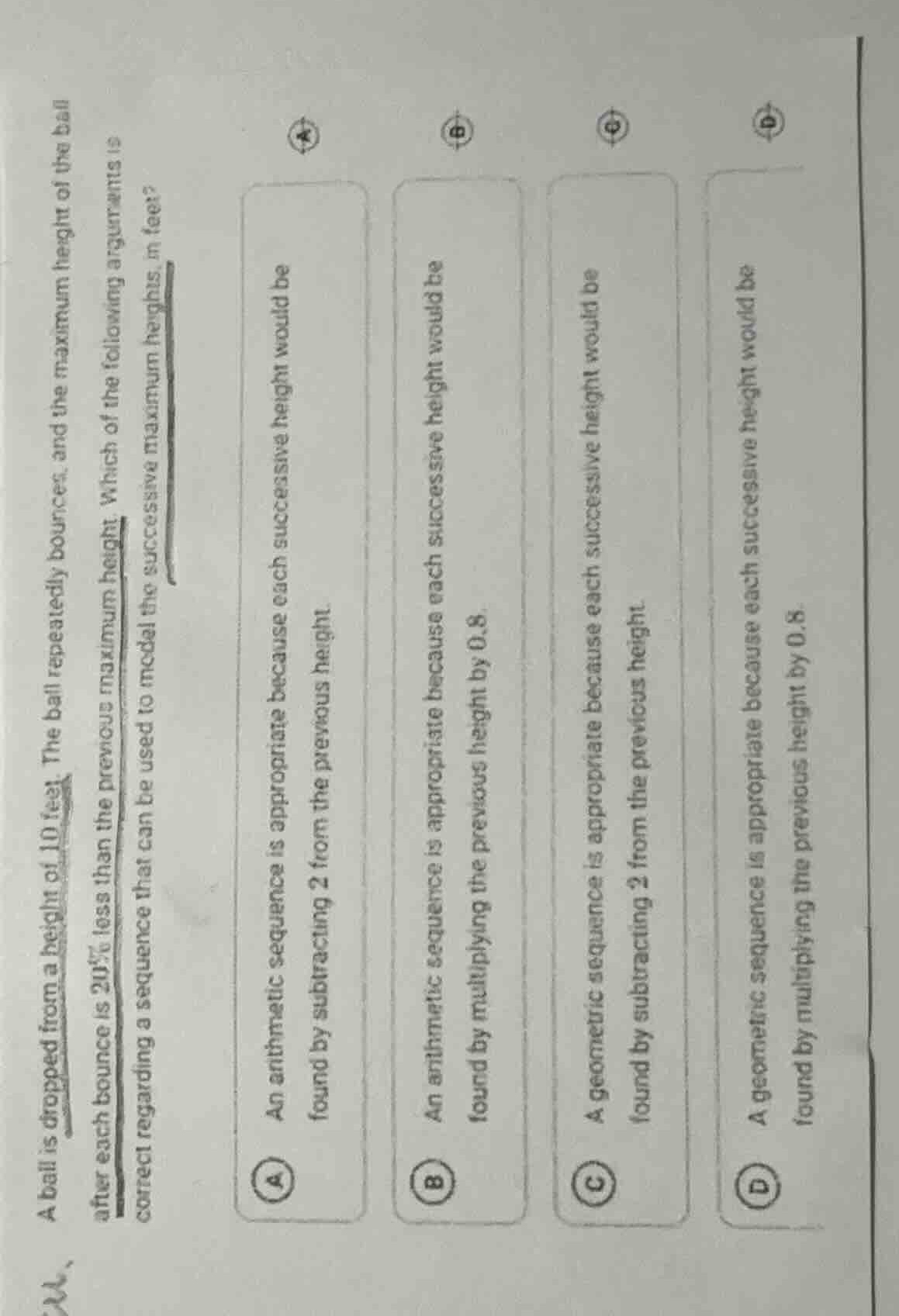
a ball is dropped from a height of 10 feet. the ball repeatedly bounces, and the maximum height of the ball after each bounce is 20% less than the previous maximum height. which of the following arguments is correct regarding a sequence that can be used to model the successive maximum heights, in feet?
a. an arithmetic sequence is appropriate because each successive height would be found by subtracting 2 from the previous height.
b. an arithmetic sequence is appropriate because each successive height would be found by multiplying the previous height by 0.8.
c. a geometric sequence is appropriate because each successive height would be found by subtracting 2 from the previous height.
d. a geometric sequence is appropriate because each successive height would be found by multiplying the previous height by 0.8.
<pre_analysis>
{
"quality": "clear",
"question_count": 1,
"skills_matched": [
"direct_cot",
"multiple_choice_formatter",
"explain_then_answer",
"tutor",
"mastery_adaptive_brevity"
],
"needs_drawing": false,
"concepts_used": [
"Sequence Classification"
],
"new_concepts": [
"Geometric Sequences",
"Exponential Decay Models"
],
"current_concepts": [
"Sequence Classification",
"Geometric Sequences",
"Exponential Decay Models"
]
}
</pre_analysis>
<reasoning>
Analyze the given problem context
Using the Sequence Classification knowledge point
- The initial height of the ball is \(10\text{ feet}\).
- After each bounce, the maximum height is \(20\%\) less than the previous maximum height.
- We need to determine whether an arithmetic or geometric sequence is appropriate to model the successive maximum heights, and find the correct common difference or common ratio.
Determine the mathematical relationship between successive terms
Using the Sequence Classification knowledge point
- Let \(h_n\) be the maximum height after the \(n\)-th bounce.
- A reduction of \(20\%\) from the previous height means:
\[
h_n = h_{n-1} - 0.20 h_{n-1} = 0.80 h_{n-1}
\]
- Since each term is found by multiplying the previous term by a constant factor of \(0.8\), this relationship is multiplicative rather than additive.
Classify the sequence type and identify the correct option
Using the Sequence Classification knowledge point
- A sequence where each term is found by multiplying the previous term by a constant is a geometric sequence.
- The constant multiplier (common ratio) is \(0.8\).
- Comparing this with the given choices:
- Option (A) describes an arithmetic sequence with subtraction.
- Option (B) describes an arithmetic sequence with multiplication (contradictory definition).
- Option (C) describes a geometric sequence with subtraction.
- Option (D) correctly states that a geometric sequence is appropriate because each successive height is found by multiplying the previous height by \(0.8\).
</reasoning>
<answer>
<mcq-option>(A) An arithmetic sequence is appropriate because each successive height would be found by subtracting 2 from the previous height.</mcq-option>
<mcq-option>(B) An arithmetic sequence is appropriate because each successive height would be found by multiplying the previous height by 0.8.</mcq-option>
<mcq-option>(C) A geometric sequence is appropriate because each successive height would be found by subtracting 2 from the previous height.</mcq-option>
<mcq-correct>(D) A geometric sequence is appropriate because each successive height would be found by multiplying the previous height by 0.8.</mcq-correct>
</answer>
<post_analysis>
{
"subject": "Mathematics",
"question_type": "Multiple Choice",
"knowledge_point": [
"Mathematics",
"Algebra",
"Sequence Classification"
]
}
</post_analysis>
Snap & solve any problem in the app
Get step-by-step solutions on Sovi AI
Photo-based solutions with guided steps
Explore more problems and detailed explanations
<pre_analysis>
{
"quality": "clear",
"question_count": 1,
"skills_matched": [
"direct_cot",
"multiple_choice_formatter",
"explain_then_answer",
"tutor",
"mastery_adaptive_brevity"
],
"needs_drawing": false,
"concepts_used": [
"Sequence Classification"
],
"new_concepts": [
"Geometric Sequences",
"Exponential Decay Models"
],
"current_concepts": [
"Sequence Classification",
"Geometric Sequences",
"Exponential Decay Models"
]
}
</pre_analysis>
<reasoning>
Analyze the given problem context
Using the Sequence Classification knowledge point
- The initial height of the ball is \(10\text{ feet}\).
- After each bounce, the maximum height is \(20\%\) less than the previous maximum height.
- We need to determine whether an arithmetic or geometric sequence is appropriate to model the successive maximum heights, and find the correct common difference or common ratio.
Determine the mathematical relationship between successive terms
Using the Sequence Classification knowledge point
- Let \(h_n\) be the maximum height after the \(n\)-th bounce.
- A reduction of \(20\%\) from the previous height means:
\[
h_n = h_{n-1} - 0.20 h_{n-1} = 0.80 h_{n-1}
\]
- Since each term is found by multiplying the previous term by a constant factor of \(0.8\), this relationship is multiplicative rather than additive.
Classify the sequence type and identify the correct option
Using the Sequence Classification knowledge point
- A sequence where each term is found by multiplying the previous term by a constant is a geometric sequence.
- The constant multiplier (common ratio) is \(0.8\).
- Comparing this with the given choices:
- Option (A) describes an arithmetic sequence with subtraction.
- Option (B) describes an arithmetic sequence with multiplication (contradictory definition).
- Option (C) describes a geometric sequence with subtraction.
- Option (D) correctly states that a geometric sequence is appropriate because each successive height is found by multiplying the previous height by \(0.8\).
</reasoning>
<answer>
<mcq-option>(A) An arithmetic sequence is appropriate because each successive height would be found by subtracting 2 from the previous height.</mcq-option>
<mcq-option>(B) An arithmetic sequence is appropriate because each successive height would be found by multiplying the previous height by 0.8.</mcq-option>
<mcq-option>(C) A geometric sequence is appropriate because each successive height would be found by subtracting 2 from the previous height.</mcq-option>
<mcq-correct>(D) A geometric sequence is appropriate because each successive height would be found by multiplying the previous height by 0.8.</mcq-correct>
</answer>
<post_analysis>
{
"subject": "Mathematics",
"question_type": "Multiple Choice",
"knowledge_point": [
"Mathematics",
"Algebra",
"Sequence Classification"
]
}
</post_analysis>