QUESTION IMAGE
Question
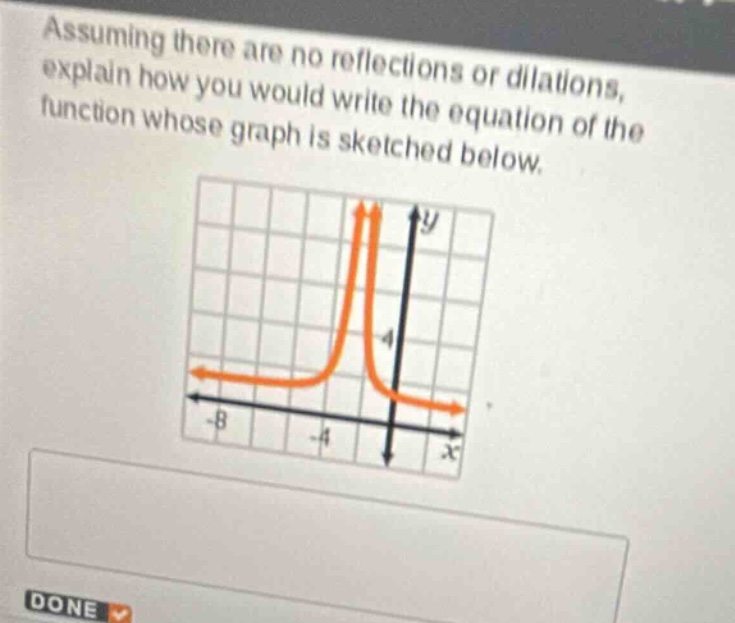
assuming there are no reflections or dilations, explain how you would write the equation of the function whose graph is sketched below.
⚡ Using what you learned: Identifying Restrictions and Asymptotes · 🆕 New: Graphing Rational Functions
Step 1: Identify the parent function
The graph has a vertical asymptote where both sides shoot up toward positive infinity. This "volcano" shape is characteristic of the parent reciprocal squared function:
Step 2: Find the vertical asymptote
By looking at the grid, the vertical asymptote (the vertical line the graph approaches but never touches) is located at:
To shift the parent function \( \frac{1}{x^2} \) horizontally to the left by \( 2 \) units, we replace \( x \) with \( (x + 2) \):
Step 3: Find the horizontal asymptote
The horizontal asymptote (the flat line the graph flattens out toward on the far left and far right) is located at:
To shift the graph vertically up by \( 1 \) unit, we add \( 1 \) to the entire function:

Snap & solve any problem in the app
Get step-by-step solutions on Sovi AI
Photo-based solutions with guided steps
Explore more problems and detailed explanations
To write the equation of the sketched graph:
- Identify the parent function: The "volcano" shape pointing upward on both sides of the vertical asymptote indicates the parent function is \( f(x) = \frac{1}{x^2} \).
- Determine the horizontal shift: The vertical asymptote is at \( x = -2 \). This represents a shift of \( 2 \) units to the left, which changes the denominator to \( (x + 2)^2 \).
- Determine the vertical shift: The horizontal asymptote is at \( y = 1 \). This represents a shift of \( 1 \) unit upward, which adds \( 1 \) to the function.
Combining these transformations, the equation is: