QUESTION IMAGE
Question
assignment
part 1: complete the operations geometrically.
use vector operations to draw the resultant vector.
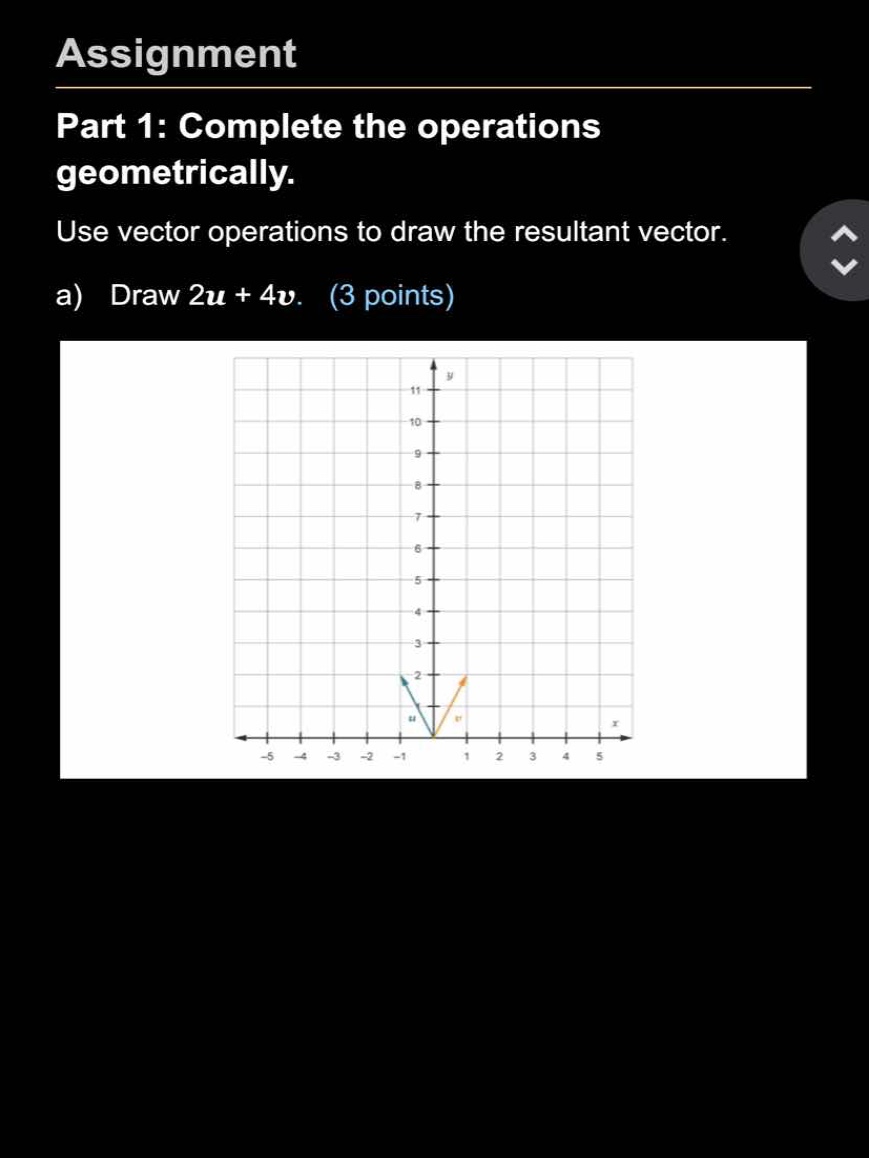
a) draw \\(2\mathbf{u} + 4\mathbf{v}\\). (3 points)
Identify the given vectors
We read the components of vectors \(\mathbf{u}\) and \(\mathbf{v}\) from the grid.
The initial point of both vectors is at the origin \((0,0)\).
The terminal point of \(\mathbf{u}\) (blue arrow) is at \((-1, 2)\).
Thus, \(\mathbf{u} = \langle -1, 2
angle\).
The terminal point of \(\mathbf{v}\) (orange arrow) is at \((1, 2)\).
Thus, \(\mathbf{v} = \langle 1, 2
angle\).
Calculate the scaled vectors
We multiply each vector by its respective scalar.
Find the resultant vector
We add the two scaled vectors together.
Describe the geometric construction
To draw the resultant vector geometrically:
- Draw \(2\mathbf{u}\) starting from the origin \((0,0)\) to \((-2, 4)\).
- From the tip of \(2\mathbf{u}\) at \((-2, 4)\), draw \(4\mathbf{v}\) moving \(4\) units right and \(8\) units up, ending at \((2, 12)\).
- Draw the resultant vector from the origin \((0,0)\) directly to the final point \((2, 12)\).

Snap & solve any problem in the app
Get step-by-step solutions on Sovi AI
Photo-based solutions with guided steps
Explore more problems and detailed explanations
To geometrically draw the resultant vector \(2\mathbf{u} + 4\mathbf{v}\):
- Identify the components of the given vectors:
- \(\mathbf{u} = \langle -1, 2
angle\)
- \(\mathbf{v} = \langle 1, 2
angle\)
- Calculate the scaled vectors:
- \(2\mathbf{u} = \langle -2, 4
angle\)
- \(4\mathbf{v} = \langle 4, 8
angle\)
- Calculate the resultant vector:
- \(2\mathbf{u} + 4\mathbf{v} = \langle 2, 12
angle\)
- Geometric Drawing Steps:
- Draw the vector \(2\mathbf{u}\) starting from the origin \((0,0)\) to the point \((-2, 4)\).
- From the terminal point \((-2, 4)\), draw the vector \(4\mathbf{v}\) (which goes \(4\) units to the right and \(8\) units up) to reach the terminal point \((2, 12)\).
- Draw the final resultant vector arrow starting from the origin \((0,0)\) and pointing directly to \((2, 12)\).