QUESTION IMAGE
Question
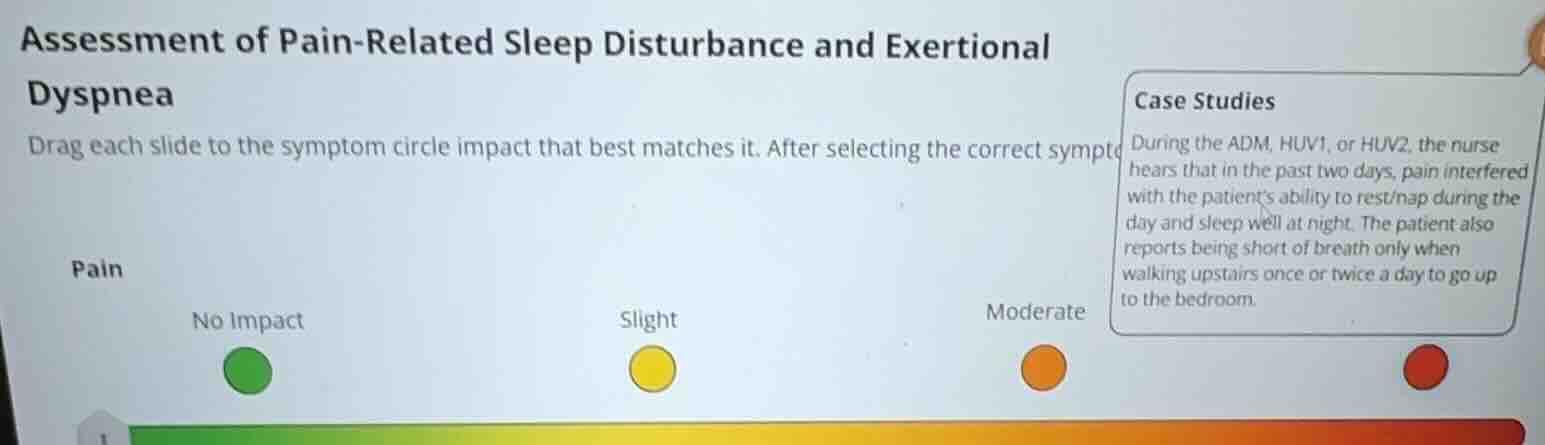
assessment of pain-related sleep disturbance and exertional dyspnea
drag each slide to the symptom circle impact that best matches it. after selecting the correct symptom
case studies
during the adm, huv1, or huv2, the nurse hears that in the past two days, pain interfered with the patients ability to rest/nap during the day and sleep well at night. the patient also reports being short of breath only when walking upstairs once or twice a day to go up to the bedroom.
pain
no impact
slight
moderate
Analyze the case study details
The patient's case study states: "During the ADM, HUV1, or HUV2, the nurse hears that in the past two days, pain interfered with the patient's ability to rest/nap during the day and sleep well at night."
Determine the impact level of pain
The patient reports that pain directly interfered with both daytime rest and nighttime sleep over the past two days. This indicates a significant, noticeable disruption to daily living activities (sleeping and resting), which goes beyond "No Impact" or "Slight" impact. However, it does not completely incapacitate the patient. Therefore, this level of disruption is classified as "Moderate".
Match with the correct visual indicator
On the assessment scale shown in the image:
- Green circle represents "No Impact".
- Yellow circle represents "Slight".
- Orange circle represents "Moderate".
- Red circle represents the highest level of impact (Severe).
The moderate impact matches the orange circle.

Snap & solve any problem in the app
Get step-by-step solutions on Sovi AI
Photo-based solutions with guided steps
Explore more problems and detailed explanations
Based on the case study, the pain interfered with the patient's ability to rest during the day and sleep at night, which represents a Moderate impact.
Therefore, the slide should be dragged to the orange circle (Moderate).