QUESTION IMAGE
Question
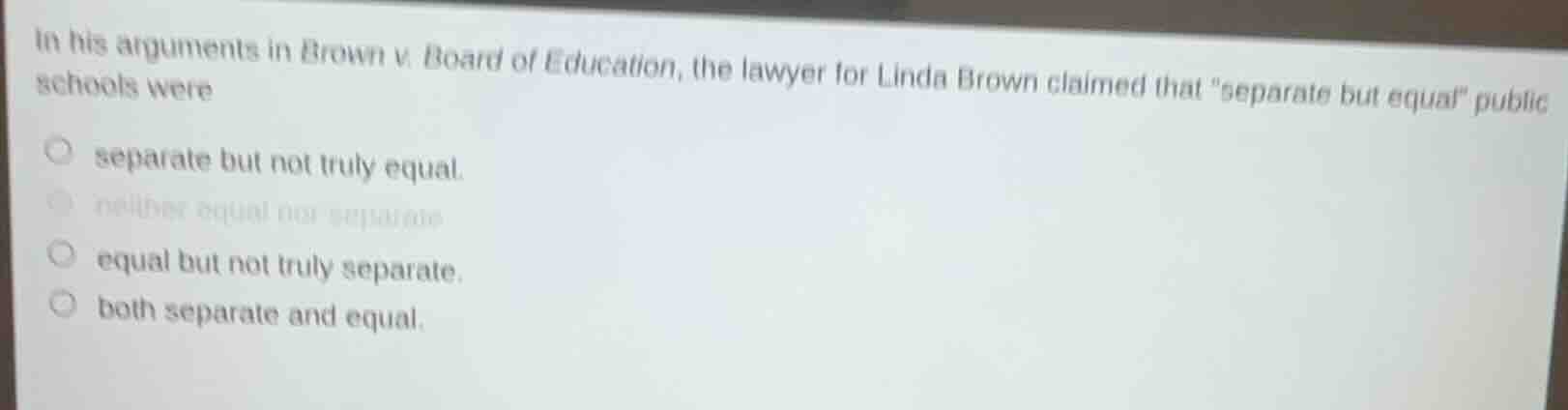
in his arguments in brown v. board of education, the lawyer for linda brown claimed that \separate but equal\ public schools were
separate but not truly equal.
neither equal nor separate.
equal but not truly separate.
both separate and equal.
Identify the core legal argument in Brown v. Board of Education
The question asks about the argument made by the lawyer for Linda Brown (Thurgood Marshall and the NAACP legal team) regarding "separate but equal" public schools.
Analyze the historical context of the case
The plaintiffs argued that segregated public schools were not equal and could never be made equal. Therefore, the doctrine of "separate but equal" established by Plessy v. Ferguson was inherently flawed because the segregated facilities were separate but not truly equal.
Evaluate the given options
- "separate but not truly equal": This matches the core argument that while the schools were physically separate, they were unequal in quality, resources, and psychological impact.
- "neither equal nor separate": Incorrect, as the schools were physically segregated (separate).
- "equal but not truly separate": Incorrect, as they were physically separate but unequal.
- "both separate and equal": Incorrect, as this was the segregationist defense, not the plaintiff's claim.

Snap & solve any problem in the app
Get step-by-step solutions on Sovi AI
Photo-based solutions with guided steps
Explore more problems and detailed explanations
- (A) separate but not truly equal. (Correct answer)
- (B) neither equal nor separate.
- (C) equal but not truly separate.
- (D) both separate and equal.