QUESTION IMAGE
Question
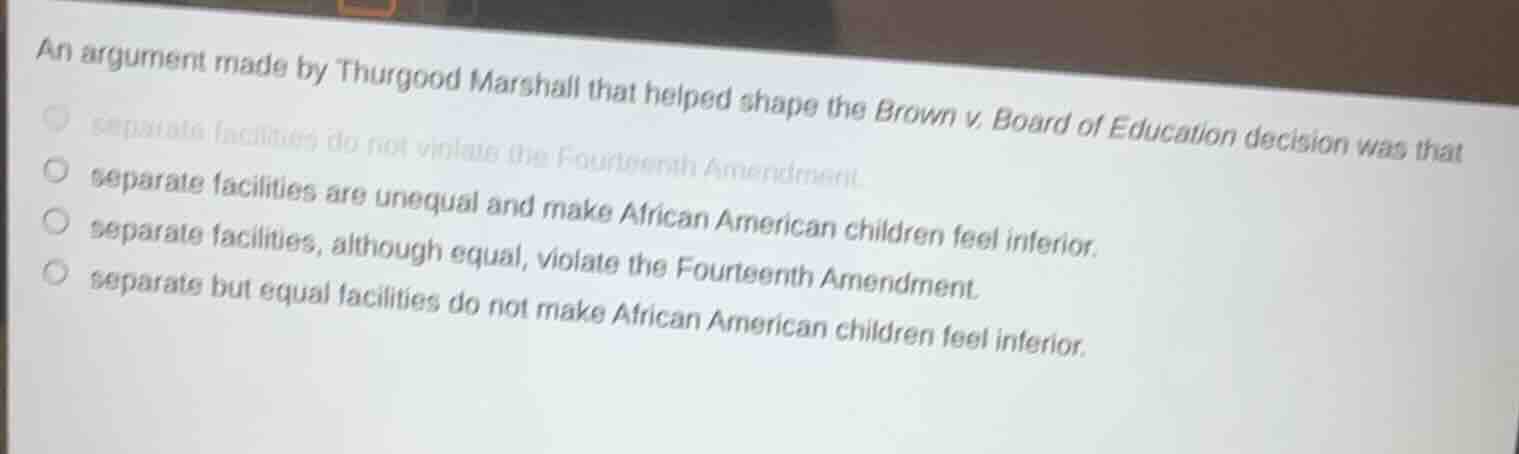
an argument made by thurgood marshall that helped shape the brown v. board of education decision was that
separate facilities do not violate the fourteenth amendment.
separate facilities are unequal and make african american children feel inferior.
separate facilities, although equal, violate the fourteenth amendment.
separate but equal facilities do not make african american children feel inferior.
Analyze Thurgood Marshall's argument
Thurgood Marshall, representing the NAACP, argued that state-mandated segregation in public schools was inherently unequal. He utilized sociological and psychological evidence, such as the famous "doll tests" conducted by Kenneth and Mamie Clark, to demonstrate that segregation inflicted psychological harm by generating a feeling of inferiority among African American children.
Evaluate the given options
- Option 1: "separate facilities do not violate the Fourteenth Amendment" — Incorrect, as Marshall argued they did violate the Equal Protection Clause.
- Option 2: "separate facilities are unequal and make African American children feel inferior" — Correct, as this directly reflects his core argument regarding the psychological damage of segregation.
- Option 3: "separate facilities, although equal, violate the Fourteenth Amendment" — Incorrect, because his argument was that separate facilities are inherently unequal.
- Option 4: "separate but equal facilities do not make African American children feel inferior" — Incorrect, as this contradicts his central psychological argument.

Snap & solve any problem in the app
Get step-by-step solutions on Sovi AI
Photo-based solutions with guided steps
Explore more problems and detailed explanations
- (A) separate facilities do not violate the Fourteenth Amendment.
- (B) separate facilities are unequal and make African American children feel inferior. (Correct answer)
- (C) separate facilities, although equal, violate the Fourteenth Amendment.
- (D) separate but equal facilities do not make African American children feel inferior.