QUESTION IMAGE
Question
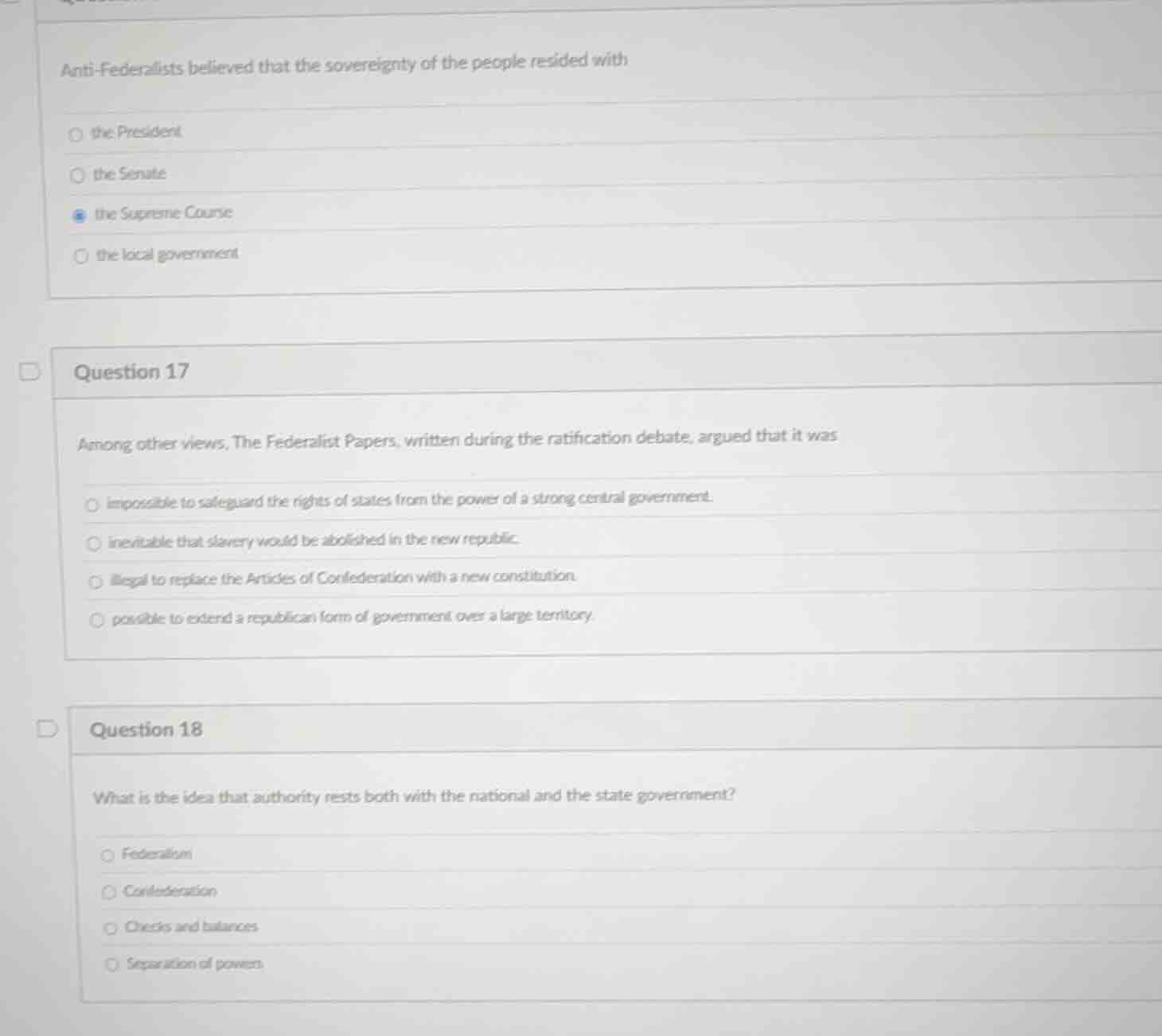
anti-federalists believed that the sovereignty of the people resided with
the president
the senate
the supreme court
the local government
question 17
among other views, the federalist papers, written during the ratification debate, argued that it was
impossible to safeguard the rights of states from the power of a strong central government.
inevitable that slavery would be abolished in the new republic.
illegal to replace the articles of confederation with a new constitution.
possible to extend a republican form of government over a large territory.
question 18
what is the idea that authority rests both with the national and the state government?
federalism
confederation
checks and balances
separation of powers
<pre_analysis>
{
"quality": "clear",
"question_count": 3,
"skills_matched": [
"direct_cot",
"multiple_choice_formatter",
"explain_then_answer",
"quick"
],
"needs_drawing": false,
"concepts_used": [
"Federalists and Anti-Federalists",
"Federalism"
],
"new_concepts": [
"The Federalist Papers",
"Republicanism over Large Territory"
],
"current_concepts": [
"Federalists and Anti-Federalists",
"The Federalist Papers",
"Federalism"
]
}
</pre_analysis>
<reasoning>
Analyze sovereignty in Anti-Federalist thought
Anti-Federalists strongly opposed a highly centralized national government, believing that true popular sovereignty and liberty could only be preserved at the local level, close to the citizens. Therefore, they argued that sovereignty resided with the local or state governments rather than national institutions like the President, Senate, or Supreme Court.
Analyze the argument of The Federalist Papers
In Federalist No. 10, James Madison famously argued against the traditional political theory that republics could only exist in small territories. He asserted that an extended republic would actually be more stable and better suited to control the influence of factions, making it possible to extend a republican form of government over a large territory.
Define shared national and state authority
The system of government where power and authority are divided and shared between a central national government and individual state governments is the definition of federalism.
</reasoning>
<answer>
Question 16
<mcq-option>(A) the President</mcq-option>
<mcq-option>(B) the Senate</mcq-option>
<mcq-option>(C) the Supreme Court</mcq-option>
<mcq-correct>(D) the local government</mcq-correct>
Question 17
<mcq-option>(A) impossible to safeguard the rights of states from the power of a strong central government.</mcq-option>
<mcq-option>(B) inevitable that slavery would be abolished in the new republic.</mcq-option>
<mcq-option>(C) illegal to replace the Articles of Confederation with a new constitution.</mcq-correct>
<mcq-correct>(D) possible to extend a republican form of government over a large territory.</mcq-correct>
Question 18
<mcq-correct>(A) Federalism</mcq-correct>
<mcq-option>(B) Confederation</mcq-option>
<mcq-option>(C) Checks and balances</mcq-option>
<mcq-option>(D) Separation of powers</mcq-option>
</answer>
<post_analysis>
{
"subject": "Social Science",
"question_type": "Multiple Choice",
"knowledge_point": [
"Social Science",
"U.S. History",
"Constitutional Era and Federalism"
]
}
</post_analysis>
Snap & solve any problem in the app
Get step-by-step solutions on Sovi AI
Photo-based solutions with guided steps
Explore more problems and detailed explanations
<pre_analysis>
{
"quality": "clear",
"question_count": 3,
"skills_matched": [
"direct_cot",
"multiple_choice_formatter",
"explain_then_answer",
"quick"
],
"needs_drawing": false,
"concepts_used": [
"Federalists and Anti-Federalists",
"Federalism"
],
"new_concepts": [
"The Federalist Papers",
"Republicanism over Large Territory"
],
"current_concepts": [
"Federalists and Anti-Federalists",
"The Federalist Papers",
"Federalism"
]
}
</pre_analysis>
<reasoning>
Analyze sovereignty in Anti-Federalist thought
Anti-Federalists strongly opposed a highly centralized national government, believing that true popular sovereignty and liberty could only be preserved at the local level, close to the citizens. Therefore, they argued that sovereignty resided with the local or state governments rather than national institutions like the President, Senate, or Supreme Court.
Analyze the argument of The Federalist Papers
In Federalist No. 10, James Madison famously argued against the traditional political theory that republics could only exist in small territories. He asserted that an extended republic would actually be more stable and better suited to control the influence of factions, making it possible to extend a republican form of government over a large territory.
Define shared national and state authority
The system of government where power and authority are divided and shared between a central national government and individual state governments is the definition of federalism.
</reasoning>
<answer>
Question 16
<mcq-option>(A) the President</mcq-option>
<mcq-option>(B) the Senate</mcq-option>
<mcq-option>(C) the Supreme Court</mcq-option>
<mcq-correct>(D) the local government</mcq-correct>
Question 17
<mcq-option>(A) impossible to safeguard the rights of states from the power of a strong central government.</mcq-option>
<mcq-option>(B) inevitable that slavery would be abolished in the new republic.</mcq-option>
<mcq-option>(C) illegal to replace the Articles of Confederation with a new constitution.</mcq-correct>
<mcq-correct>(D) possible to extend a republican form of government over a large territory.</mcq-correct>
Question 18
<mcq-correct>(A) Federalism</mcq-correct>
<mcq-option>(B) Confederation</mcq-option>
<mcq-option>(C) Checks and balances</mcq-option>
<mcq-option>(D) Separation of powers</mcq-option>
</answer>
<post_analysis>
{
"subject": "Social Science",
"question_type": "Multiple Choice",
"knowledge_point": [
"Social Science",
"U.S. History",
"Constitutional Era and Federalism"
]
}
</post_analysis>