QUESTION IMAGE
Question
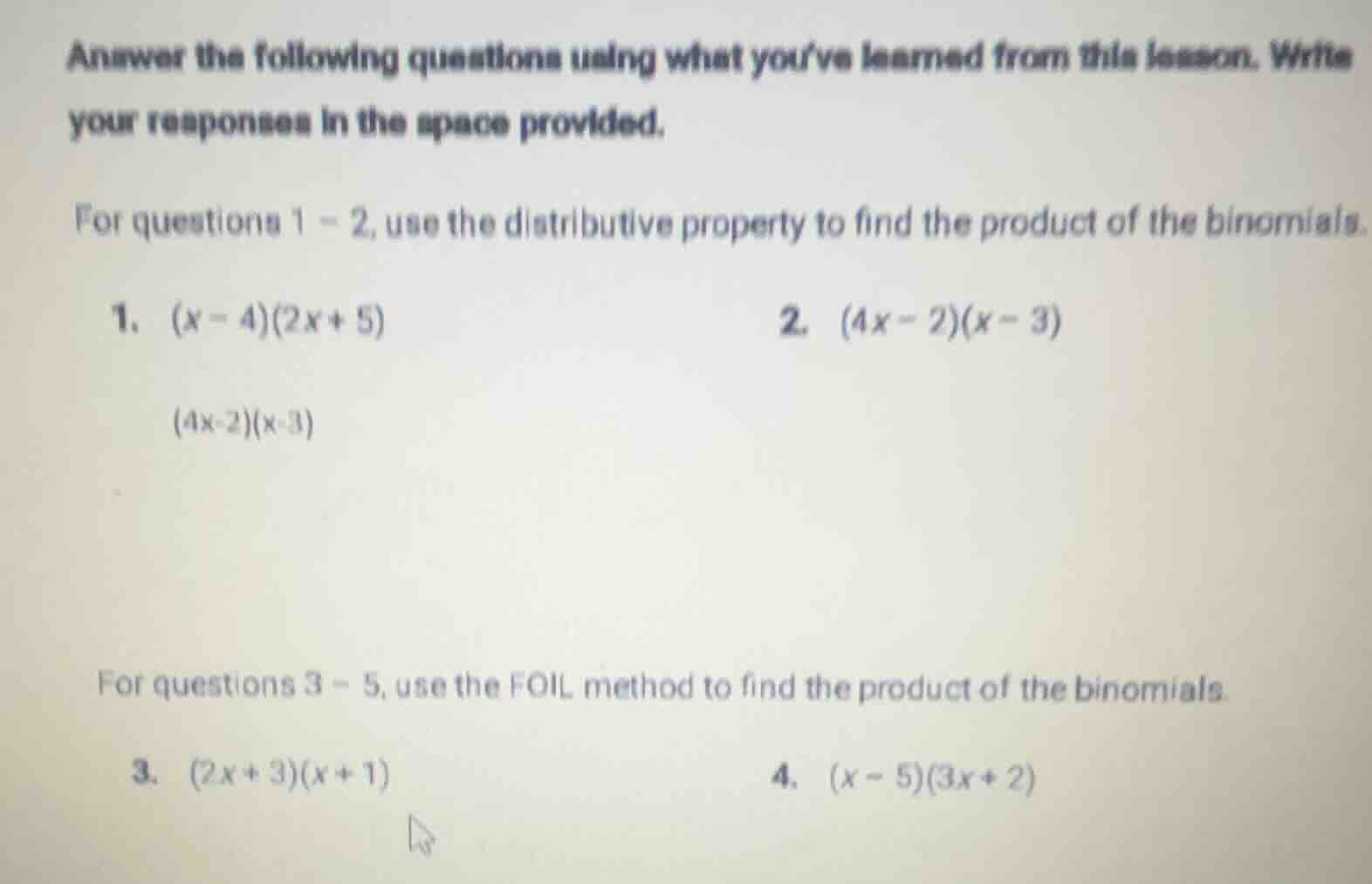
answer the following questions using what you’ve learned from this lesson. write your responses in the space provided.
for questions 1 - 2, use the distributive property to find the product of the binomials.
- ((x - 4)(2x + 5)) 2. ((4x - 2)(x - 3))
((4x - 2)(x - 3))
for questions 3 - 5, use the foil method to find the product of the binomials.
- ((2x + 3)(x + 1)) 4. ((x - 5)(3x + 2))
Question 1: \((x - 4)(2x + 5)\)
Step 1: Apply distributive property (FOIL)
Multiply \(x\) by \((2x + 5)\) and \(-4\) by \((2x + 5)\):
\(x(2x + 5) - 4(2x + 5)\)
Step 2: Distribute further
\(x \cdot 2x + x \cdot 5 - 4 \cdot 2x - 4 \cdot 5\)
\(2x^2 + 5x - 8x - 20\)
Step 3: Combine like terms
\(2x^2 + (5x - 8x) - 20\)
\(2x^2 - 3x - 20\)
Step 1: Apply distributive property (FOIL)
Multiply \(4x\) by \((x - 3)\) and \(-2\) by \((x - 3)\):
\(4x(x - 3) - 2(x - 3)\)
Step 2: Distribute further
\(4x \cdot x - 4x \cdot 3 - 2 \cdot x + 2 \cdot 3\)
\(4x^2 - 12x - 2x + 6\)
Step 3: Combine like terms
\(4x^2 + (-12x - 2x) + 6\)
\(4x^2 - 14x + 6\)
Step 1: FOIL method (First, Outer, Inner, Last)
- First: \(2x \cdot x = 2x^2\)
- Outer: \(2x \cdot 1 = 2x\)
- Inner: \(3 \cdot x = 3x\)
- Last: \(3 \cdot 1 = 3\)
Step 2: Combine terms
\(2x^2 + 2x + 3x + 3\)
Step 3: Combine like terms
\(2x^2 + (2x + 3x) + 3\)
\(2x^2 + 5x + 3\)

Snap & solve any problem in the app
Get step-by-step solutions on Sovi AI
Photo-based solutions with guided steps
Explore more problems and detailed explanations
\(2x^2 - 3x - 20\)