QUESTION IMAGE
Question
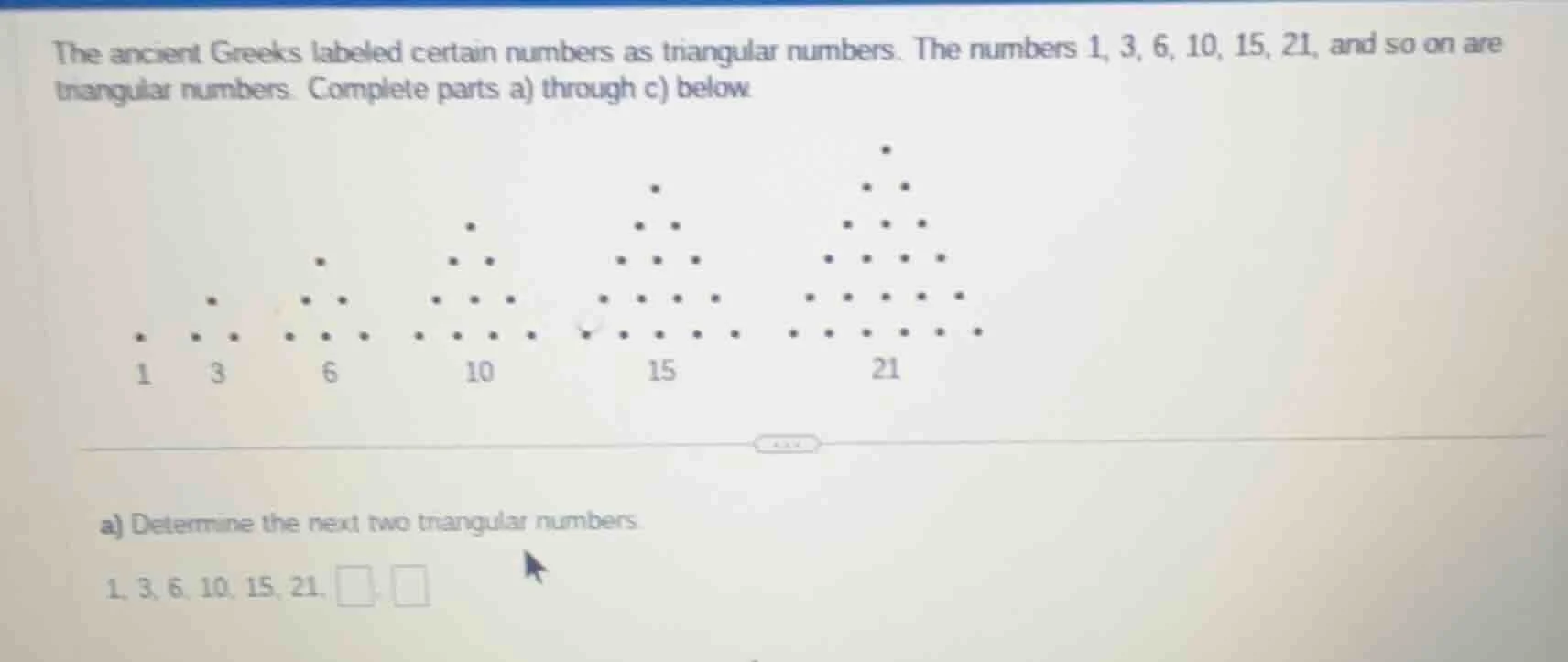
the ancient greeks labeled certain numbers as triangular numbers. the numbers 1, 3, 6, 10, 15, 21, and so on are triangular numbers. complete parts a) through c) below
(images of dot patterns for 1, 3, 6, 10, 15, 21)
a) determine the next two triangular numbers.
1, 3, 6, 10, 15, 21, \square, \square
Step1: Identify pattern of differences
The differences between consecutive triangular numbers increase by 1 each time: $3-1=2$, $6-3=3$, $10-6=4$, $15-10=5$, $21-15=6$.
Step2: Calculate first next number
Add 7 to 21 (since the next difference is 7).
$21 + 7 = 28$
Step3: Calculate second next number
Add 8 to 28 (since the following difference is 8).
$28 + 8 = 36$

Snap & solve any problem in the app
Get step-by-step solutions on Sovi AI
Photo-based solutions with guided steps
Explore more problems and detailed explanations
28, 36