QUESTION IMAGE
Question
analyzing use of the quadratic formula
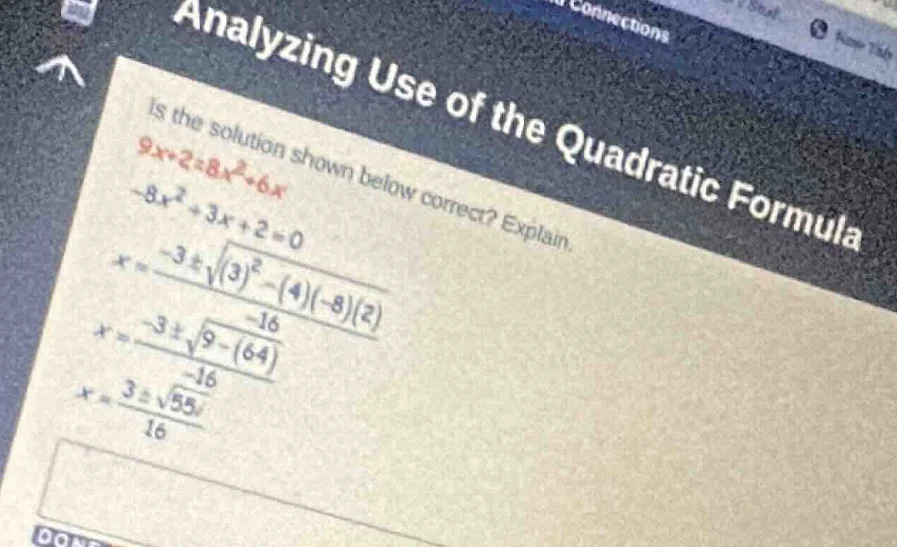
is the solution shown below correct? explain.
$9x + 2 = 8x^2 + 6x$
$-8x^2 + 3x + 2 = 0$
$x = \frac{-3 \pm \sqrt{(3)^2 - (4)(-8)(2)}}{-16}$
$x = \frac{-3 \pm \sqrt{9 - (64)}}{-16}$
$x = \frac{3 \pm \sqrt{55}}{16}$
Step1: Recall Quadratic Formula
The quadratic formula for \(ax^2 + bx + c = 0\) is \(x=\frac{-b\pm\sqrt{b^2 - 4ac}}{2a}\). First, we need to get the quadratic equation in standard form correctly. The original equation is \(9x + 2=8x^2+6x\). Rearranging terms: \(8x^2+6x - 9x - 2 = 0\), so \(8x^2 - 3x - 2 = 0\). Wait, but in the solution, they have \(-8x^2+3x + 2 = 0\). Let's check that rearrangement: \(9x + 2-8x^2 - 6x = 0\) simplifies to \(-8x^2 + 3x + 2 = 0\). So \(a=-8\), \(b = 3\), \(c = 2\).
Step2: Check Discriminant Calculation
Discriminant is \(b^2-4ac\). Plugging \(a=-8\), \(b = 3\), \(c = 2\): \(3^2-4\times(-8)\times2=9 + 64=73\). But in the solution, they calculated \(9-(64)\) (wait, \(4\times(-8)\times2=-64\), so \(-4ac=-4\times(-8)\times2 = 64\), so \(b^2-4ac=9 + 64 = 73\), not \(9 - 64\)). Also, the quadratic formula denominator is \(2a\), here \(a=-8\), so \(2a=-16\), but in the last step, they have denominator \(16\) (they took absolute value or messed up the sign). Also, the numerator: original \(x=\frac{-b\pm\sqrt{...}}{2a}\), \(b = 3\), so \(-b=-3\), but in the last step, they have \(3\pm\sqrt{55}\), which is incorrect because discriminant was miscalculated.
Step3: Identify Errors
- When rearranging the equation, let's do it properly: \(9x + 2 = 8x^2 + 6x\) → \(0 = 8x^2 + 6x - 9x - 2\) → \(8x^2 - 3x - 2 = 0\) (or multiplying both sides by -1: \(-8x^2 + 3x + 2 = 0\), which is what they did, so \(a=-8\), \(b = 3\), \(c = 2\) is correct here).
- Discriminant calculation: \(b^2-4ac=(3)^2-4\times(-8)\times(2)=9 + 64 = 73\), but in the solution, they have \(9-(64)\) (which is wrong, it should be \(9 + 64\)).
- Denominator: \(2a = 2\times(-8)=-16\), but in the last step, they have \(16\) (they probably took \(\frac{-b\pm\sqrt{...}}{2a}=\frac{-3\pm\sqrt{73}}{-16}=\frac{3\mp\sqrt{73}}{16}\), but their discriminant is wrong, and they have \(\sqrt{55}\) which is incorrect). Also, the middle step has \(\sqrt{9 - 64}\) which is \(\sqrt{-55}\), but they wrote \(\sqrt{55}\) later, and messed up signs.

Snap & solve any problem in the app
Get step-by-step solutions on Sovi AI
Photo-based solutions with guided steps
Explore more problems and detailed explanations
The solution is incorrect. Errors include: (1) Miscalculating the discriminant (\(b^2 - 4ac\) should be \(9 + 64 = 73\), not \(9 - 64\)); (2) Incorrectly handling the denominator (\(2a=-16\), not \(16\) in the final step without proper sign adjustment); (3) Incorrect numerator sign and discriminant value in the final step. The correct discriminant is \(73\), and the solution steps have multiple arithmetic and sign errors.