QUESTION IMAGE
Question
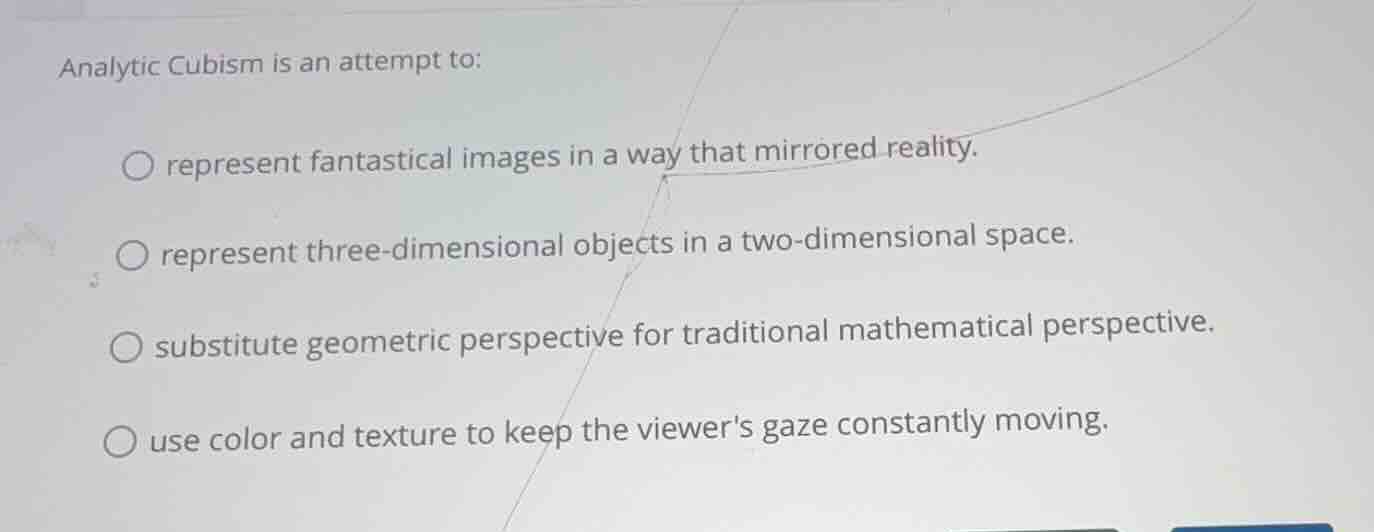
analytic cubism is an attempt to:
represent fantastical images in a way that mirrored reality.
represent three-dimensional objects in a two-dimensional space.
substitute geometric perspective for traditional mathematical perspective.
use color and texture to keep the viewers gaze constantly moving.
🆕 New Concept Discovered: Art History Analysis
Understanding core goals of major art movements.
Step 1: Define Analytic Cubism
Analytic Cubism was the first phase of the Cubist art movement, developed by Pablo Picasso and Georges Braque between 1909 and 1912.
The core philosophy of this movement was to reject the traditional, single-viewpoint perspective that had dominated Western art since the Renaissance. Instead of painting an object from one fixed angle, Cubists analyzed the subject by breaking it down into basic geometric forms and depicting it from multiple viewpoints simultaneously.
Step 2: Evaluate the Options
- "represent fantastical images in a way that mirrored reality"
- Incorrect: Cubism focused on real-world subjects (like people, musical instruments, and still lifes) rather than fantastical or dream-like imagery, which is more characteristic of Surrealism.
- "represent three-dimensional objects in a two-dimensional space"
- Correct: By showing multiple angles of a three-dimensional object at the same time on a flat, two-dimensional canvas, Analytic Cubism attempted to represent the true, multi-dimensional nature of objects without relying on the illusion of depth.
- "substitute geometric perspective for traditional mathematical perspective"
- Incorrect: Cubists did not substitute one systematic perspective for another; they abandoned traditional perspective entirely to show multiple viewpoints at once.
- "use color and texture to keep the viewer's gaze constantly moving"
- Incorrect: Analytic Cubism actually used a very limited, monochromatic color palette (mostly browns, grays, and ochres) to prevent color from distracting the viewer from the structural analysis of the forms.

Snap & solve any problem in the app
Get step-by-step solutions on Sovi AI
Photo-based solutions with guided steps
Explore more problems and detailed explanations
represent three-dimensional objects in a two-dimensional space.