QUESTION IMAGE
Question
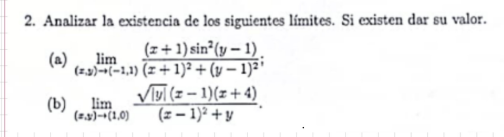
- analizar la existencia de los siguientes límites. si existen dar su valor.
(a) \\(\lim_{(x,y) \to (-1,1)} \frac{(x+1)\sin^2(y-1)}{(x+1)^2 + (y-1)^2}\\);
(b) \\(\lim_{(x,y) \to (1,0)} \frac{\sqrt{|y|}(x-1)(x+4)}{(x-1)^2 + y}\\).
🆕 New Concept Discovered: Multivariable Limits
Analyzing limits in two variables using substitution and path testing.
Step 1: Simplify part (a) using variable substitution
To analyze the limit
we can simplify the expression by shifting the limit point to the origin \( (0,0) \). Let:
As \( (x,y) \to (-1,1) \), we have \( (u,v) \to (0,0) \). Substituting these into the limit gives:
Step 2: Analyze part (a) using polar coordinates
We can convert the limit to polar coordinates where \( u = r\cos(\theta) \) and \( v = r\sin(\theta) \), with \( r \to 0 \):
Using the fundamental trigonometric limit \( \sin(w) \approx w \) as \( w \to 0 \), we can approximate \( \sin^2(r\sin(\theta)) \approx r^2\sin^2(\theta) \) for small \( r \):
Since \( |\cos(\theta)\sin^2(\theta)| \le 1 \) is bounded, taking the limit as \( r \to 0 \) yields:
Thus, the limit for part (a) exists and its value is \( 0 \).
Step 3: Simplify part (b) using variable substitution
For the second limit:
Let \( u = x - 1 \), which means \( x = u + 1 \). As \( (x,y) \to (1,0) \), we have \( (u,y) \to (0,0) \). Substituting these into the expression gives:
Step 4: Test paths for part (b) to check existence
To see if this limit exists, we can approach the origin \( (0,0) \) along different paths.
Path 1: Approach along the curve \( y = m u^2 \) (where \( m > 0 \)):
If we approach from the positive side \( u \to 0^+ \), then \( |u| = u \):
Since this value depends directly on the choice of \( m \) (the path chosen), approaching along different parabolic paths yields different limiting values.
Because the limit value is not unique, the limit in part (b) does not exist.

Snap & solve any problem in the app
Get step-by-step solutions on Sovi AI
Photo-based solutions with guided steps
Explore more problems and detailed explanations
(a) The limit exists and its value is \( 0 \).
(b) The limit does not exist.[LLM SSE On Failure]