QUESTION IMAGE
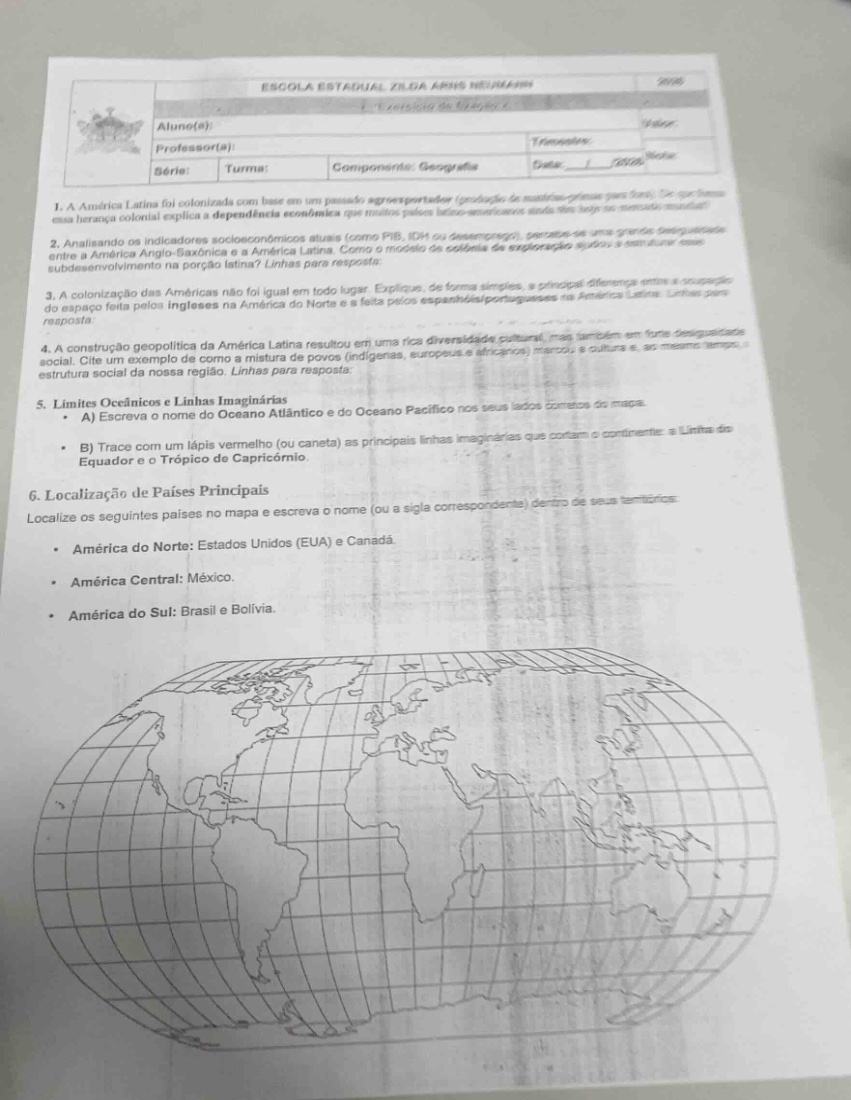
Question
- a américa latina foi colonizada com base em um passado agroexportador (produção de matérias-primas para fora). de que forma essa herança colonial explica a dependência econômica que muitos países latino-americanos ainda têm hoje no mercado mundial?
- analisando os indicadores socioeconômicos atuais (como pib, idh ou desemprego), percebe-se uma grande desigualdade entre a américa anglo-saxônica e a américa latina. como o modelo de colônia de exploração ajudou a estruturar esse subdesenvolvimento na porção latina? linhas para resposta:
- a colonização das américas não foi igual em todo lugar. explique, de forma simples, a principal diferença entre a ocupação do espaço feita pelos ingleses na américa do norte e a feita pelos espanhóis/portugueses na américa latina. linhas para resposta:
- a construção geopolítica da américa latina resultou em uma rica diversidade cultural, mas também em forte desigualdade social. cite um exemplo de como a mistura de povos (indígenas, europeus e africanos) marcou a cultura e, ao mesmo tempo, a estrutura social da nossa região. linhas para resposta:
- limites oceânicos e linhas imaginárias
- a) escreva o nome do oceano atlântico e do oceano pacífico nos seus lados corretos do mapa.
- b) trace com um lápis vermelho (ou caneta) as principais linhas imaginárias que cortam o continente: a linha do equador e o trópico de capricórnio.
- localização de países principais
localize os seguintes países no mapa e escreva o nome (ou a sigla correspondente) dentro de seus territórios:
- américa do norte: estados unidos (eua) e canadá.
- américa central: méxico.
- américa do sul: brasil e bolívia.
Analyze colonial economic legacy
Latin America's colonial model focused on resource extraction (agro-exportation). This established a dependency on exporting raw materials and importing manufactured goods, which persists today.
Compare socioeconomic indicators
Anglo-America's settler colonialism favored internal market development and education. Latin America's exploitation colonialism concentrated wealth and land, structuring long-term inequality and underdevelopment.
Contrast colonization models
English colonization in North America was predominantly settler-based, focusing on local development. Spanish and Portuguese colonization in Latin America was exploitation-based, focusing on extracting wealth for the metropoles.
Explain cultural and social diversity
The forced migration of enslaved Africans, displacement of indigenous peoples, and arrival of Europeans created a rich cultural syncretism, but also established rigid, racially-stratified social hierarchies.
Identify oceans and imaginary lines
The Atlantic Ocean lies east of the Americas; the Pacific Ocean lies west. The Equator cuts through northern South America, and the Tropic of Capricorn cuts through the southern portion.
Locate specified countries
Canada and the USA are in North America. Mexico is in Central/North America. Brazil and Bolivia are located in South America.

Snap & solve any problem in the app
Get step-by-step solutions on Sovi AI
Photo-based solutions with guided steps
Explore more problems and detailed explanations
Question 1
The colonial agro-export heritage focused Latin American economies on extracting raw materials for foreign markets. This created a structural dependency on external demand and foreign manufactured goods, limiting domestic industrial development.
Question 2
The exploitation colony model concentrated land, wealth, and power in the hands of a small colonial elite while exploiting indigenous and enslaved populations. This structured deep-seated social inequalities and limited public investment in education and infrastructure, leading to the lower GDP and HDI indicators observed today compared to Anglo-America.
Question 3
The main difference lies in their primary objectives: English colonization in North America was largely "settler colonization" (colônia de povoamento), aimed at establishing self-sustaining communities and developing local markets. In contrast, Spanish and Portuguese colonization in Latin America was "exploitation colonization" (colônia de exploração), designed to extract precious resources and agricultural goods to enrich the European metropoles.
Question 4
The mixing of indigenous, European, and African populations enriched Latin American culture through syncretic music, food, religion, and language. However, this process occurred under violent colonial structures (slavery and forced labor) that established a racialized social hierarchy, where wealth and privilege remained concentrated among European descendants, leaving indigenous and Afro-descendant populations marginalized.
Question 5
- A) Oceans:
- Atlantic Ocean (Oceano Atlântico): Write this name in the body of water to the east (right) of the American continent.
- Pacific Ocean (Oceano Pacífico): Write this name in the body of water to the west (left) of the American continent.
- B) Imaginary Lines:
- Equator (Linha do Equador): Trace a red line horizontally across the northern part of South America (passing through northern Brazil, Colombia, and Ecuador).
- Tropic of Capricorn (Trópico de Capricórnio): Trace a red line horizontally across the southern part of South America (passing through southern Brazil, Paraguay, Argentina, and Chile).
Question 6
- North America:
- Canada: Locate and label the northernmost country in North America.
- Estados Unidos (EUA): Locate and label the country directly south of Canada.
- Central America:
- México: Locate and label the country directly south of the United States.
- South America:
- Brasil: Locate and label the largest country in South America, occupying the eastern portion.
- Bolívia: Locate and label the landlocked country in the central-western part of South America, bordering Brazil to the north and east.