QUESTION IMAGE
Question
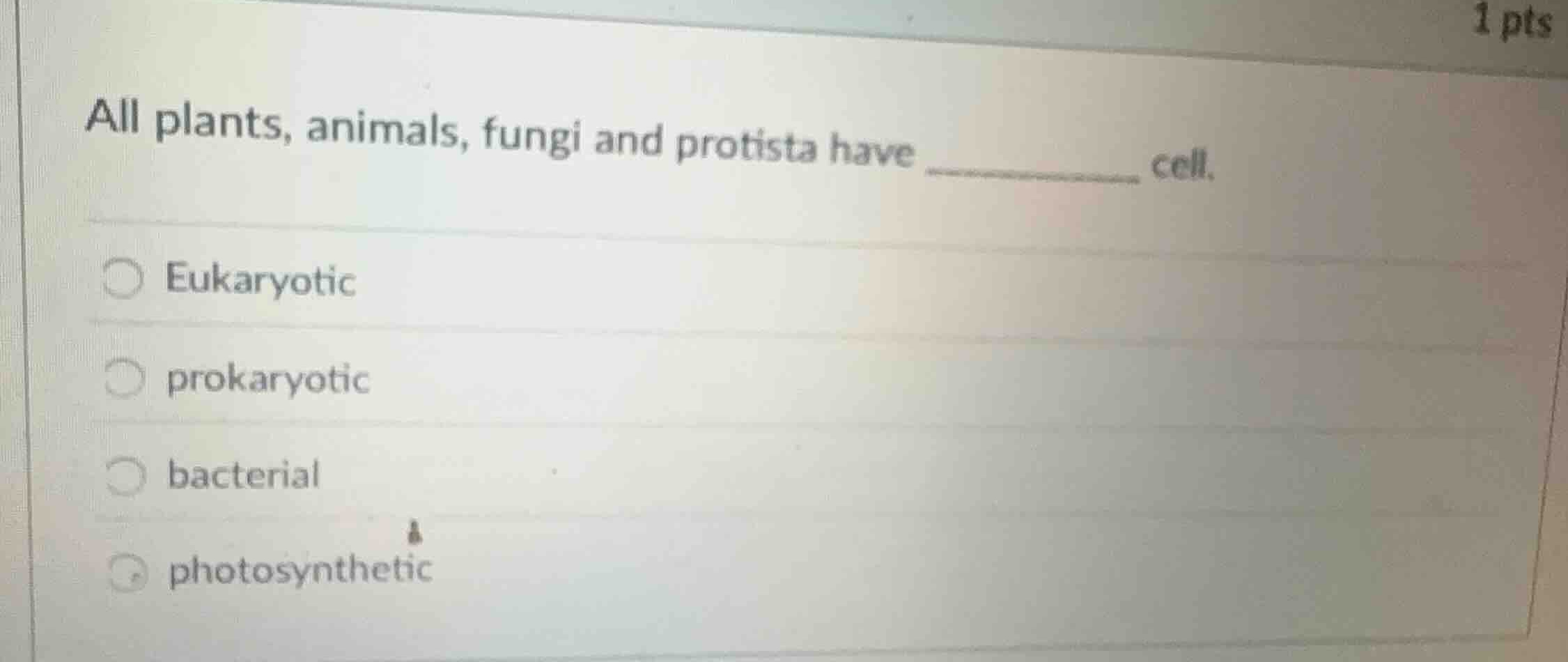
all plants, animals, fungi and protista have ________ cell.
- eukaryotic
- prokaryotic
- bacterial
- photosynthetic
🆕 New Concept Discovered: Cell Classification
Cells are grouped by whether they have a nucleus.
Step 1: Understand the two main cell types
Living organisms are divided into two primary categories based on their cellular structure:
- Prokaryotes (prokaryotic cells): Simple, single-celled organisms that lack a membrane-bound nucleus. Examples include bacteria and archaea.
- Eukaryotes (eukaryotic cells): More complex cells that contain a defined, membrane-bound nucleus housing their DNA, along with other specialized structures called organelles.
Step 2: Classify the given kingdoms
The question lists four major groups of organisms:
- Plants: Multicellular organisms with complex cells containing nuclei and organelles.
- Animals: Multicellular organisms with complex cells containing nuclei and organelles.
- Fungi: Organisms (like mushrooms and yeasts) with complex cells containing nuclei.
- Protista: Mostly single-celled (but some multicellular) organisms that possess a distinct nucleus.
Because all four of these kingdoms consist of organisms with a defined nucleus and membrane-bound organelles, they are classified as having eukaryotic cells.

Snap & solve any problem in the app
Get step-by-step solutions on Sovi AI
Photo-based solutions with guided steps
Explore more problems and detailed explanations
Eukaryotic