QUESTION IMAGE
Question
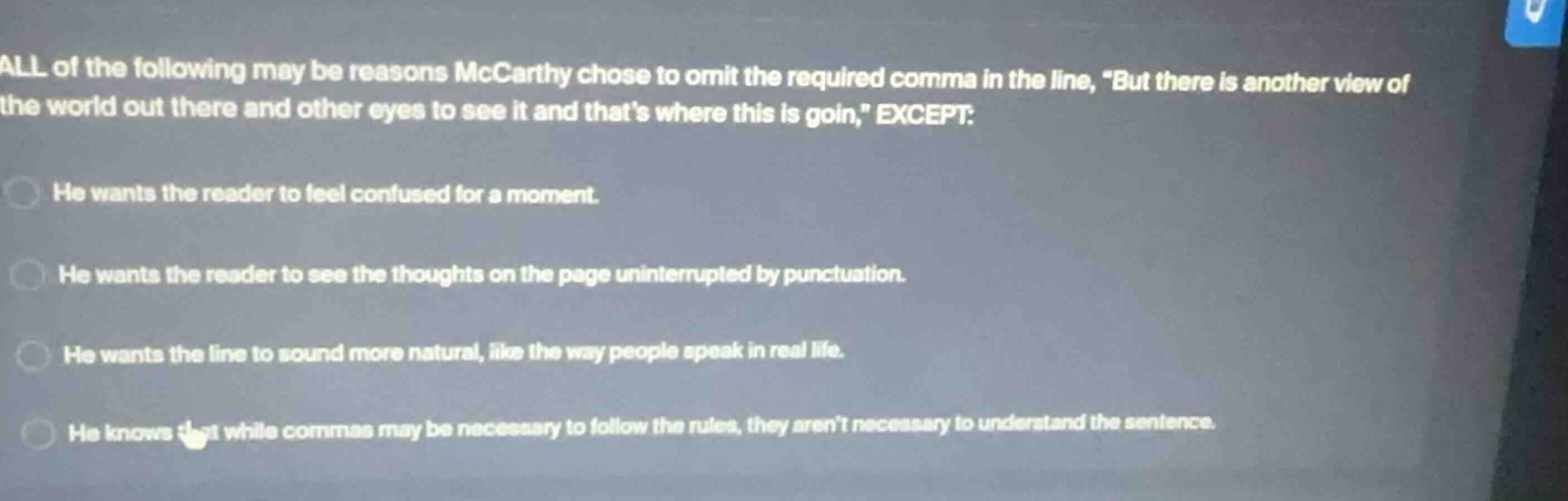
all of the following may be reasons mccarthy chose to omit the required comma in the line, \but there is another view of the world out there and other eyes to see it and thats where this is goin,\ except:
he wants the reader to feel confused for a moment.
he wants the reader to see the thoughts on the page uninterrupted by punctuation.
he wants the line to sound more natural, like the way people speak in real life.
he knows that while commas may be necessary to follow the rules, they arent necessary to understand the sentence.
Analyze the author's stylistic choice
Using the Stylistic Grammar Choices and Authorial Intent knowledge points
Cormac McCarthy is famous for his minimalist approach to punctuation, particularly his omission of commas in compound sentences. In the line, "But there is another view of the world out there and other eyes to see it and that's where this is goin," he deliberately leaves out commas before the coordinating conjunctions ("and").
Authors omit punctuation to create a continuous, uninterrupted flow of thoughts on the page, mimicking the natural cadence of spoken language or a stream of consciousness. This stylistic choice is built on the understanding that while commas are grammatically required by formal rules to separate independent clauses, they are not strictly necessary for a reader to comprehend the meaning of this specific sentence.
Evaluate the "EXCEPT" options
Using the Stylistic Grammar Choices and Authorial Intent knowledge points
Let's evaluate each option to find the one that is not a valid reason for McCarthy's stylistic choice:
- "He wants the reader to see the thoughts on the page uninterrupted by punctuation." — This is a standard reason for omitting punctuation (creating a stream-of-consciousness effect).
- "He wants the line to sound more natural, like the way people speak in real life." — This is a valid reason, as spoken English rarely has the distinct, rigid pauses that formal comma rules dictate.
- "He knows that while commas may be necessary to follow the rules, they aren't necessary to understand the sentence." — This is also a valid reason; the sentence remains perfectly legible and comprehensible without them.
- "He wants the reader to feel confused for a moment." — This is incorrect. McCarthy's stylistic omission of commas is intended to enhance the flow, rhythm, and voice of the narrative, not to intentionally cause confusion or make the text unreadable.

Snap & solve any problem in the app
Get step-by-step solutions on Sovi AI
Photo-based solutions with guided steps
Explore more problems and detailed explanations
- (A) He wants the reader to feel confused for a moment. (Correct answer)
- (B) He wants the reader to see the thoughts on the page uninterrupted by punctuation.
- (C) He wants the line to sound more natural, like the way people speak in real life.
- (D) He knows that while commas may be necessary to follow the rules, they aren't necessary to understand the sentence.