Sovi.AI - AI Math Tutor

Scan to solve math questions

QUESTION IMAGE

all of the following are false about conflict resolution except: * 2 po…

Question

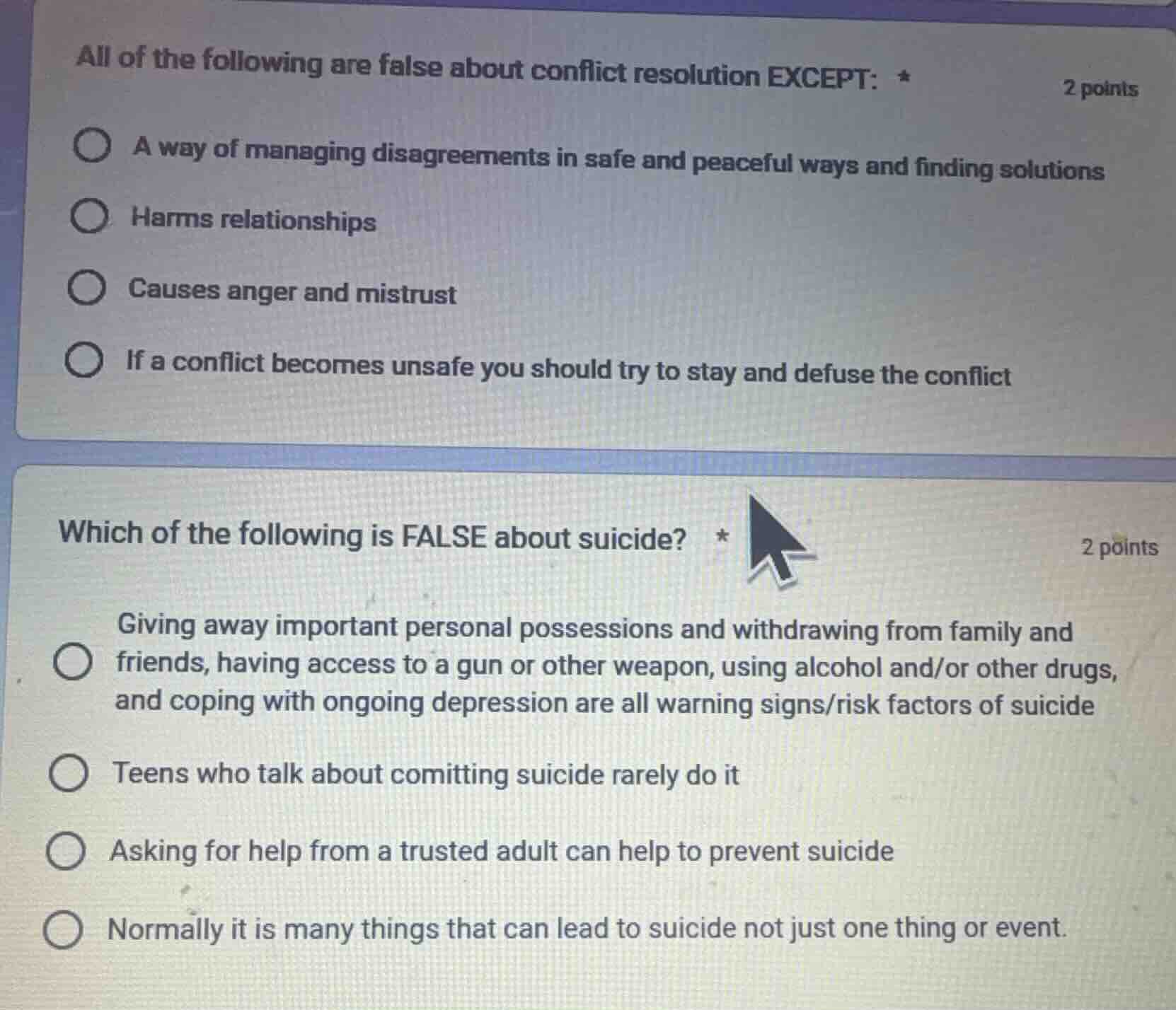
all of the following are false about conflict resolution except: *
2 points
a way of managing disagreements in safe and peaceful ways and finding solutions
harms relationships
causes anger and mistrust
if a conflict becomes unsafe you should try to stay and defuse the conflict

which of the following is false about suicide? *
2 points
giving away important personal possessions and withdrawing from family and friends, having access to a gun or other weapon, using alcohol and/or other drugs, and coping with ongoing depression are all warning signs/risk factors of suicide
teens who talk about committing suicide rarely do it
asking for help from a trusted adult can help to prevent suicide
normally it is many things that can lead to suicide not just one thing or event.

Explanation:

Response

<pre_analysis>
{
"quality": "clear",
"question_count": 2,
"skills_matched": [
"direct_cot",
"multiple_choice_formatter",
"explain_then_answer",
"tutor"
],
"needs_drawing": false,
"concepts_used": [
"Mental Health Disorders"
],
"new_concepts": [
"Conflict Resolution",
"Suicide Prevention Education"
],
"current_concepts": [
"Conflict Resolution",
"Mental Health Disorders",
"Suicide Prevention Education"
]
}
</pre_analysis>

<reasoning>

Analyze the first question on conflict resolution

The question asks: "All of the following are false about conflict resolution EXCEPT:". This double-negative phrasing means we are looking for the single statement that is true about conflict resolution.

  • "A way of managing disagreements in safe and peaceful ways and finding solutions": This is the definition of conflict resolution, making it a true statement.
  • "Harms relationships": This is false; successful conflict resolution strengthens relationships.
  • "Causes anger and mistrust": This is false; resolution aims to reduce anger and build trust.
  • "If a conflict becomes unsafe you should try to stay and defuse the conflict": This is false; if a situation becomes physically unsafe, the priority is to remove yourself and seek help, not stay.

Thus, the first option is the only true statement.

Analyze the second question on suicide myths and facts

The question asks: "Which of the following is FALSE about suicide?". We need to identify the incorrect statement among the choices.

  • "Giving away important possessions and withdrawing from family and friends, having access to a gun or other weapon, using alcohol and/or other drugs, and coping with ongoing depression are all warning signs/risk factors of suicide": This is a true statement.
  • "Teens who talk about committing suicide rarely do it": This is a dangerous myth and is false. Talking about suicide is a major warning sign and must always be taken seriously. This relates to Mental Health Disorders awareness.
  • "Asking for help from a trusted adult can help to prevent suicide": This is a true statement.
  • "Normally it is many things that can lead to suicide not just one thing or event": This is a true statement, as suicide is complex and usually involves multiple intersecting risk factors.

Thus, the second option is the false statement.
</reasoning>

<answer>

Question 1

<mcq-correct>(A) A way of managing disagreements in safe and peaceful ways and finding solutions</mcq-correct>
<mcq-option>(B) Harms relationships</mcq-option>
<mcq-option>(C) Causes anger and mistrust</mcq-option>
<mcq-option>(D) If a conflict becomes unsafe you should try to stay and defuse the conflict</mcq-option>

Question 2

<mcq-option>(A) Giving away important possessions and withdrawing from family and friends, having access to a gun or other weapon, using alcohol and/or other drugs, and coping with ongoing depression are all warning signs/risk factors of suicide</mcq-option>
<mcq-correct>(B) Teens who talk about comitting suicide rarely do it</mcq-correct>
<mcq-option>(C) Asking for help from a trusted adult can help to prevent suicide</mcq-option>
<mcq-option>(D) Normally it is many things that can lead to suicide not just one thing or event</mcq-option>
</answer>

<post_analysis>
{
"subject": "Social Science",
"question_type": "Multiple Choice",
"knowledge_point": [
"Social Science",
"Psychology",
"Mental Health and Conflict Resolution"
]
}
</post_analysis>

Answer:

<pre_analysis>
{
"quality": "clear",
"question_count": 2,
"skills_matched": [
"direct_cot",
"multiple_choice_formatter",
"explain_then_answer",
"tutor"
],
"needs_drawing": false,
"concepts_used": [
"Mental Health Disorders"
],
"new_concepts": [
"Conflict Resolution",
"Suicide Prevention Education"
],
"current_concepts": [
"Conflict Resolution",
"Mental Health Disorders",
"Suicide Prevention Education"
]
}
</pre_analysis>

<reasoning>

Analyze the first question on conflict resolution

The question asks: "All of the following are false about conflict resolution EXCEPT:". This double-negative phrasing means we are looking for the single statement that is true about conflict resolution.

  • "A way of managing disagreements in safe and peaceful ways and finding solutions": This is the definition of conflict resolution, making it a true statement.
  • "Harms relationships": This is false; successful conflict resolution strengthens relationships.
  • "Causes anger and mistrust": This is false; resolution aims to reduce anger and build trust.
  • "If a conflict becomes unsafe you should try to stay and defuse the conflict": This is false; if a situation becomes physically unsafe, the priority is to remove yourself and seek help, not stay.

Thus, the first option is the only true statement.

Analyze the second question on suicide myths and facts

The question asks: "Which of the following is FALSE about suicide?". We need to identify the incorrect statement among the choices.

  • "Giving away important possessions and withdrawing from family and friends, having access to a gun or other weapon, using alcohol and/or other drugs, and coping with ongoing depression are all warning signs/risk factors of suicide": This is a true statement.
  • "Teens who talk about committing suicide rarely do it": This is a dangerous myth and is false. Talking about suicide is a major warning sign and must always be taken seriously. This relates to Mental Health Disorders awareness.
  • "Asking for help from a trusted adult can help to prevent suicide": This is a true statement.
  • "Normally it is many things that can lead to suicide not just one thing or event": This is a true statement, as suicide is complex and usually involves multiple intersecting risk factors.

Thus, the second option is the false statement.
</reasoning>

<answer>

Question 1

<mcq-correct>(A) A way of managing disagreements in safe and peaceful ways and finding solutions</mcq-correct>
<mcq-option>(B) Harms relationships</mcq-option>
<mcq-option>(C) Causes anger and mistrust</mcq-option>
<mcq-option>(D) If a conflict becomes unsafe you should try to stay and defuse the conflict</mcq-option>

Question 2

<mcq-option>(A) Giving away important possessions and withdrawing from family and friends, having access to a gun or other weapon, using alcohol and/or other drugs, and coping with ongoing depression are all warning signs/risk factors of suicide</mcq-option>
<mcq-correct>(B) Teens who talk about comitting suicide rarely do it</mcq-correct>
<mcq-option>(C) Asking for help from a trusted adult can help to prevent suicide</mcq-option>
<mcq-option>(D) Normally it is many things that can lead to suicide not just one thing or event</mcq-option>
</answer>

<post_analysis>
{
"subject": "Social Science",
"question_type": "Multiple Choice",
"knowledge_point": [
"Social Science",
"Psychology",
"Mental Health and Conflict Resolution"
]
}
</post_analysis>