QUESTION IMAGE
Question
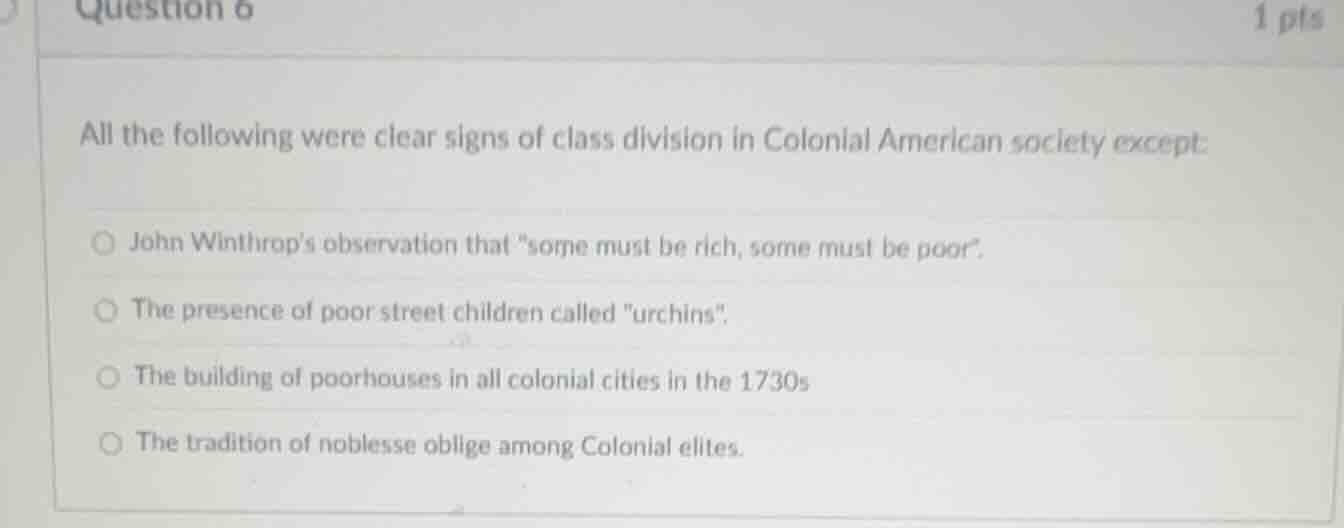
all the following were clear signs of class division in colonial american society except:
john winthrops observation that \some must be rich, some must be poor\.
the presence of poor street children called \urchins\.
the building of poorhouses in all colonial cities in the 1730s
the tradition of noblesse oblige among colonial elites.
Analyze the question prompt
The question asks for the option that was not a clear sign of class division in Colonial American society. This requires evaluating each option to see if it represents an actual historical indicator of economic stratification and class disparity.
Evaluate the first option
John Winthrop's famous sermon, "A Model of Christian Charity" (1630), explicitly states that "some must be rich, some poor." This is a direct, ideological acknowledgment of social and economic hierarchy from the very beginning of the Puritan colony, reflecting Colonial Class Conflict and stratification.
Evaluate the second and third options
The presence of impoverished street children ("urchins") and the construction of public poorhouses in major cities during the 1730s are concrete, material evidence of growing urban poverty and economic inequality in the colonies.
Evaluate the fourth option
The concept of noblesse oblige—the traditional European aristocratic obligation of the wealthy to act generously and responsibly toward the poor—was largely absent among Colonial American elites. Unlike European nobility, the colonial gentry did not have a deeply rooted, institutionalized tradition of paternalistic social responsibility to alleviate class divisions.
Formulate the final conclusion
Since noblesse oblige was not a widespread or established tradition among colonial elites to address or signal class division, it is the correct "except" choice.

Snap & solve any problem in the app
Get step-by-step solutions on Sovi AI
Photo-based solutions with guided steps
Explore more problems and detailed explanations
- (A) John Winthrop's observation that "some must be rich, some must be poor".
- (B) The presence of poor street children called "urchins".
- (C) The building of poorhouses in all colonial cities in the 1730s.
- (D) The tradition of noblesse oblige among Colonial elites. (Correct answer)