QUESTION IMAGE
Question
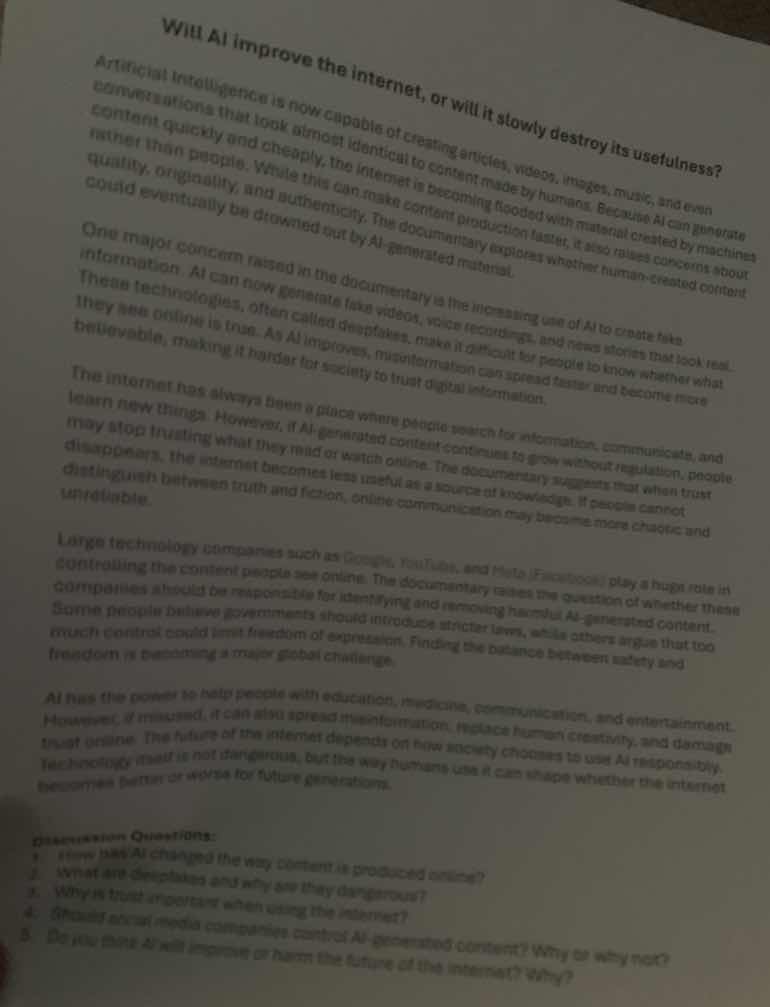
will ai improve the internet, or will it slowly destroy its usefulness?
artificial intelligence is now capable of creating articles, videos, images, music, and even conversations that look almost identical to content made by humans. because ai can generate content quickly and cheaply, the internet is becoming flooded with material created by machines rather than people. while this can make content production faster, it also raises concerns about quality, originality, and authenticity. the documentary explores whether human-created content could eventually be drowned out by ai-generated material.
one major concern raised in the documentary is the increasing use of ai to create fake information. ai can now generate fake videos, voice recordings, and news stories that look real. these technologies, often called deepfakes, make it difficult for people to know whether what they see online is true. as ai improves, misinformation can spread faster and become more believable, making it harder for society to trust digital information.
the internet has always been a place where people search for information, communicate, and learn new things. however, if ai-generated content continues to grow without regulation, people may stop trusting what they read or watch online. the documentary suggests that when trust disappears, the internet becomes less useful as a source of knowledge. if people cannot distinguish between truth and fiction, online communication may become more chaotic and unreliable.
large technology companies such as google, youtube, and meta (facebook) play a huge role in controlling the content people see online. the documentary raises the question of whether these companies should be responsible for identifying and removing harmful ai-generated content. some people believe governments should introduce stricter laws, while others argue that too much control could limit freedom of expression. finding the balance between safety and freedom is becoming a major global challenge.
ai has the power to help people with education, medicine, communication, and entertainment. however, if misused, it can also spread misinformation, replace human creativity, and damage trust online. the future of the internet depends on how society chooses to use ai responsibly. technology itself is not dangerous, but the way humans use it can shape whether the internet becomes better or worse for future generations.
discussion questions:
- how has ai changed the way content is produced online?
- what are deepfakes and why are they dangerous?
- why is trust important when using the internet?
- should social media companies control ai-generated content? why or why not?
- do you think ai will improve or harm the future of the internet? why?
Analyze AI content production
The first paragraph explains how AI has changed content production. We will use the AI-Generated Content concept to analyze this. The text states that AI can generate articles, videos, images, music, and conversations quickly and cheaply. This has flooded the internet with machine-created material, accelerating production speeds but raising concerns about quality, originality, and authenticity.
Define deepfakes and their dangers
The second paragraph introduces deepfakes. We will apply the Misinformation vs Disinformation concept here. Deepfakes are AI-generated fake videos, voice recordings, and news stories that look highly realistic. They are dangerous because they make it difficult for people to verify what is true, allowing misinformation to spread faster and become more believable, which ultimately damages societal trust in digital information.
Explain the importance of trust
The third paragraph discusses trust online. We will connect this to Digital Literacy. Trust is the foundation of using the internet as a reliable source of knowledge. If users cannot distinguish between truth and fiction, they may stop trusting what they read or watch. This makes online communication chaotic, unreliable, and significantly less useful.
Evaluate content regulation by tech companies
The fourth paragraph discusses the role of large technology companies (like Google, YouTube, and Meta) and governments in controlling content. This is a debate about regulation. Some believe these platforms must identify and remove harmful AI content, while others worry that too much control limits freedom of expression. Finding a balance between safety and free speech is a major global challenge.
Assess the future impact of AI
The final paragraph summarizes the dual nature of AI. It has positive potential in education, medicine, and communication, but carries risks of spreading misinformation and replacing human creativity. The future depends on responsible human use and societal choices rather than the technology itself.

Snap & solve any problem in the app
Get step-by-step solutions on Sovi AI
Photo-based solutions with guided steps
Explore more problems and detailed explanations
Question 1
AI has changed online content production by making it possible to generate articles, videos, images, music, and conversations much faster and cheaper than humans can. This has led to the internet becoming flooded with machine-created material, which raises concerns about the quality, originality, and authenticity of online content.
Question 2
Deepfakes are highly realistic, AI-generated fake videos, voice recordings, and news stories designed to look and sound real. They are dangerous because they make it extremely difficult for people to distinguish between real and fabricated media, allowing misinformation to spread rapidly and making it harder for society to trust digital information.
Question 3
Trust is crucial because the internet relies on being a useful source of knowledge, communication, and learning. If users cannot trust whether the information they encounter is true or false, the internet loses its utility, and online communication becomes chaotic, confusing, and unreliable.
Question 4
Whether social media companies should control AI-generated content is a complex debate with two main viewpoints:
- Yes, they should: Because these platforms host the content, they have a responsibility to protect users by identifying and removing harmful deepfakes and misinformation to maintain safety and trust.
- No, they should not (or only with strict limits): Because giving private tech giants too much control over what people can see and post could lead to censorship and limit freedom of expression.
Question 5
Whether AI will improve or harm the future of the internet depends on how humanity chooses to manage it:
- It could improve the internet by enhancing education, medicine, efficiency, and creative tools if used responsibly and with proper regulations.
- It could harm the internet if left unregulated, as unchecked misinformation, deepfakes, and a loss of digital trust could destroy the usefulness of the web.
Ultimately, the technology itself is not dangerous; its impact depends entirely on human choices and responsible digital citizenship.