QUESTION IMAGE
Question
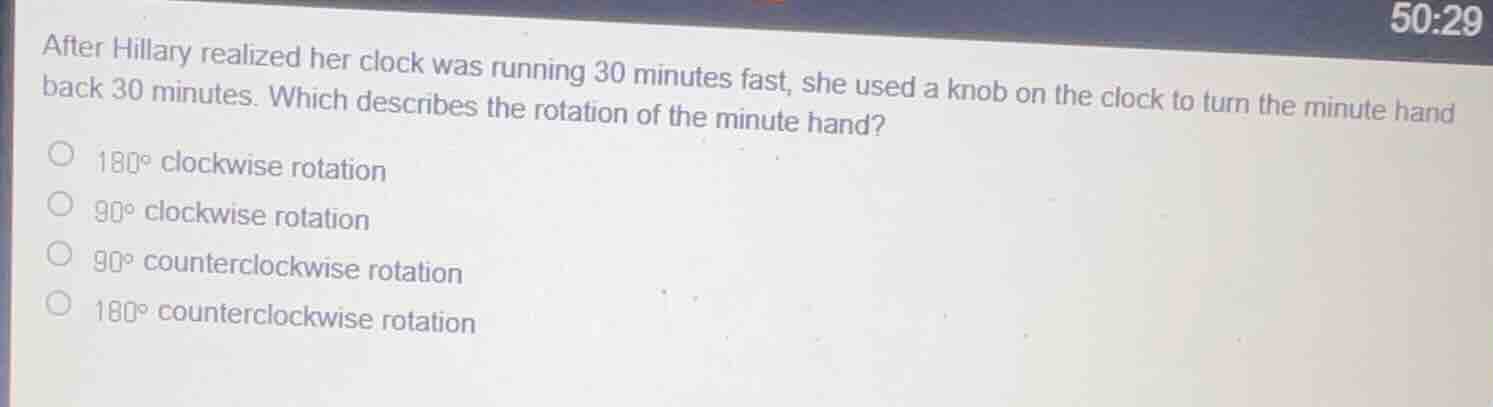
after hillary realized her clock was running 30 minutes fast, she used a knob on the clock to turn the minute hand back 30 minutes. which describes the rotation of the minute hand?
\\(180^\circ\\) clockwise rotation
\\(90^\circ\\) clockwise rotation
\\(90^\circ\\) counterclockwise rotation
\\(180^\circ\\) counterclockwise rotation
<pre_analysis>
{
"quality": "clear",
"question_count": 1,
"skills_matched": [
"step_cot",
"multiple_choice_formatter",
"explain_then_answer",
"quick"
],
"needs_drawing": false,
"concepts_used": [
"Clockwise Rotation Angle"
],
"new_concepts": [],
"current_concepts": [
"Clockwise Rotation Angle",
"Rotation Rules"
]
}
</pre_analysis>
<reasoning>
Determine the direction of rotation
To turn a clock hand back (earlier in time), we must rotate it in the direction opposite to its normal movement. Since a clock normally runs clockwise, turning the hand back requires a counterclockwise rotation.
Calculate the angle of rotation
A full circle represents \(360^\circ\) and corresponds to \(60\) minutes on a clock face.
\[
\text{Angle per minute} = \frac{360^\circ}{60} = 6^\circ/\text{minute}
\]
For a change of \(30\) minutes:
\[
\text{Angle} = 30 \times 6^\circ = 180^\circ
\]
Combine direction and angle
Combining the counterclockwise direction with the calculated angle of \(180^\circ\) yields a \(180^\circ\) counterclockwise rotation.
</reasoning>
<answer>
<mcq-option>(A) \(180^\circ\) clockwise rotation</mcq-option>
<mcq-option>(B) \(90^\circ\) clockwise rotation</mcq-option>
<mcq-option>(C) \(90^\circ\) counterclockwise rotation</mcq-option>
<mcq-correct>(D) \(180^\circ\) counterclockwise rotation</mcq-correct>
</answer>
<post_analysis>
{
"subject": "Mathematics",
"question_type": "Multiple Choice",
"knowledge_point": [
"Mathematics",
"Geometry",
"Rotation Rules"
]
}
</post_analysis>
Snap & solve any problem in the app
Get step-by-step solutions on Sovi AI
Photo-based solutions with guided steps
Explore more problems and detailed explanations
<pre_analysis>
{
"quality": "clear",
"question_count": 1,
"skills_matched": [
"step_cot",
"multiple_choice_formatter",
"explain_then_answer",
"quick"
],
"needs_drawing": false,
"concepts_used": [
"Clockwise Rotation Angle"
],
"new_concepts": [],
"current_concepts": [
"Clockwise Rotation Angle",
"Rotation Rules"
]
}
</pre_analysis>
<reasoning>
Determine the direction of rotation
To turn a clock hand back (earlier in time), we must rotate it in the direction opposite to its normal movement. Since a clock normally runs clockwise, turning the hand back requires a counterclockwise rotation.
Calculate the angle of rotation
A full circle represents \(360^\circ\) and corresponds to \(60\) minutes on a clock face.
\[
\text{Angle per minute} = \frac{360^\circ}{60} = 6^\circ/\text{minute}
\]
For a change of \(30\) minutes:
\[
\text{Angle} = 30 \times 6^\circ = 180^\circ
\]
Combine direction and angle
Combining the counterclockwise direction with the calculated angle of \(180^\circ\) yields a \(180^\circ\) counterclockwise rotation.
</reasoning>
<answer>
<mcq-option>(A) \(180^\circ\) clockwise rotation</mcq-option>
<mcq-option>(B) \(90^\circ\) clockwise rotation</mcq-option>
<mcq-option>(C) \(90^\circ\) counterclockwise rotation</mcq-option>
<mcq-correct>(D) \(180^\circ\) counterclockwise rotation</mcq-correct>
</answer>
<post_analysis>
{
"subject": "Mathematics",
"question_type": "Multiple Choice",
"knowledge_point": [
"Mathematics",
"Geometry",
"Rotation Rules"
]
}
</post_analysis>