QUESTION IMAGE
Question
in addition to the facts in the diagram, which other statements are necessary to prove that \\(\delta abc\\) is congruent to \\(\delta efg\\) by the asa criterion?
i. \\(m\angle b = m\angle f\\)
ii. \\(bc = fg\\)
iii. \\(m\angle a = m\angle e\\)
iv. \\(fg = 3\\)
v. \\(m\angle b = m\angle e\\)
- i and iii only
- i or iv only
- i only
- ii or v only
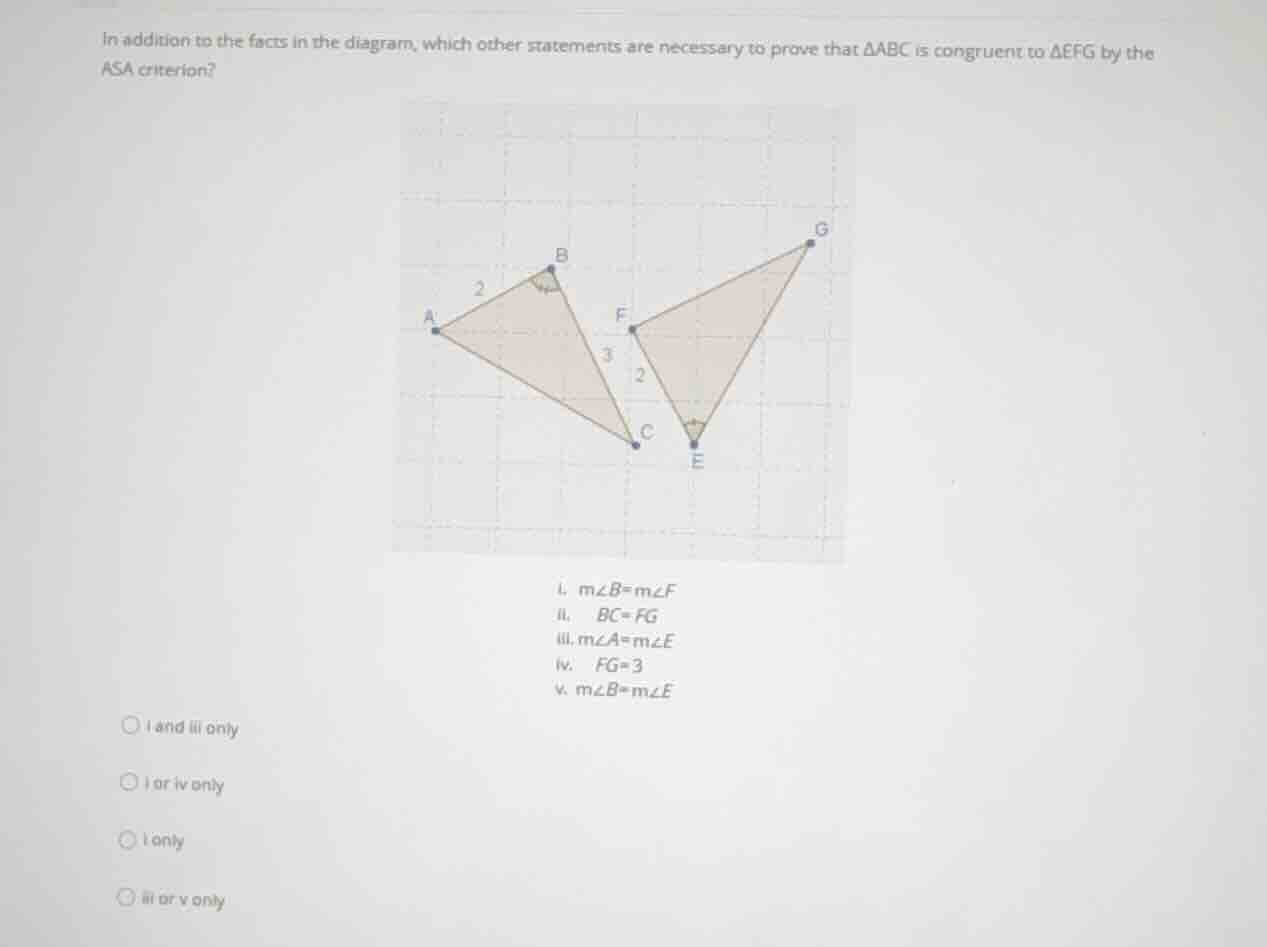
Identify given information from the diagram
We analyze the given markings on \(\Delta ABC\) and \(\Delta EFG\):
- Side length \(AB = 2\)
- Side length \(FE = 2\)
- Angle \(\angle B\) has an arc marking, and angle \(\angle E\) has a matching arc marking, so \(m\angle B = m\angle E\).
- Side length \(BC = 3\) is labeled.
Thus, we currently have:
- One pair of congruent sides: \(AB = FE = 2\)
- One pair of congruent angles: \(m\angle B = m\angle E\)
Understand the ASA criterion requirement
To prove \(\Delta ABC \cong \Delta EFG\) using the Angle-Side-Angle (ASA) criterion:
- We need two pairs of congruent angles and the included congruent side between them.
- The known congruent side pair is \(AB\) and \(FE\).
- The angles that include side \(AB\) in \(\Delta ABC\) are \(\angle A\) and \(\angle B\).
- The angles that include side \(FE\) in \(\Delta EFG\) are \(\angle F\) and \(\angle E\).
- Since we already know \(\angle B \cong \angle E\), we must establish that the other adjacent angles are congruent: \(\angle A \cong \angle F\).
- Therefore, we need \(m\angle A = m\angle F\).
Evaluate the given statements
Let's check the statements provided:
- i. \(m\angle B = m\angle F\)
- ii. \(BC = FG\)
- iii. \(m\angle A = m\angle E\)
- iv. \(FG = 3\)
- v. \(m\angle B = m\angle E\)
None of the statements directly state \(m\angle A = m\angle F\). Let's re-evaluate if we can use other combinations or if there is an alternative interpretation of the options.
Let's look at the options:
- "i and iii only"
- "i or iv only"
- "i only"
- "ii or v only"
Wait, let's look at the diagram again.
In \(\Delta ABC\), side \(AB = 2\), side \(BC = 3\), and the angle marked is \(\angle B\).
In \(\Delta EFG\), side \(FE = 2\), and the angle marked is \(\angle E\).
Wait, is the angle marked in \(\Delta EFG\) actually \(\angle E\)?
Looking closely at \(\Delta EFG\), the vertices are:
- \(F\) is the top-left vertex of the right triangle.
- \(E\) is the bottom vertex.
- \(G\) is the top-right vertex.
The arc marking is at vertex \(E\).
The side labeled \(2\) is \(FE\).
So we have:
- In \(\Delta ABC\): side \(AB = 2\), angle \(\angle B\) is marked.
- In \(\Delta EFG\): side \(FE = 2\), angle \(\angle E\) is marked.
If we want to prove \(\Delta ABC \cong \Delta EFG\) by ASA:
We need two angles and the included side.
The side must be the included side.
If we use the side of length 2:
- In \(\Delta ABC\), the side is \(AB\). The adjacent angles are \(\angle A\) and \(\angle B\).
- In \(\Delta EFG\), the side is \(FE\). The adjacent angles are \(\angle F\) and \(\angle E\).
We already have \(\angle B \cong \angle E\) (from the arc markings).
So we need \(\angle A \cong \angle F\), which means \(m\angle A = m\angle F\). But this is not in the list of statements.
What if we use the side of length 3?
- In \(\Delta ABC\), side \(BC = 3\). The adjacent angles are \(\angle B\) and \(\angle C\).
- In \(\Delta EFG\), if we have \(FG = 3\) (Statement iv), then the corresponding side is \(FG\). The adjacent angles are \(\angle F\) and \(\angle G\).
But the correspondence is \(\Delta ABC \cong \Delta EFG\), so…

Snap & solve any problem in the app
Get step-by-step solutions on Sovi AI
Photo-based solutions with guided steps
Explore more problems and detailed explanations
- I and III only (Correct answer)
- I or IV only
- I only
- II or V only