QUESTION IMAGE
Question
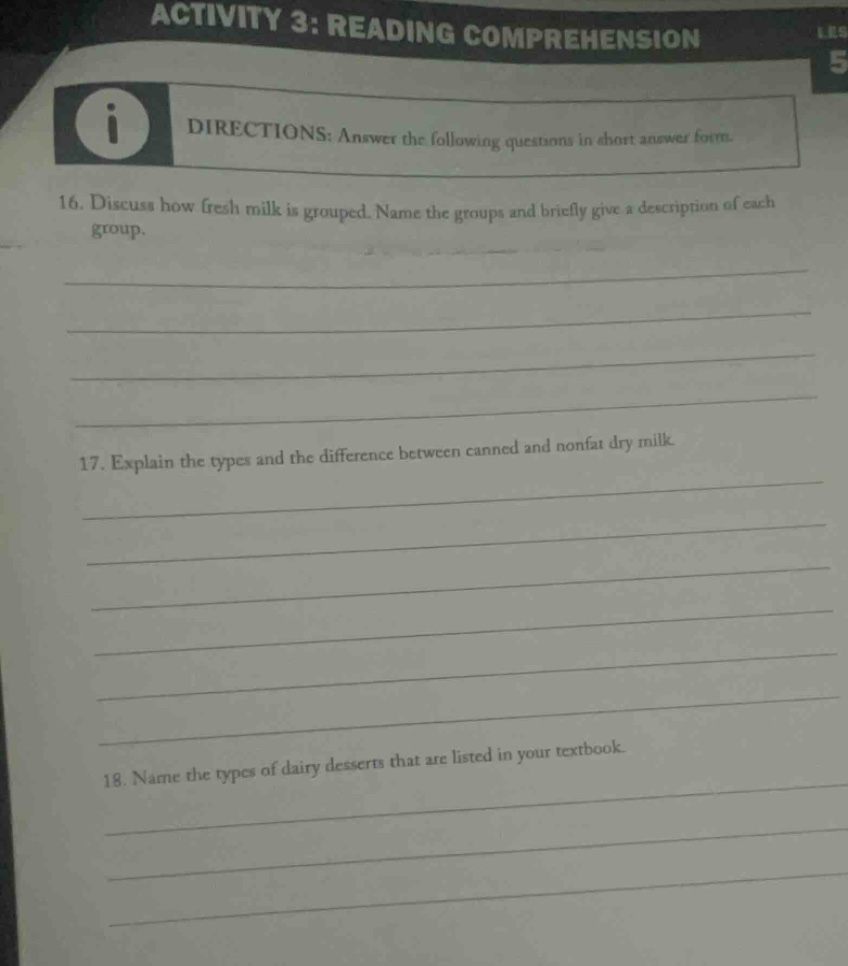
activity 3: reading comprehension
directions: answer the following questions in short answer form.
- discuss how fresh milk is grouped. name the groups and briefly give a description of each group.
- explain the types and the difference between canned and nonfat dry milk.
- name the types of dairy desserts that are listed in your textbook.
Classification of fresh milk
Fresh milk is grouped into Grade A (meets strict sanitary standards for fluid consumption) and Grade B (under less stringent standards, used primarily for manufacturing manufactured dairy products like cheese and butter).
Canned vs. nonfat dry milk
Canned milk includes evaporated milk (60% water removed, sterilized in cans) and sweetened condensed milk (60% water removed, sugar added as a preservative). Nonfat dry milk is pasteurized skim milk with nearly all water removed (usually down to less than 5% moisture) to form a powder.
Common dairy desserts
Standard dairy desserts typically categorized in food science textbooks include ice cream, sherbet, frozen yogurt, custard, pudding, and gelato.

Snap & solve any problem in the app
Get step-by-step solutions on Sovi AI
Photo-based solutions with guided steps
Explore more problems and detailed explanations
Question 16
- Grade A Milk: Produced under the strictest sanitary conditions; suitable for direct fluid consumption.
- Grade B Milk: Produced under less stringent standards; used primarily for manufacturing processed dairy products like cheese, butter, and powdered milk.
Question 17
- Canned Milk Types:
- Evaporated Milk: Homogenized whole or skim milk with about 60% of water removed, then sealed and sterilized in cans.
- Sweetened Condensed Milk: Concentrated milk with about 60% of water removed and a high concentration of added sugar (about 40–45%) to preserve it without sterilization.
- Nonfat Dry Milk: Pasteurized skim milk with nearly all water removed (reduced to a powder containing less than 5% moisture), allowing for long-term shelf-stable storage.
Question 18
- Ice cream, sherbet, frozen yogurt, custard, pudding, and gelato.