QUESTION IMAGE
Question
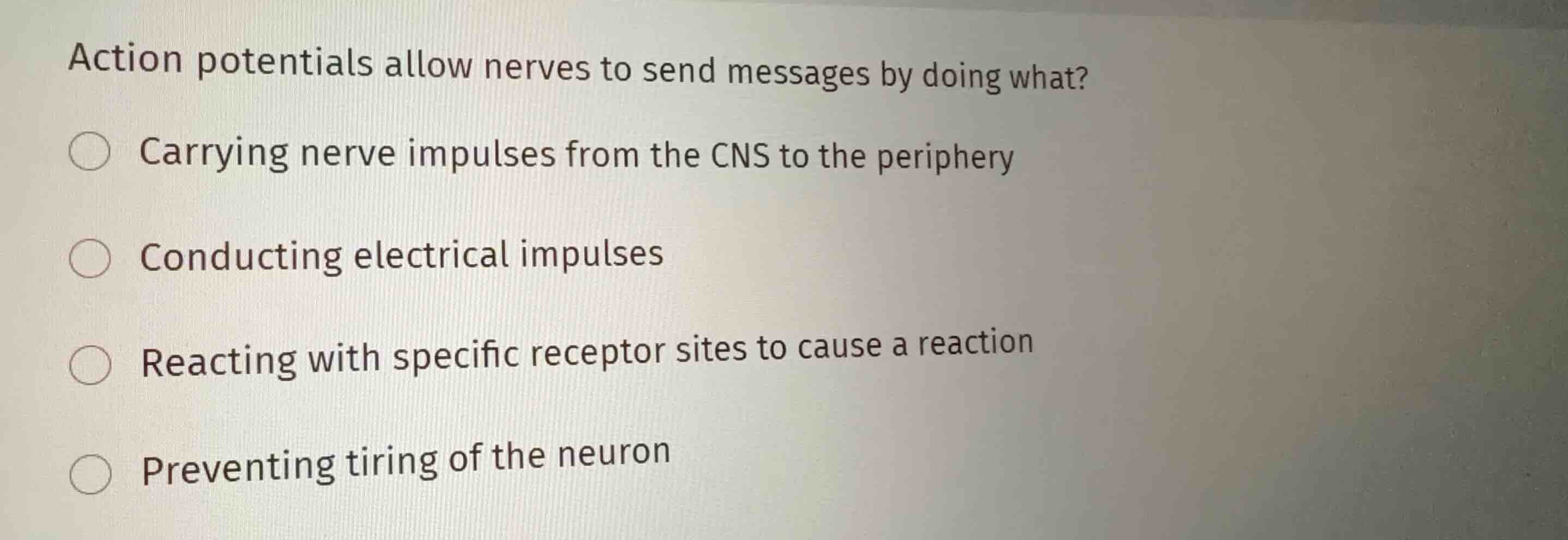
action potentials allow nerves to send messages by doing what?
carrying nerve impulses from the cns to the periphery
conducting electrical impulses
reacting with specific receptor sites to cause a reaction
preventing tiring of the neuron
Analyze the function of action potentials
Action potentials are rapid, temporary changes in the membrane potential of an excitable cell (such as a neuron). They serve as the primary mechanism by which the nervous system transmits information over long distances. This process is fundamentally electrical in nature, involving the movement of ions across the neuronal membrane to propagate a signal along the axon.
Evaluate the given options
- Carrying nerve impulses from the CNS to the periphery: This describes the specific direction of motor (efferent) pathways, but does not define the general mechanism of how action potentials themselves allow nerves to send messages.
- Conducting electrical impulses: This directly and accurately describes the fundamental mechanism. Action potentials propagate along the axon as electrical signals (impulses) to transmit information.
- Reacting with specific receptor sites to cause a reaction: This describes chemical synaptic transmission (neurotransmitter action), which occurs at the synapse after the action potential reaches the axon terminal, rather than the action potential itself.
- Preventing tiring of the neuron: This is biologically incorrect; action potentials do not prevent cellular fatigue.

Snap & solve any problem in the app
Get step-by-step solutions on Sovi AI
Photo-based solutions with guided steps
Explore more problems and detailed explanations
- (A) Carrying nerve impulses from the CNS to the periphery
- (B) Conducting electrical impulses (Correct answer)
- (C) Reacting with specific receptor sites to cause a reaction
- (D) Preventing tiring of the neuron