QUESTION IMAGE
Question
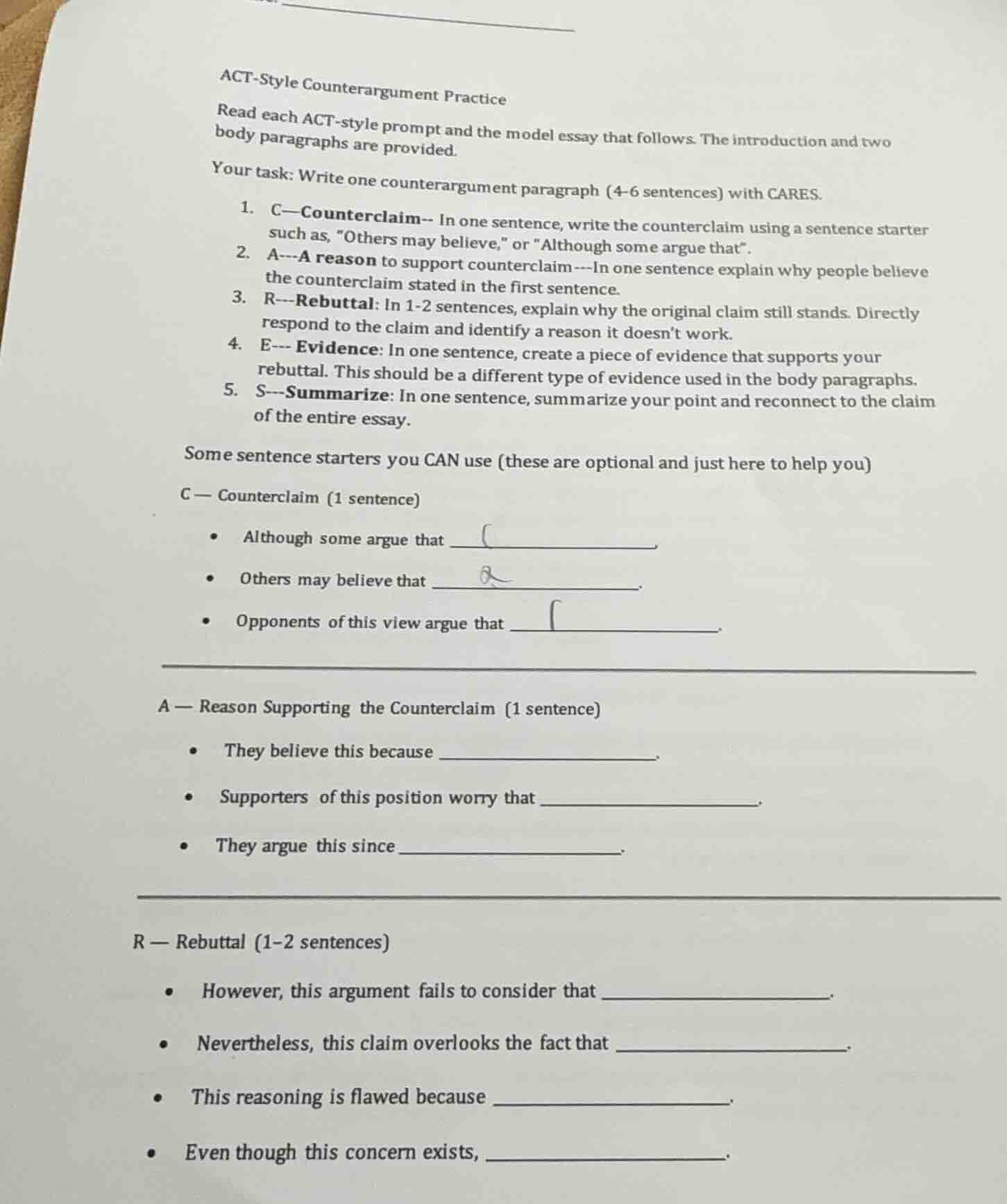
act-style counterargument practice
read each act-style prompt and the model essay that follows. the introduction and two body paragraphs are provided.
your task: write one counterargument paragraph (4-6 sentences) with cares.
- c-counterclaim- in one sentence, write the counterclaim using a sentence starter such as, \others may believe,\ or \although some argue that\.
- a-a reason to support counterclaim-in one sentence explain why people believe the counterclaim stated in the first sentence.
- r-rebuttal: in 1-2 sentences, explain why the original claim still stands. directly respond to the claim and identify a reason it doesnt work.
- e-evidence: in one sentence, create a piece of evidence that supports your rebuttal. this should be a different type of evidence used in the body paragraphs.
- s-summarize: in one sentence, summarize your point and reconnect to the claim of the entire essay.
some sentence starters you can use (these are optional and just here to help you)
c- counterclaim (1 sentence)
- although some argue that
- others may believe that
- opponents of this view argue that
a- reason supporting the counterclaim (1 sentence)
- they believe this because
- supporters of this position worry that
- they argue this since
r- rebuttal (1-2 sentences)
- however, this argument fails to consider that
- nevertheless, this claim overlooks the fact that
- this reasoning is flawed because
- even though this concern exists,
Analyze the prompt and C.A.R.E.S. requirements
The task is to write a concise counterargument paragraph (4–6 sentences) using the C.A.R.E.S. structure:
- C (Counterclaim): State the opposing view using a starter like "Others may believe..."
- A (Reason to support counterclaim): Explain why opponents hold this view.
- R (Rebuttal): Explain why the original claim still stands.
- E (Evidence): Provide a piece of evidence supporting the rebuttal.
- S (Summarize): Summarize the point and reconnect to the main thesis.
Since the prompt text refers to an ACT-style prompt and model essay not fully visible in the image, we will construct a highly versatile, direct, and concise model paragraph based on a standard ACT topic (e.g., whether technology in classrooms is beneficial or distracting) to demonstrate the structure clearly.
Draft the concise C.A.R.E.S. paragraph
- C: Others may believe that integrating personal tablets and laptops in classrooms is too distracting for students.
- A: Supporters of this position worry that access to the internet leads to off-task browsing and decreased focus during lessons.
- R: However, this argument fails to consider that structured digital integration actually increases student engagement and prepares them for a tech-driven workforce.
- E: For instance, a recent educational study showed that classrooms utilizing interactive software saw a 15% increase in active participation.
- S: Ultimately, when managed properly, technology serves as an essential tool that enhances learning rather than a distraction.

Snap & solve any problem in the app
Get step-by-step solutions on Sovi AI
Photo-based solutions with guided steps
Explore more problems and detailed explanations
Here is a concise, direct model counterargument paragraph following the C.A.R.E.S. structure:
Others may believe that integrating personal laptops in classrooms is too distracting for students. Supporters of this position worry that constant access to the internet leads to off-task browsing and decreased focus during lessons. However, this argument fails to consider that structured digital integration actually increases student engagement and prepares them for a tech-driven workforce. For instance, a recent educational study showed that classrooms utilizing interactive learning software saw a 15% increase in active participation. Ultimately, when managed properly, technology serves as an essential tool that enhances learning rather than a distraction.