Sovi.AI - AI Math Tutor

Scan to solve math questions

QUESTION IMAGE

according to the video, what do art movements often reflect? whats happ…

Question

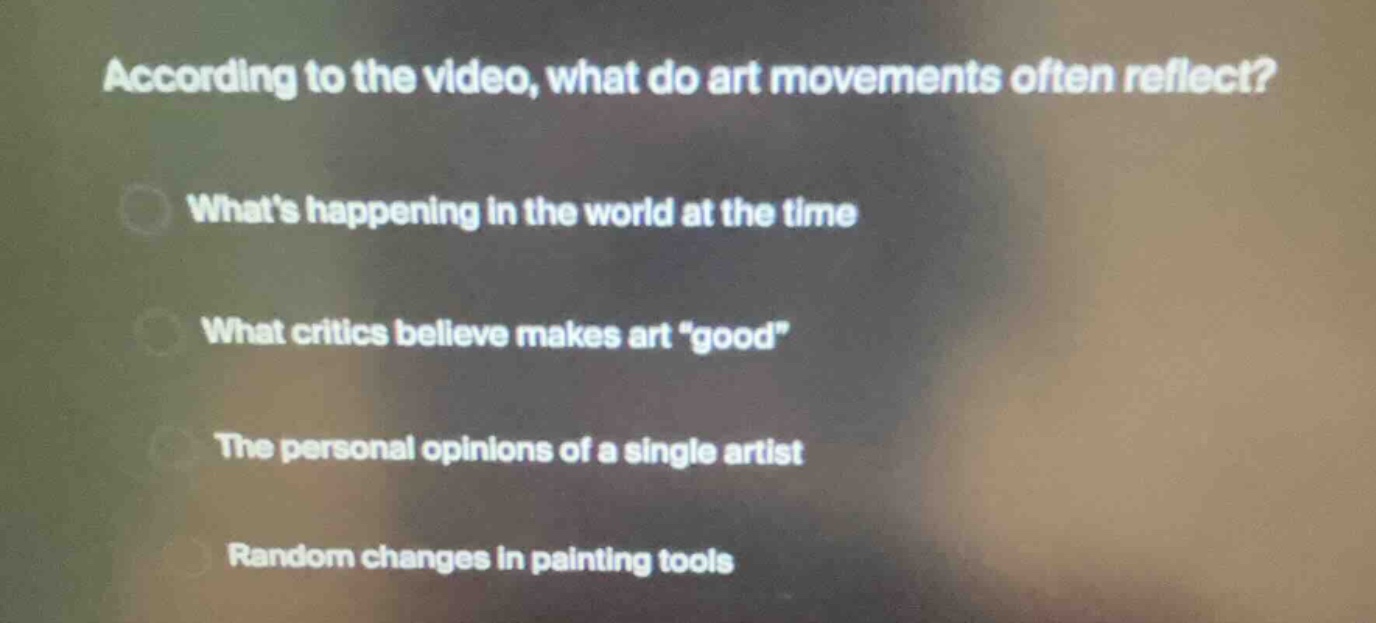
according to the video, what do art movements often reflect?

whats happening in the world at the time
what critics believe makes art \good\
the personal opinions of a single artist
random changes in painting tools

Explanation:

Response

<pre_analysis>
{
"quality": "clear",
"question_count": 1,
"skills_matched": [
"direct_cot",
"multiple_choice_formatter",
"explain_then_answer",
"quick"
],
"needs_drawing": false,
"concepts_used": [],
"new_concepts": [
"Art Movements",
"Historical Context"
],
"current_concepts": [
"Art Movements",
"Historical Context",
"Art History"
]
}
</pre_analysis>

<reasoning>

Analyze the question and options

The question asks what art movements often reflect. Art movements are historically defined by shared styles, philosophies, or goals among artists, which are deeply influenced by the historical, social, and political events of their era.

Evaluate the choices

  • "What's happening in the world at the time": This aligns with the fundamental principle of art history that art movements reflect their contemporary historical and cultural context.
  • "What critics believe makes art 'good'": Critics react to movements, but they do not define what the movements themselves reflect.
  • "The personal opinions of a single artist": Movements involve groups of artists over time, not just a single individual.
  • "Random changes in painting tools": Technological shifts influence mediums, but movements are driven by deeper cultural and philosophical shifts rather than random tool changes.

Determine the correct option

The most accurate and standard educational answer is that art movements reflect the historical and social context of their time.
</reasoning>

<answer>
<mcq-correct>(A) What's happening in the world at the time</mcq-correct>
<mcq-option>(B) What critics believe makes art "good"</mcq-option>
<mcq-option>(C) The personal opinions of a single artist</mcq-option>
<mcq-option>(D) Random changes in painting tools</mcq-option>
</answer>

<post_analysis>
{
"subject": "Arts",
"question_type": "Multiple Choice",
"knowledge_point": [
"Arts",
"Art History",
"Art Movements"
]
}
</post_analysis>

Answer:

<pre_analysis>
{
"quality": "clear",
"question_count": 1,
"skills_matched": [
"direct_cot",
"multiple_choice_formatter",
"explain_then_answer",
"quick"
],
"needs_drawing": false,
"concepts_used": [],
"new_concepts": [
"Art Movements",
"Historical Context"
],
"current_concepts": [
"Art Movements",
"Historical Context",
"Art History"
]
}
</pre_analysis>

<reasoning>

Analyze the question and options

The question asks what art movements often reflect. Art movements are historically defined by shared styles, philosophies, or goals among artists, which are deeply influenced by the historical, social, and political events of their era.

Evaluate the choices

  • "What's happening in the world at the time": This aligns with the fundamental principle of art history that art movements reflect their contemporary historical and cultural context.
  • "What critics believe makes art 'good'": Critics react to movements, but they do not define what the movements themselves reflect.
  • "The personal opinions of a single artist": Movements involve groups of artists over time, not just a single individual.
  • "Random changes in painting tools": Technological shifts influence mediums, but movements are driven by deeper cultural and philosophical shifts rather than random tool changes.

Determine the correct option

The most accurate and standard educational answer is that art movements reflect the historical and social context of their time.
</reasoning>

<answer>
<mcq-correct>(A) What's happening in the world at the time</mcq-correct>
<mcq-option>(B) What critics believe makes art "good"</mcq-option>
<mcq-option>(C) The personal opinions of a single artist</mcq-option>
<mcq-option>(D) Random changes in painting tools</mcq-option>
</answer>

<post_analysis>
{
"subject": "Arts",
"question_type": "Multiple Choice",
"knowledge_point": [
"Arts",
"Art History",
"Art Movements"
]
}
</post_analysis>