QUESTION IMAGE
Question
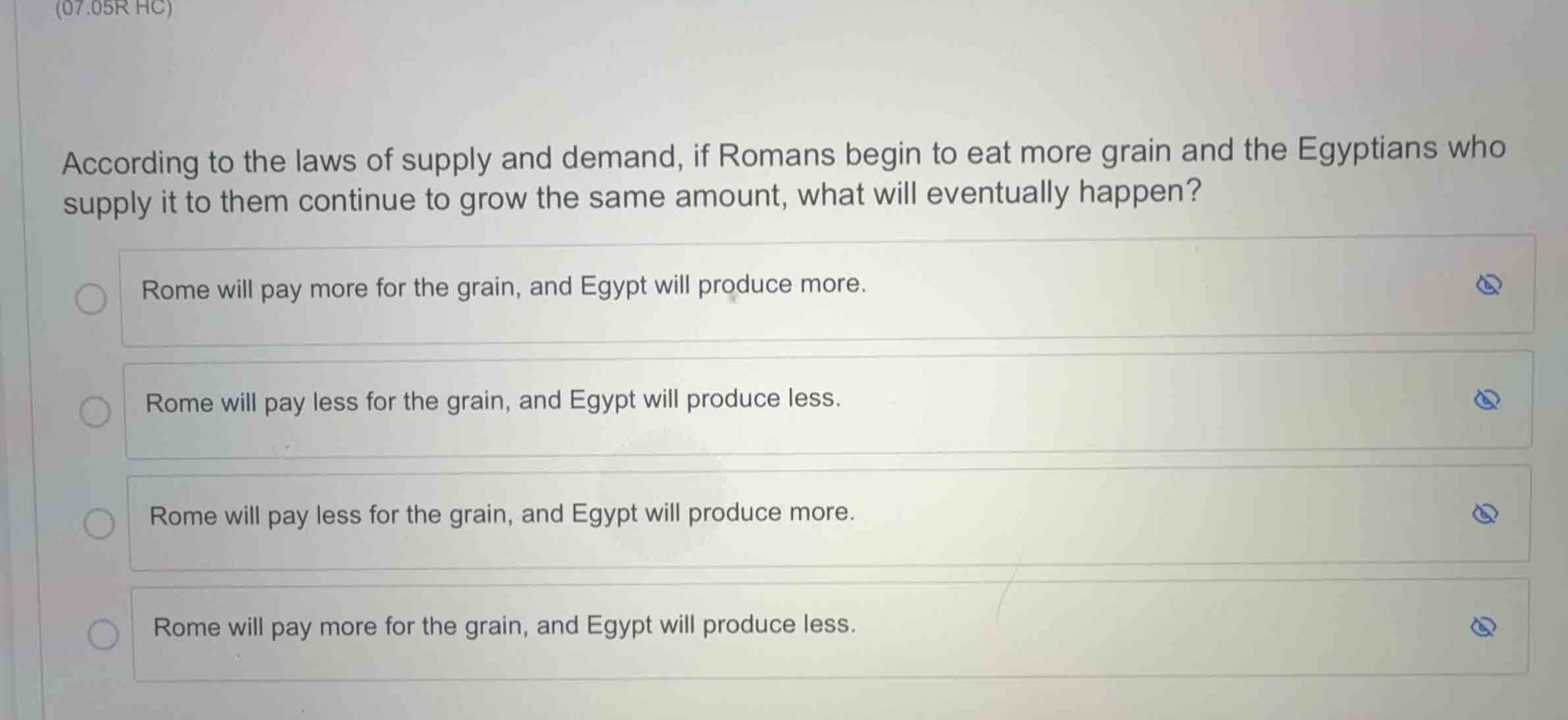
according to the laws of supply and demand, if romans begin to eat more grain and the egyptians who supply it to them continue to grow the same amount, what will eventually happen?
rome will pay more for the grain, and egypt will produce more.
rome will pay less for the grain, and egypt will produce less.
rome will pay less for the grain, and egypt will produce more.
rome will pay more for the grain, and egypt will produce less.
Analyze the demand shift
The prompt states that Romans begin to eat more grain. In economic terms, this represents an increase in the demand for grain in Rome. When demand increases while supply remains constant, a shortage occurs at the initial price, which drives the market price upward. Therefore, Rome will pay more for the grain.
Analyze the supply response
The prompt asks what will "eventually happen" under the laws of supply and demand. Although the Egyptian producers initially "continue to grow the same amount" (supply is constant in the short run), the resulting higher market price creates an incentive for suppliers. According to the law of supply, a higher price leads producers to increase the quantity supplied. Thus, Egypt will eventually produce more grain to capitalize on the higher prices.
Evaluate the options
- Option 1: "Rome will pay more for the grain, and Egypt will produce more." This matches our economic analysis of an increase in demand leading to higher prices and a subsequent increase in production.
- Option 2: "Rome will pay less..." Incorrect, as increased demand raises prices.
- Option 3: "Rome will pay less..." Incorrect, as increased demand raises prices.
- Option 4: "...Egypt will produce less." Incorrect, as higher prices incentivize more production, not less.
This analysis connects directly to the historical Roman Economy, where Rome relied heavily on grain imports from Egypt, making their trade relationship highly sensitive to market forces.

Snap & solve any problem in the app
Get step-by-step solutions on Sovi AI
Photo-based solutions with guided steps
Explore more problems and detailed explanations
- (A) Rome will pay more for the grain, and Egypt will produce more. (Correct answer)
- (B) Rome will pay less for the grain, and Egypt will produce less.
- (C) Rome will pay less for the grain, and Egypt will produce more.
- (D) Rome will pay more for the grain, and Egypt will produce less.