QUESTION IMAGE
Question
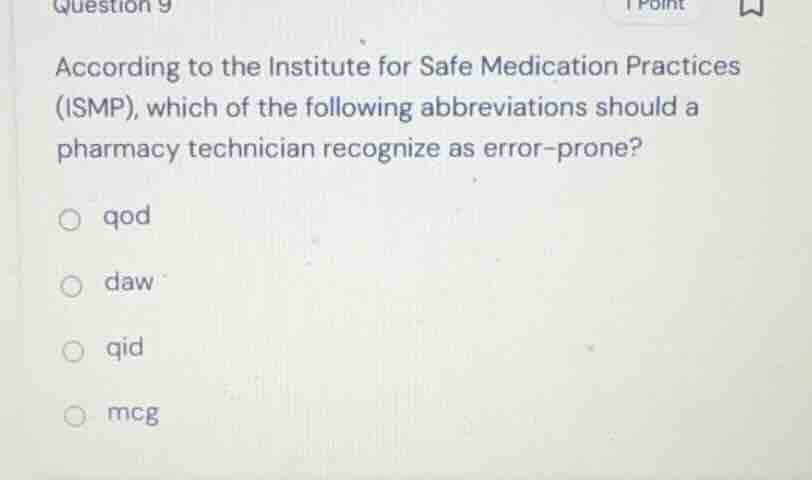
according to the institute for safe medication practices (ismp), which of the following abbreviations should a pharmacy technician recognize as error-prone?
qod
daw
qid
mcg
Identify the core safety guidelines
Using the ISMP Guidelines and Error-Prone Abbreviations knowledge points
- The Institute for Safe Medication Practices (ISMP) maintains a list of error-prone abbreviations, symbols, and dose designations that are frequently associated with medication errors.
- These abbreviations should be avoided in all forms of medical communication to prevent misinterpretation and patient harm.
Evaluate the abbreviation options
Using the Error-Prone Abbreviations knowledge point
- qod (or Q.O.D.): Means "every other day". It is highly error-prone because the "o" can easily be misread as "i", leading to "qid" (four times daily), which represents an eight-fold overdose. ISMP recommends writing out "every other day".
- daw: Stands for "Dispense as Written". This is a standard billing and dispensing code, not classified as an error-prone clinical abbreviation by ISMP.
- qid: Stands for "four times a day". While it must be read carefully, it is a standard Latin abbreviation that is not on the ISMP do-not-use list (unlike qod).
- mcg: Stands for "microgram". ISMP recommends using "mcg" instead of "µg" because the Greek letter mu (µ) can easily be misread as "m", leading to a thousand-fold overdose of milligrams (mg). Thus, "mcg" is the safe, preferred abbreviation.

Snap & solve any problem in the app
Get step-by-step solutions on Sovi AI
Photo-based solutions with guided steps
Explore more problems and detailed explanations
- (A) qod (Correct answer)
- (B) daw
- (C) qid
- (D) mcg