Sovi.AI - AI Math Tutor

Scan to solve math questions

QUESTION IMAGE

according to our course materials, what distinguished the new kingdom p…

Question

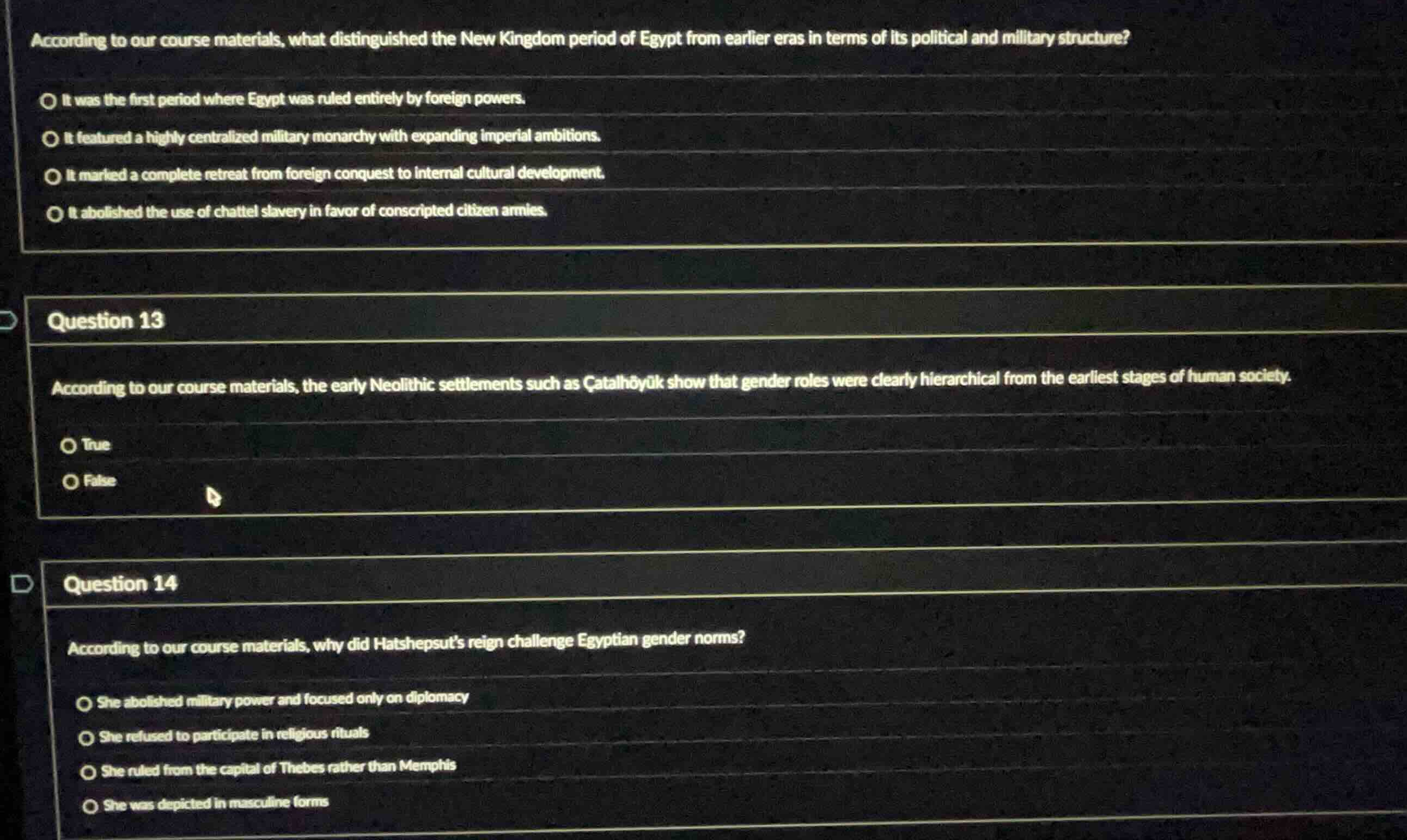
according to our course materials, what distinguished the new kingdom period of egypt from earlier eras in terms of its political and military structure?

it was the first period where egypt was ruled entirely by foreign powers.
it featured a highly centralized military monarchy with expanding imperial ambitions.
it marked a complete retreat from foreign conquest to internal cultural development.
it abolished the use of chattel slavery in favor of conscripted citizen armies.

question 13
according to our course materials, the early neolithic settlements such as çatalhöyük show that gender roles were clearly hierarchical from the earliest stages of human society.

true
false

question 14
according to our course materials, why did hatshepsuts reign challenge egyptian gender norms?

she abolished military power and focused only on diplomacy
she refused to participate in religious rituals
she ruled from the capital of thebes rather than memphis
she was depicted in masculine forms

Explanation:

Response

<pre_analysis>
{
"quality": "clear",
"question_count": 3,
"skills_matched": [
"direct_cot",
"explain_then_answer",
"quick"
],
"needs_drawing": false,
"concepts_used": [
"New Kingdom Egypt",
"Neolithic Gender Roles",
"Hatshepsut Reign"
],
"new_concepts": [],
"current_concepts": [
"New Kingdom Egypt",
"Neolithic Gender Roles",
"Hatshepsut Reign"
]
}
</pre_analysis>

<reasoning>

Analyze New Kingdom Egypt political and military structure

The New Kingdom period of Egypt (c. 1550–1077 BCE) was characterized by aggressive territorial expansion, the creation of an empire, and a highly centralized military monarchy, distinguishing it from the more isolationist or less expansionist Old and Middle Kingdoms.

Evaluate Neolithic gender roles at Çatalhöyük

Archaeological evidence from early Neolithic settlements like Çatalhöyük suggests a relatively egalitarian social structure with minimal differentiation in diet, labor, or burial practices based on gender, meaning gender roles were not clearly hierarchical from the earliest stages.

Analyze Hatshepsut's challenge to Egyptian gender norms

Hatshepsut challenged traditional Egyptian gender norms by assuming the full political and religious authority of a male pharaoh, which was visually reinforced by having herself depicted in traditional masculine forms, including the pharaonic beard and kilt, in official statues and reliefs.
</reasoning>

<answer>

Question 12

<mcq-option>(A) It was the first period where Egypt was ruled entirely by foreign powers.</mcq-option>
<mcq-correct>(B) It featured a highly centralized military monarchy with expanding imperial ambitions.</mcq-correct>
<mcq-option>(C) It marked a complete retreat from foreign conquest to internal cultural development.</mcq-option>
<mcq-option>(D) It abolished the use of chattel slavery in favor of conscripted citizen armies.</mcq-option>

Question 13

<mcq-option>True</mcq-option>
<mcq-correct>False</mcq-correct>

Question 14

<mcq-option>(A) She abolished military power and focused only on diplomacy</mcq-option>
<mcq-option>(B) She refused to participate in religious rituals</mcq-option>
<mcq-option>(C) She ruled from the capital of Thebes rather than Memphis</mcq-option>
<mcq-correct>(D) She was depicted in masculine forms</mcq-correct>
</answer>

<post_analysis>
{
"subject": "Social Science",
"question_type": "Multi-part",
"knowledge_point": [
"Social Science",
"History",
"Ancient World History"
]
}
</post_analysis>

Answer:

<pre_analysis>
{
"quality": "clear",
"question_count": 3,
"skills_matched": [
"direct_cot",
"explain_then_answer",
"quick"
],
"needs_drawing": false,
"concepts_used": [
"New Kingdom Egypt",
"Neolithic Gender Roles",
"Hatshepsut Reign"
],
"new_concepts": [],
"current_concepts": [
"New Kingdom Egypt",
"Neolithic Gender Roles",
"Hatshepsut Reign"
]
}
</pre_analysis>

<reasoning>

Analyze New Kingdom Egypt political and military structure

The New Kingdom period of Egypt (c. 1550–1077 BCE) was characterized by aggressive territorial expansion, the creation of an empire, and a highly centralized military monarchy, distinguishing it from the more isolationist or less expansionist Old and Middle Kingdoms.

Evaluate Neolithic gender roles at Çatalhöyük

Archaeological evidence from early Neolithic settlements like Çatalhöyük suggests a relatively egalitarian social structure with minimal differentiation in diet, labor, or burial practices based on gender, meaning gender roles were not clearly hierarchical from the earliest stages.

Analyze Hatshepsut's challenge to Egyptian gender norms

Hatshepsut challenged traditional Egyptian gender norms by assuming the full political and religious authority of a male pharaoh, which was visually reinforced by having herself depicted in traditional masculine forms, including the pharaonic beard and kilt, in official statues and reliefs.
</reasoning>

<answer>

Question 12

<mcq-option>(A) It was the first period where Egypt was ruled entirely by foreign powers.</mcq-option>
<mcq-correct>(B) It featured a highly centralized military monarchy with expanding imperial ambitions.</mcq-correct>
<mcq-option>(C) It marked a complete retreat from foreign conquest to internal cultural development.</mcq-option>
<mcq-option>(D) It abolished the use of chattel slavery in favor of conscripted citizen armies.</mcq-option>

Question 13

<mcq-option>True</mcq-option>
<mcq-correct>False</mcq-correct>

Question 14

<mcq-option>(A) She abolished military power and focused only on diplomacy</mcq-option>
<mcq-option>(B) She refused to participate in religious rituals</mcq-option>
<mcq-option>(C) She ruled from the capital of Thebes rather than Memphis</mcq-option>
<mcq-correct>(D) She was depicted in masculine forms</mcq-correct>
</answer>

<post_analysis>
{
"subject": "Social Science",
"question_type": "Multi-part",
"knowledge_point": [
"Social Science",
"History",
"Ancient World History"
]
}
</post_analysis>