QUESTION IMAGE
Question
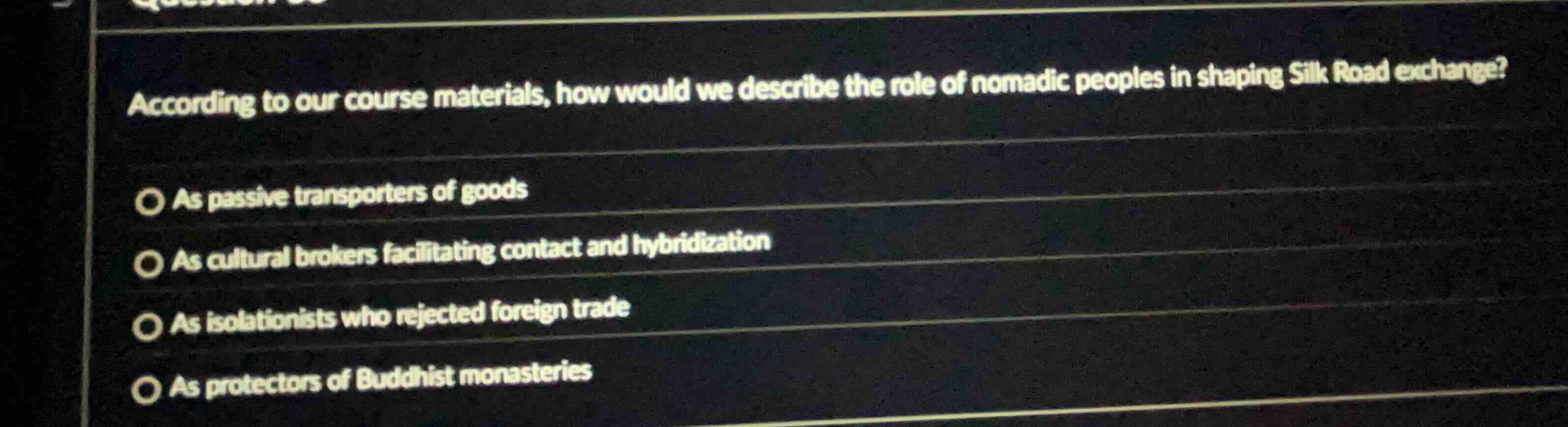
according to our course materials, how would we describe the role of nomadic peoples in shaping silk road exchange?
as passive transporters of goods
as cultural brokers facilitating contact and hybridization
as isolationists who rejected foreign trade
as protectors of buddhist monasteries
<pre_analysis>
{
"quality": "clear",
"question_count": 1,
"skills_matched": [
"direct_cot",
"multiple_choice_formatter",
"explain_then_answer",
"quick"
],
"needs_drawing": false,
"concepts_used": [
"Silk Road Nomads",
"Silk Road Trade"
],
"new_concepts": [],
"current_concepts": [
"Silk Road Nomads",
"Silk Road Trade"
]
}
</pre_analysis>
<reasoning>
Analyze the historical role of nomadic peoples on the Silk Road
Nomadic groups were active agents of exchange rather than passive carriers, serving as intermediaries who connected different sedentary civilizations and fostered cultural hybridization.
Evaluate the given options
- "As passive transporters of goods" incorrectly characterizes nomads as passive rather than active agents.
- "As cultural brokers facilitating contact and hybridization" accurately reflects their role in connecting cultures and enabling cultural exchange.
- "As isolationists who rejected foreign trade" contradicts their active participation in trade networks.
- "As protectors of Buddhist monasteries" is too narrow and does not describe their primary overarching role in shaping exchange.
</reasoning>
<answer>
<mcq-option>As passive transporters of goods</mcq-option>
<mcq-correct>As cultural brokers facilitating contact and hybridization</mcq-correct>
<mcq-option>As isolationists who rejected foreign trade</mcq-option>
<mcq-option>As protectors of Buddhist monasteries</mcq-option>
</answer>
<post_analysis>
{
"subject": "Social Science",
"question_type": "Multiple Choice",
"knowledge_point": [
"Social Science",
"History",
"Silk Road Trade"
]
}
</post_analysis>
Snap & solve any problem in the app
Get step-by-step solutions on Sovi AI
Photo-based solutions with guided steps
Explore more problems and detailed explanations
<pre_analysis>
{
"quality": "clear",
"question_count": 1,
"skills_matched": [
"direct_cot",
"multiple_choice_formatter",
"explain_then_answer",
"quick"
],
"needs_drawing": false,
"concepts_used": [
"Silk Road Nomads",
"Silk Road Trade"
],
"new_concepts": [],
"current_concepts": [
"Silk Road Nomads",
"Silk Road Trade"
]
}
</pre_analysis>
<reasoning>
Analyze the historical role of nomadic peoples on the Silk Road
Nomadic groups were active agents of exchange rather than passive carriers, serving as intermediaries who connected different sedentary civilizations and fostered cultural hybridization.
Evaluate the given options
- "As passive transporters of goods" incorrectly characterizes nomads as passive rather than active agents.
- "As cultural brokers facilitating contact and hybridization" accurately reflects their role in connecting cultures and enabling cultural exchange.
- "As isolationists who rejected foreign trade" contradicts their active participation in trade networks.
- "As protectors of Buddhist monasteries" is too narrow and does not describe their primary overarching role in shaping exchange.
</reasoning>
<answer>
<mcq-option>As passive transporters of goods</mcq-option>
<mcq-correct>As cultural brokers facilitating contact and hybridization</mcq-correct>
<mcq-option>As isolationists who rejected foreign trade</mcq-option>
<mcq-option>As protectors of Buddhist monasteries</mcq-option>
</answer>
<post_analysis>
{
"subject": "Social Science",
"question_type": "Multiple Choice",
"knowledge_point": [
"Social Science",
"History",
"Silk Road Trade"
]
}
</post_analysis>