QUESTION IMAGE
Question
absolute value functions and translations
complete
2 3 4 5 6 7 8 9 10
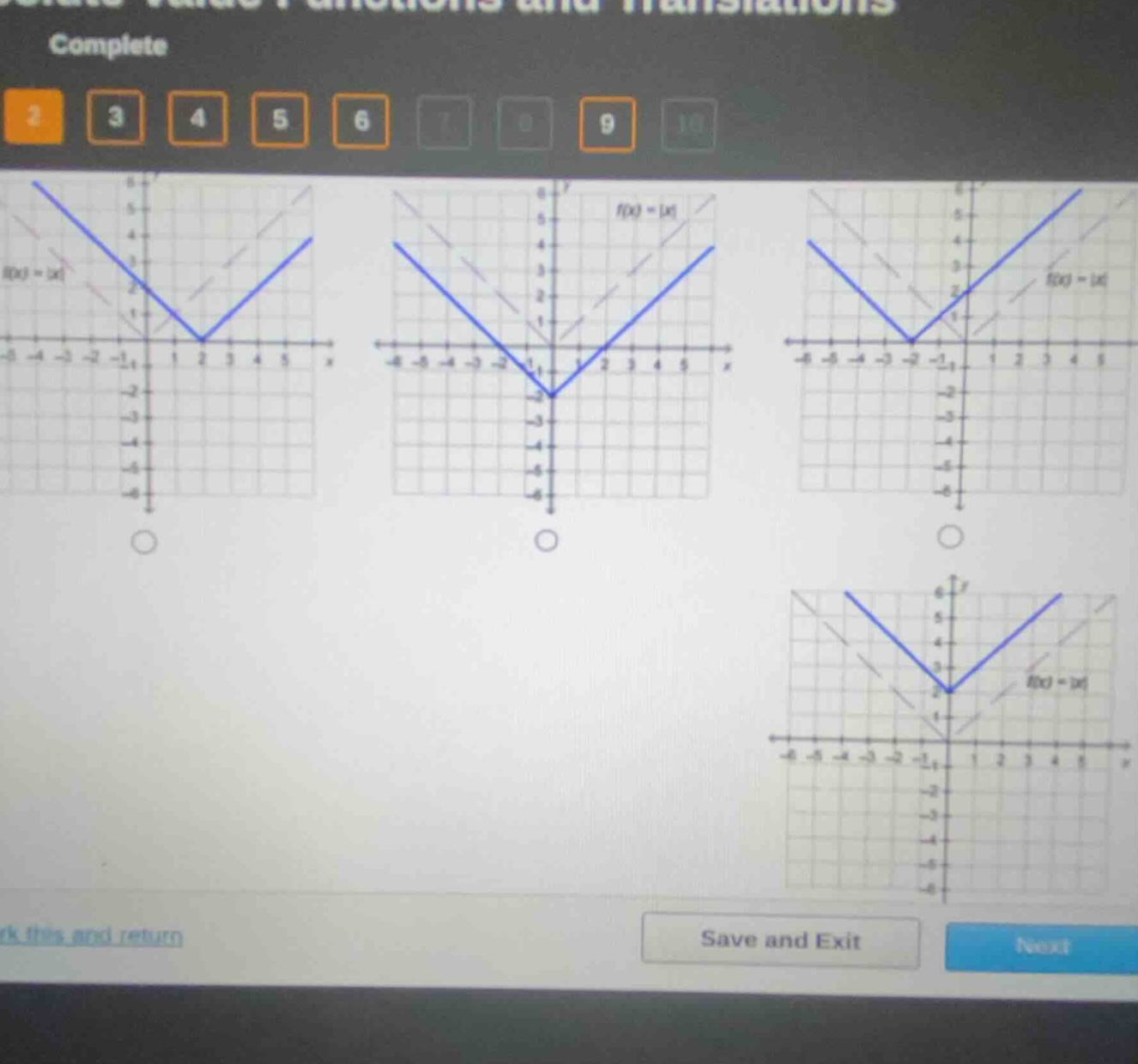
(f(x) = |x|)
(f(x) = |x|)
(f(x) = |x|)
(f(x) = |x|)
Identify the parent function and transformation
Using the Absolute Value Functions knowledge point
Determine the vertex shift
Using the Absolute Value Functions knowledge point
Analyze the range of the function
Using the Absolute Value Functions knowledge point
Match with the given options
The student's query asks for a conceptual explanation of why the range of \(g(x) = |x - 12| - 2\) is \(y \ge -2\).
The absolute value expression \(|x - 12|\) represents a distance on the number line, which is always non-negative (\(\ge 0\)).
Subtracting \(2\) from this non-negative value shifts the minimum value of the function from \(0\) down to \(-2\).
Therefore, the lowest value the function can output is \(-2\), and it can produce any value greater than or equal to \(-2\).

Snap & solve any problem in the app
Get step-by-step solutions on Sovi AI
Photo-based solutions with guided steps
Explore more problems and detailed explanations
Question 1
- (A) The graph is shifted 12 units to the right and 2 units up, so the vertex is at (12, 2).
- (B) The absolute value term \(|x - 12|\) is always greater than or equal to 0. Subtracting 2 shifts the minimum value down to -2, making the range \(y \ge -2\). (Correct answer)
- (C) The range is restricted because the domain of the function is restricted to positive numbers.
- (D) The graph is reflected across the x-axis, which changes the direction of the inequality.