QUESTION IMAGE
Question
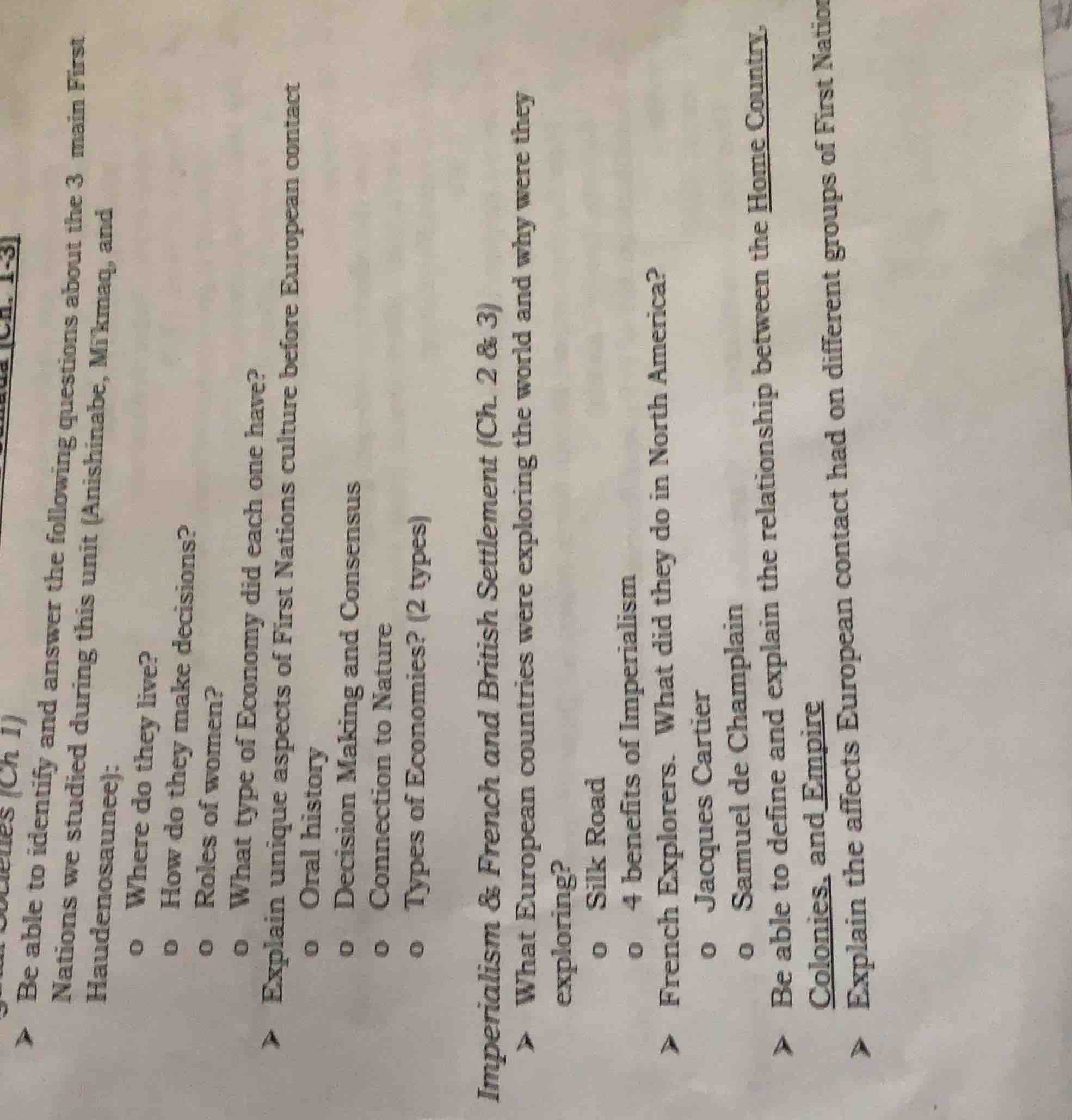
be able to identify and answer the following questions about the 3 main first nations we studied during this unit (anishinabe, mikmaq, and haudenosaunee):
- where do they live?
- how do they make decisions?
- roles of women?
- what type of economy did each one have?
explain unique aspects of first nations culture before european contact
- oral history
- decision making and consensus
- connection to nature
- types of economies? (2 types)
imperialism & french and british settlement (ch. 2 & 3)
what european countries were exploring the world and why were they exploring?
- silk road
- 4 benefits of imperialism
french explorers. what did they do in north america?
- jacques cartier
- samuel de champlain
be able to define and explain the relationship between the home country, colonies, and empire
explain the affects european contact had on different groups of first nations
First Nations Societies Analysis
- Anishinabe, Mi'kmaq, Haudenosaunee:
- Locations: Mi'kmaq lived in the Atlantic region (maritimes); Anishinabe lived in the wooded areas of central Canada (Great Lakes/Ontario); Haudenosaunee lived in fertile agricultural areas south of the St. Lawrence River.
- Decision Making: Mi'kmaq used local/grand councils; Anishinabe used a clan system with specialized leaders; Haudenosaunee used a consensus-based Grand Council governed by the Great Law of Peace.
- Roles of Women: Highly respected; Haudenosaunee Clan Mothers chose chiefs and vetoed decisions; Mi'kmaq and Anishinabe women managed camps, gathered resources, and participated in community councils.
- Economy: Mi'kmaq and Anishinabe had hunter-gatherer economies (seasonal movement); Haudenosaunee had an agricultural economy (Three Sisters: corn, beans, squash).
First Nations Culture and Economy
- Oral History: Used to pass down laws, values, histories, and traditions through generations without written language.
- Decision Making and Consensus: All group members or representatives discussed issues until everyone agreed on a path forward.
- Connection to Nature: Deep spiritual respect; resources were shared, and only what was needed was taken, viewing humans as part of the ecosystem.
- Types of Economies: Hunter-gatherer (nomadic/semi-nomadic, resource-based) and Agricultural (settled, crop-cultivating).
Imperialism and Exploration
- European Countries: France, Britain, Spain, and Portugal explored to find new trade routes, expand territory, and acquire wealth.
- Silk Road: The overland trade route connecting Europe to Asia; Ottoman control of this route forced Europeans to find sea routes.
- 4 Benefits of Imperialism (for Home Countries):
- Access to raw materials/resources.
- New markets for manufactured goods.
- Increased global power and territory.
- Spread of religious and cultural influence.
French Explorers
- Jacques Cartier: Explored the St. Lawrence River, claimed the land for France, and established early contact with the Haudenosaunee.
- Samuel de Champlain: Founded Quebec City (1608), mapped the Great Lakes, and established the fur trade alliance with the Huron and Algonquins.
Colonies, Empire, and Contact
- Colony and Home Country: A colony is a territory controlled by a distant sovereign nation (the home country). The colony provides raw materials, while the home country provides manufactured goods and military protection.
- Effects of Contact: Introduced devastating European diseases (smallpox), disrupted traditional economies through the fur trade, led to territorial displacement, and created new military alliances and conflicts.

Snap & solve any problem in the app
Get step-by-step solutions on Sovi AI
Photo-based solutions with guided steps
Explore more problems and detailed explanations
Question 1: First Nations Societies (Anishinabe, Mi'kmaq, Haudenosaunee)
- Where do they live?
- Mi'kmaq: Atlantic coast/Maritime provinces.
- Anishinabe: Wooded areas of Ontario and Manitoba (Great Lakes region).
- Haudenosaunee: Fertile agricultural lands south of the St. Lawrence River.
- How do they make decisions?
- Mi'kmaq: Local leaders met in councils; Grand Council made regional decisions.
- Anishinabe: Clan system where each clan had a specific leadership role.
- Haudenosaunee: Consensus-based decision-making through the Grand Council of 50 chiefs.
- Roles of women?
- Mi'kmaq: Prepared food, raised children, and voiced opinions in local councils.
- Anishinabe: Managed the camp, gathered wild rice, and held equal status in community life.
- Haudenosaunee: Clan Mothers held high political power, chose the chiefs, and could remove them.
- What type of Economy did each one have?
- Mi'kmaq: Hunter-gatherer (seasonal hunting and fishing).
- Anishinabe: Hunter-gatherer (wild rice harvesting, fishing, and hunting).
- Haudenosaunee: Agricultural (farming the "Three Sisters": corn, beans, and squash).
Question 2: Aspects of First Nations Culture
- Oral history: Passing down history, laws, and cultural values through spoken stories and songs rather than writing.
- Decision Making and Consensus: A process where everyone discusses an issue until all members reach a mutual agreement.
- Connection to Nature: A belief that humans are interconnected with the land, leading to deep respect and sustainable resource use.
- Types of Economies:
- Hunter-Gatherer: Semi-nomadic, relying on wild resources.
- Agricultural: Settled, relying on cultivated crops.
Question 3: Imperialism & French and British Settlement
- What European countries were exploring the world and why?
- Who: Britain, France, Spain, and Portugal.
- Why: To find new trade routes to Asia, claim land, gather wealth (gold/furs), and spread Christianity.
- Silk Road: The overland trade route between Europe and Asia that became blocked/taxed by the Ottoman Empire, forcing sea exploration.
- 4 benefits of Imperialism:
- Acquisition of raw materials (furs, timber, gold).
- New markets to sell manufactured goods.
- Expansion of national territory and global power.
- Spread of the home country's religion and culture.
Question 4: French Explorers
- Jacques Cartier: Explored the St. Lawrence River, claimed the territory for France, and made early contact with the Haudenosaunee.
- Samuel de Champlain: Established the first permanent French settlement at Quebec (1608) and built the fur trade network.
Question 5: Colonies, Empire, and Contact
- Relationship between Colony and Home Country: The colony exists to benefit the home country by sending raw materials back, while the home country controls the colony's government and sells finished goods back to them.
- Effects of European contact on First Nations:
- Depopulation due to introduced European diseases (like smallpox).
- Shift in traditional economies toward the fur trade.
- Loss of land and territorial displacement.
- Introduction of European technologies (metal tools, firearms).